Lycée Jean Perrin is a public secondary school in Lyon, located on the plateau of Saint-Rambert at the border of Lyon and Monts d'Or. It overlooks the tertiary district of l’Industrie and the Saône near Île-Barbe. The school is the oldest public high school in the city after lycée Ampère. Its history extends over more than one and a half century: a small lycée of Saint-Rambert was built in 1864 as an annex of lycée de Lyon, and the institution became an annex of lycée du Parc during its construction in 1914. It officially took the name Lycée Jean Perrin in 1949 and gained autonomy in 1960 with the construction of the current buildings. Named after physicist Jean Perrin, who won the Nobel Prize in physics and completed his secondary studies there, the school recruits students in Lyon and Monts d'Or. Today it educates about 650 secondary school students and offers general, technological, international, European and binational sections, as well as preparatory classes for scientific grandes écoles and sports training centers.
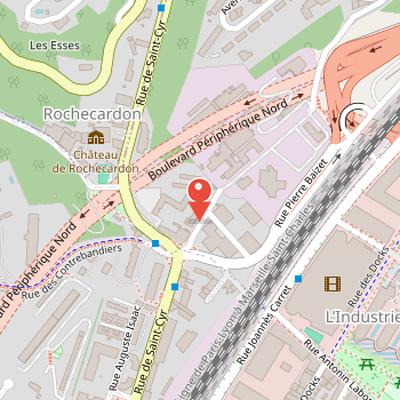
Nearby Objects
-
 Stadium of La Duchère 900 m away
 -
 Gare de Lyon-Vaise 1000 m away
 -
 Halle d'athlétisme Stéphane-Diagana 1000 m away
 -
 Église Notre-Dame de l'Annonciation 1100 m away
 -
 Cité scolaire Antoine-de-Saint-Exupéry 1400 m away
Location and Educational Profile
Lycee Jean Perrin de Lyon is the oldest public high school in the city of Lyon after lycee Ampere. It was initially an annex of lycee Ampere, which places it within the early history of public secondary education in the city. The school is located on the plateau of Saint-Rambert, at the border of Lyon and des Monts d'Or. From this position, it overlooks the tertiary district of l'Industrie and the Saone near Ile-Barbe.
The school has developed a varied educational offer, including European, binational, and international sections. It also provides preparatory classes for scientific grandes ecoles and includes Poles sportifs Espoirs. Its internat d'excellence has hosted prestigious students and teachers, adding to its profile within the city's educational landscape.
History and Institutional Identity
Lycee Jean Perrin in Lyon has a history spanning more than a century and a half. Its origins go back to 1864, when a small lycee in Saint-Rambert was built as an annex of lycee de Lyon. During its construction in 1914, the school became an annex of lycee du Parc. It was officially named lycee Jean-Perrin in 1949, and gained autonomy in 1960 with the construction of its current buildings. Today it is a public secondary school in Lyon, recruiting students from Lyon and the Monts d'Or.
The school is named after the physicist Jean Perrin, who lived from 1870 to 1942 and received the Nobel Prize in physics. Jean Perrin also completed his secondary studies at the lycee. This link gives the institution a name tied both to scientific achievement and to its own educational past.
Educational Offerings and Sports Training
Lycee Jean Perrin de Lyon educates about 650 secondary school students and offers a wide range of programs. Its general baccalaureat includes eight specialties: Mathematiques, Physique-Chimie, SVT, Sciences de l'ingenieur, Humanites Litterature et Philosophie, HGGSP, AMC, and SES. The school also provides a technological STMG pathway with CFE, RHC, and Mercatique specialties. In 2019, it opened a Section Internationale Britannique. It also includes three binational sections, Abibac allemand, Esabac italien, and Bachibac espagnol, as well as two European sections in German and Spanish.
The lycee has hosted three sports training centers since the mid-1970s, for girls handball, boys handball, and boys volleyball. A new gymnasium for these centers is to be constructed by the AURA region by 2025. The school also hosts five Classes preparatoires aux grandes ecoles, with two first-year classes, MPSI and PCSI, and three second-year classes, MP, PC, and PSI, for about 200 students.
Academic Results and Ranking
In 2023, Lyccee Jean Perrin de Lyon achieved a 96 percent success rate in the general Baccalaureat, with 68 percent of students receiving mentions AB, B, or TB. Across all general and STMG streams, the success rate was 92 percent. The school's results have increased steadily since the implementation of the new Baccalaureat, rising from 87 percent in 2021 to 91 percent in 2022 and then to 96 percent in 2023 for the general track. In the same year, the lycee was ranked 40th out of 145 in L'Etudiant's national CPGE ranking. This ranking concerned MP classes and their integration into 27 Grandes ecoles.