CinéFabrique is a public higher education film school in Lyon and Marseille. Founded in 2015 by director Claude Mouriéras, it trains young students aged 18 and over for cinema and audiovisual professions. Its honorary president is director Abderrahmane Sissako. The school teaches professions related to cinema in fields comparable to other French film and audiovisual schools, and its curriculum is built around practical work.
The school offers programs in seven departments: scenario, image, sound, editing, VFX, sets, and production. It also provides a free preparatory class for young scholarship holders aged 18 to 25 living in Auvergne-Rhône-Alpes, called the COP. Training combines high-level technical instruction with continuous artistic research, frequent shootings, and a largely theoretical framework. A third year is conducted in alternation.
CinéFabrique reports producing 100 films each year. Its students have worked on feature film shoots and visited cinema equipment rental and post-production companies. In Lyon, students can earn 120 ECTS credits validated by university Lumière-Lyon-II after the second year, before continuing to the third year toward the school diploma and a national professional bachelor's degree.
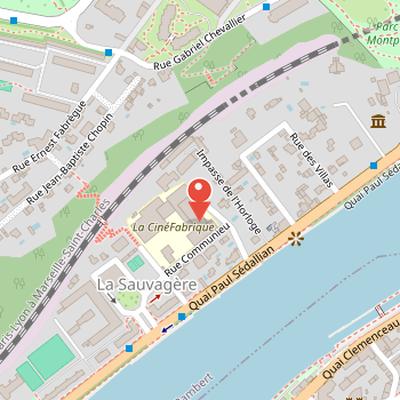
Nearby Objects
-
 Villa Tony Garnier 200 m away
 -
 Abbaye de l'Île Barbe 450 m away
 -
 Lycée Jean Perrin 1600 m away
 -
 Théâtre de la Croix-Rousse 1800 m away
 -
 Jardin Rosa Mir 1900 m away
CineFabrique as a Film Education Institution
La CineFabrique is a public higher education institution based in Lyon and Marseille. It trains young students aged from 18 upward in cinema and audiovisual professions. Its teaching is presented as comparable to that of institutions such as the Ecole nationale superieure Louis-Lumiere and La Femis in Paris, as well as the Ecole nationale superieure de l'audiovisuel in Toulouse. The school emphasizes a practice-based pedagogy, with about 100 films produced each year. Its curriculum also includes a third alternating year.
Awards and institutional history
CineFabrique was founded in 2015 by director Claude Mourieras. Its honorary president is director Abderrahmane Sissako. The school has been associated with several notable festival achievements. In 2019, it won first prize in the CinEfondation section at the Cannes Festival through Louise Courvoisier and her short film Mano a mano. This was noted as the first time since 1998 that a student from a French film school had won the first prize at Cannes. In 2022, Laurene Fernandez received third prize in CinEfondation at Cannes for the short film Les humains sont cons quand ils s'empilent. In 2025, Oumnia Hanader was selected at Cannes for CinEfondation with the short film Bimo, and Kim Fino received the jury prize in the national competition at the Clermont-Ferrand Short Film Festival for Oh Maybe Not Tonight. Emmanuel Macron also announced the creation of a new CineFabrique in Marseille.
Training and Professional Pathways
CineFabrique offers training across seven departments: scenario, image, sound, editing, VFX, sets, and production. Its programs combine high-level technical instruction with continuous artistic research, and they include very frequent shootings alongside mostly theoretical teaching. The initial training is led by prestigious instructors, and the curriculum includes a third year conducted in alternation. Students can take part in feature film shootings such as Nos batailles and Alice et le Maire, and they also visit cinema equipment rental companies like Groupe TSF and post-production companies in sound, image, and editing such as Polyson.
The school also provides a free preparatory class called the COP, reserved for young scholarship holders aged 18 to 25 living in Auvergne-Rhone-Alpes. At the end of the second year, students at CinEFabrique Lyon can obtain 120 ECTS credits validated by university Lumiere-Lyon-II. They may then continue into the third year to aim for the CinEFabrique institutional diploma and the national professional bachelor's degree Techniques du son et de l'image from university Lumiere-Lyon-II.
The training leads to five professional titles registered with the RNCP and recognized by the State: director of photography, sound engineer, screenwriter, chief editor, and producer. Two additional titles, chief decorator and special effects supervisor, are offered but are not yet recognized by the State because they were created recently. Studies end with the production of a final project film. CinEFabrique also offers continuing education for professionals who want to improve their skills.
Technical Facilities and Equipment
CineFabrique has a substantial technical and financial infrastructure that supports its training activity. Its Moyens techniques et financiers receives significant financial support from the State, CNC, the Ministry of Culture, and the Auvergne-Rhone-Alpes region, as well as backing from various other public and private institutions. In 2018, its budget was 3.5 million euros.
The school's premises include a wide range of professional facilities. Through CNC-Region co-financing, it acquired eighteen post-production boxes. It also has seventeen professional editing rooms, six of which are equipped with 5.1 sound systems, together with two shooting studios, one projection room, and four mixing auditoriums. These spaces indicate a strong emphasis on practical production and post-production work.
CineFabrique also provides students with professional-grade equipment. This includes Arri Mini, Varicam, Sony F55, and Sony Venice cameras, as well as Super 16 Aaton XTR Prod film cameras. The available equipment further includes Cooke, Zeiss, Angenieux, and Sony lenses; Aaton Cantar, Sonosax, SoundDevice, and Nagra recorders; Shoeps microphones; Alpha 7 cameras; and lighting and machinery equipment.
Educational Principles and Community Outreach
CineFabrique distinguishes itself through a policy of social and cultural diversity. Admission does not require any diploma, and the school organizes integration periods to support students entering its programmes. Its teaching approach is based primarily on practical experience, with students learning cinema through direct production and workshop-based work.
The school also places emphasis on collective and local engagement. It has a collaborative organic and local school cafeteria, and it conducts filmmaking workshops in Lyon neighborhoods and rural areas. Through these activities, filmmakers assist young people aged 15 and older in writing and directing fiction short films.
CineFabrique also maintains an international dimension through its Cine Nomad School exchange program. Students participate in the Camerimage festival, adding another public and professional context to their training and visibility.
Admission by Competitive Selection
Admission to CinéFabrique is based on a three-round competition. The written exam is not eliminatory, and the contest does not require a baccalaureate when a derogation is granted. In the first round, candidates must submit a short film of no more than three minutes on a given theme, two three-hour online questionnaires, one general and one specialized, as well as a letter of motivation, a portfolio, and a CV. This stage is supervised by more than 100 examiners, mostly cinema professionals. The second round takes place over two days at the school and includes one specialized workshop and one filming workshop. The third round is an oral exam lasting about ten minutes before a jury of about fifteen professionals. Until 2022, about candidates competed each year for 35 places. Since the opening of the Marseille campus, the school has offered 100 places.