The Abbaye de l'Île Barbe is an ancient Benedictine abbey in Lyon, France, in the Saint-Rambert-l'Île-Barbe district. An abbey was founded on Île Barbe before the 6th century, making it the first monastic establishment in the Lyon region and one of the oldest in Gaul. The monastery adopted the Rule of Saint Benedict in the 9th century and was then dedicated to Saint Martin, after having been dedicated to Saint Andrew. Charlemagne endowed it with a fine library, and Louis the Pious granted it the right to have three toll-free ships on the Saône, Rhône, and Doubs rivers in 816. The abbey was repeatedly damaged over the centuries, including sackings in 676, 725 by Saracens, and 937 by Hungarians, and it was devastated and burned again in 1562 by Protestant troops of Baron des Adrets. It was suppressed in 1782, and its property was sold and dispersed in 1788. During the French Revolution and the First Empire, the site became a stone quarry. By the 19th century, only the Romanesque church of Notre-Dame, part of the old church of Saint Loup, and some religious building remains survived.
Nearby Objects
-
 Villa Tony Garnier 300 m away
 -
 CinéFabrique 450 m away
 -
 Théâtre de la Croix-Rousse 1800 m away
 -
 Jardin Rosa Mir 1900 m away
 -
 Lycée Jean Perrin 2000 m away
Location and Historical Identity
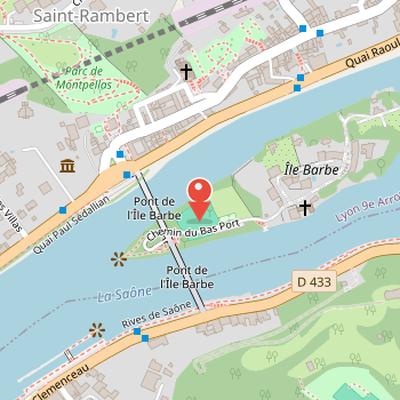
The abbaye de l'Ile Barbe is an ancient Benedictine abbey located in Lyon, France. It is situated in the Saint-Rambert-l'Ile-Barbe district of Lyon. Its identity is closely linked to this specific part of the city, where it stands as a notable historic religious site.
Medieval Development and Later Losses
An abbey was founded on Ile Barbe before the 6th century, making it the first monastic establishment in the Lyon region and one of the oldest in Gaul. In the 9th century, its occupants adopted the Rule of Saint Benedict, and the abbey was then dedicated to Saint Martin, having previously been dedicated to Saint Andrew. Its importance was marked by royal and imperial support: Charlemagne endowed it with a fine library, Louis the Pious granted it the right to have three toll-free ships on the Saone, Rhone, and Doubs rivers in 816, and Charles of Provence confirmed its immunity and protection in 861. A charter of 971 also confirms its possessions to Abbot Heldebert and notes that the abbey founded the priory of Saint-Rambert.
The abbey suffered repeated violence over the centuries. It was sacked in 676, again in 725 by Saracens, and in 937 by Hungarians. In 1562, Protestant troops of Baron des Adrets devastated and burned the site. A cartulary roll created in 1367 preserves records of homage, rights acknowledgments, donations, land acquisitions, and an important convention linking the abbey to Count Charles of Anjou for properties in the Gap and Embrun regions.
From the start of the 16th century, the abbey came under the commendatory system benefiting the Albon family. Pope Paul V secularized the abbey in 1617, after which the monks became canons. In 1741, Pierre Guerin de Tencin, Archbishop of Lyon, united the chapter of canons with the cathedral chapter of Saint John. The abbey was suppressed in 1782, its buildings were returned to the Saint John chapter, and all property was sold and dispersed on August 1, 1788. During the French Revolution and the First Empire, the site was turned into a stone quarry, and many blocks were sold for construction in Vaise and Saint-Rambert. By the 19th century, only the Romanesque church of Notre-Dame, part of the old church of Saint Loup, and some religious building remains survived. The small church of Saint John the Baptist adjoins the abbey church of Saint Andrew.
The Abbey Layout and Enclosures
According to the reconstitution, the abbey was surrounded by a fortified enclosure, following the line now marked by the wall that borders the tree-lined promenade. Access to the abbey domain was controlled by two gates, while the island itself could be reached through three ports. The reconstitution also places a fortress castle on a rock north of the abbey, used as a refuge in case of invasion and said to contain the rich library known as Charlemagne's library.
The abbey complex is described as including two churches. At the northern end of the island, the Saint-Andre priory stood apart from the monastery within its own enclosure, with a chapel dedicated to Saint Andrew and Saint Anne. On the Notre-Dame square, behind the gate of the same name, stood the tithe house and the abbot's house, the latter including a chapel dedicated to Saint Denys. Buildings were also arranged around the large cloister. Near the Saone river, on the Saint-Rambert side, there were monks' refectories and vaulted cellars.
Abbots and Religious Figures
The abbaye de l'ile Barbe is associated with a long list of abbots and religious figures, reflecting a lengthy institutional history. Among the names recorded are Saint Dorothee in the 4th century, Philetus, Julien, Christophe, Antoine, Martin, Aigobert, Astorg, and Maxime. Ambroise is noted as serving until the year 516, followed by other figures such as Loup, Maximin, Bligigaire, Vinfrid, Rotfred, Garland, Licinius, Saint Benoit, Campion, Alaric, Bartholomee, and Argeric.
The list continues into the early medieval period with Herbert until 861 and Gundramnus from 861, then Norbert, Varengard, Garlarin until 876, and Leobon from 876. Astorg II is identified as being from the 800s. Additional names include Etienne, Elgedis, Antoine II, Halinand, Romuald, and Eudes. Taken together, these names indicate a succession of religious officeholders linked to the abbey across several centuries.
Medieval Abbots and Religious Leadership
The recorded list of abbots and religious figures for the abbey of l'ile Barbe shows a continuous succession across the late 10th to early 13th centuries. Cumanus is listed until 971, followed by Heldebert from 971 to 994 and Benoit II from 994 to 1007. The sequence then continues with Bernard from 1007 to 1008, Garnier from 1008 to 1055, and Humbert from 1055 to 1070. Ogier is noted from 1070, while Clement is listed until 1096, then Guy from 1096 to 1116 and Girin from 1116 to 1128. Josserand is listed from 1128, followed by Hugues and Olderic, and then Guillaume until 1150. Later entries include Girin II from 1150 to 1152, Saturnin from 1152, and Vicard until 1168. The list also mentions Hugues de Tournon, identified as Moine, in 1161, and Hugues II from 1168 to 1183. The succession continues with Guichard as abbe from 1183 to 1198, Gaucerand from 1198 to 1200, and Guy II from 1200 to 1222. Taken together, these names preserve a basic chronology of the abbey's leadership over more than two centuries.
Abbey Leadership in the Thirteenth and Fourteenth Centuries
The recorded list of abbots and religious for the abbaye de l'ile Barbe shows a succession of names across the 13th and early 14th centuries. Bermond is listed from 1222 to 1224, followed by Guillaume II de Jarez from 1224 to 1243. The sequence then includes Foulques from 1243 to 1245, Omer from 1245 to 1246, and Pierre from 1246 to 1250. Several entries overlap with these dates, including Zacharie de Talaru as a monk in 1249 and again in 1256, and Hugues de Varennes as monk and cellarer in 1250.
Further names continue through the century: Geoffroy de Vertelay from 1250 to 1261, Humbert de Vassailleu as monk in 1261, Pierre II de Vertelay from 1261 to 1270, and Girin III de Sartines from 1270 to 1296. Additional religious figures appear in the record, such as Aymon de Vaux as claustral prior in 1272, Robert de Ryon as a religious in 1284, and the group of Hugues, Jean, Pierre, Pierre, then Claude de Roncherol, noted as monks from 1284 to 1440.
The list continues with André de Marze from 1296 to 1322, Estienne de Vego as monk in 1300, and Guigues de Roussillon as monk in 1309. In the 14th century, the sequence includes Beraud de Mercoeur from 1322 to 1329, Pons de Guizeu from 1329 to 1334, Raymond de Beaufort from 1334, Beraud II de La Baume, Galbald until 1345, Simon de Gillans from 1345, Begon de Brossan until 1350, Jean Pilus-Fortis de Rabastens from 1350 to 1354, and Guillaume III de Landore from 1354 to 1372. This succession provides a chronological record of the abbey's leadership and religious personnel during a long period of its history.
Abbots and Religious Office Holders
The recorded list of abbots and religious figures for the abbaye de l'Ile Barbe shows a succession of office holders in the late 14th and early 15th centuries. Pierre III de Villette is listed from 1372 to 1394. Pierre de Verriere, identified as Aumosnier, appears in 1383 and again in 1401. Jean II de Sonhetto is listed from 1394 to 1400, followed by Pierre IV de Thurey from 1400 to 1428. These entries indicate a documented continuity of religious leadership during this period.
Abbots and Religious Figures in the 15th and 16th Centuries
The available facts record a sequence of abbots and religious figures linked to the abbaye de l'ile Barbe across the 15th and 16th centuries. In 1411, Faucerand du Saix is listed as a religious, and Antoine de Salornay appears as a monk in 1419. Faucerand du Saix is again recorded in 1421, alongside Jean Rostain, also noted as a monk. Between 1428 and 1436, the abbey is associated with Aynard de Cordon. The year 1436 is particularly dense in the records, with Durand Vert, Berno de Vienne, and Durand Vignols all named, each identified respectively as a monk, monk, and religious. Claude de Sotizon is then listed from 1436 to 1458.
The mid 15th century continues with several individual names. Antoine de Rochefort la Valette appears as a monk in 1451, followed by Jean de Vaugrigneuse in 1452 and Eustache de Vaugrigneuse in 1453, both noted as monks. In the same year, Aynard de Villeneufve is identified as a chantre. Guillaume de la Sale is listed as a monk in 1455. From 1458 to 1485, Edouard de Messey is recorded, and André le Viste is named as a religious in 1464. The entries then note cardinal Charles de Bourbon from 1485 to 1488 and Henri de Seylac from 1488 to 1500.
Around the turn of the 16th century, the records include Philibert Rosset as a monk in 1500, Guyllaume de Villeneufve as a monk in 1507, and Antoine III d'Albon de Saint-Andre from 1500 to 1515. Jacques de Sassenage is also listed as a religious in 1500, and Guillaume de Semur is identified in 1505 as a religious and chamarier. The sequence continues with Antoine IV d'Albon de Saint-Forgeul from 1515 to 1525 and Antoine V d'Albon de Saint-Forgeul from 1525 to 1562. The latest entries provided are Claude Sautreau, described as a monk and chantre, Fleury de Salemard as a cloistrier religious, and Louis Vallier and Antoine de Vauselles as monks, all in 1551.
Abbots and Religious Officeholders
The abbey's recorded abbots and religious officeholders show a long and overlapping sequence of leadership. Pierre V d'Espignac is listed from 1562 to 1599, followed by Jean III de Chatillon from 1599 to 1609. Claude II de Narestang appears from 1606 to 1613, and Antoine VI de Narestang from 1616 to 1620. Camille de Neufville de Villeroy is listed for a notably long period, from 1620 to 1693. The list also includes Claude Le Laboureur, identified as prevot du chapitre, from 1630 to 1660. Antoine VII de Thelis de Saint-Cyr de Valorges is recorded from 1693 to 1741. These names provide a chronological view of the abbey's religious administration over nearly two centuries.
Abbey Possessions
The abbey of l'Ile Barbe held a number of properties across the surrounding region. Its possessions included the Chateau de Grangent in the Jarez, the church of Saint-Clement in Chambon-Feugerolles, and the church of Saint-Rambert-sur-Loire in the county of Forez. Other listed holdings were the chapel of Sainte-Foy-Saint-Sulpice in the county of Forez, the church of Saint-Martin of Marclopt, the tower and church of Chambles, and the chapel Notre-Dame of Bonson. These properties show the abbey's presence in several nearby settlements and religious sites.