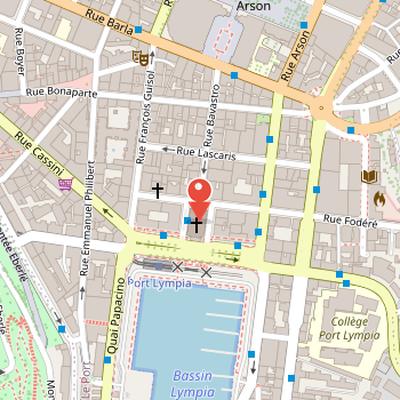
Église Notre-Dame du Port, also known as église de l'Immaculée Conception, is a neo-classical church located in Nice’s port district, opposite the Baie des Anges. It was inaugurated in 1853 on the place Île de Beauté at Port Lympia. Construction began in 1840 with the laying of the first stone, following the decision made by letters patent of King Charles-Félix of Sardinia and Duke of Savoy. The work, based on plans by Nice architect Joseph Vernier, lasted until 1853 and was interrupted in 1845 after a collapse caused by the swampy geological subsoil. The sea-facing facade, added in 1896 by architect Jules Fèbvre, features a white neo-classical composition with four Ionic columns, a portico, and a pediment. A statue of the Virgin Mary stands at the top of the pediment, and a Latin inscription reads “Maria sine labe concepta O.P.N.” The church was listed as a historical monument in 1991 as part of the architectural ensemble of place Île-de-Beauté and was included in the UNESCO World Heritage listing of the city of Nice in 2021.
Nearby Objects
-
 Cimetière du Château 400 m away
 -
 Chapelle du Saint-Sépulcre 450 m away
 -
 Monument to Giuseppe Garibaldi 450 m away
 -
 Place Garibaldi 450 m away
 -
 Église Saint-Martin-Saint-Augustin 450 m away
Location and heritage status
Eglise Notre-Dame du Port, also known as Eglise de l'Immaculee Conception, is a church in Nice in a neo-classical architectural style. It was inaugurated in 1853 on Place Ile de Beaute at Port Lympia, in the port district opposite the Baie des Anges. Since 1991, it has been listed as a historical monument as part of the architectural ensemble built at Place Ile-de-Beaute. The church was also included in the UNESCO World Heritage listing of the city of Nice in 2021.
Construction and Architectural Evolution
The construction of the church on the seaside road was decided by letters patent of King Charles-Felix of Sardinia and Duke of Savoy. Work began in 1840 with the laying of the first stone and continued until 1853, following plans by the Nice architect Joseph Vernier. In 1845, construction collapsed because of the swampy geological subsoil in the district. The church later received a neo-classical white seaward facade in 1896, designed by architect Jules Febvre, with four Ionic columns. This facade contrasts with the ocre neo-baroque Provencal architectural style inspired by Place Massena and Old Nice. At the top of the pediment stands a statue of the Virgin Mary facing Port Lympia of Nice and Baie des Anges, beneath a Latin inscription reading 'Maria sine labe concepta O.P.N', meaning 'Mary Immaculate Conception, pray for us'. The ceiling collapsed during the 1944 port bombardment in the Battle of Nice liberation and was reconstructed in reinforced concrete in the 1950s. A later facade restoration was inaugurated after nearly one and a half years of interior and exterior works costing 1.9 million euros.
Facade and Dedication
The church has a sea-facing facade designed in a neo-classical style. Its front elevation includes ionic columns, a portico, and a pediment. The pediment carries a Latin dedication reading Maria sine labe concepta O.P.N. These features give the building a formal architectural character and a clearly articulated ceremonial frontage.