Le Pâquier is a vast landscaped promenade in the city of Annecy, covering seven and a half hectares. Situated on the shores of Lake Annecy, it offers a view across the lake toward the surrounding mountains. It forms the central element of a larger ensemble of parks and gardens that includes the gardens of Europe, the gardens of the Impérial Palace, and the beach of Annecy-le-Vieux.
The Pâquier originally extended over a larger area of land. Historical accounts describe the original Pâquier terrains as much larger than the current site, with lands that were too close to the lake and too humid. These areas were used as pasture for livestock and later transformed over the centuries, through inheritances, into gardens, orchards, and wet meadows. The name Pâquier is linked to the word for pasture in Arpitan Savoyard, Lo Paquiér.
Historical references mention several private and institutional owners, including the Mossière and Menthon families, and note a 1613 donation by Count Bernard VI de Menthon to the children of Annecy.
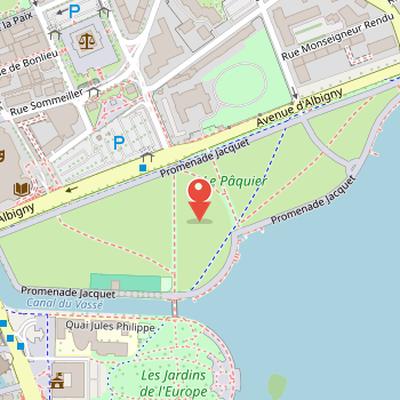
Nearby Objects
-
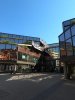 Bonlieu Cultural Center 300 m away
 -
 Église Saint-Maurice 400 m away
 -
 Saint-François-de-Sales Church 400 m away
 -
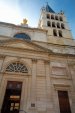 Notre-Dame-de-Liesse Church 500 m away
 -
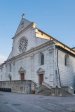 St. Peter's Cathedral 550 m away
Le Paquier as a Lakeside Promenade
Le Paquier is a vast landscaped promenade of seven and a half hectares in Annecy. It is located on the shores of Lake Annecy and provides views across the lake toward the surrounding mountains. As the central element of a larger complex of parks and gardens, it is connected with the gardens of Europe, the gardens of the Imperial Palace, and the beach of Annecy-le-Vieux.
The site originally extended over a larger area of land. At the beginning of the 20th century, an investor nicknamed Intro was associated with it, and numerous construction projects involving Le Paquier remained controversial in local news until the 1970s. A separate local legend, based on the writings of Chanoine Claude-Antoine Ducis, claims that a generous lady donated Le Paquier to the city of Annecy. Ducis mentioned it in the 1892 issue of La Revue savoisienne.
Origins and Early Ownership of Le Pe2quier
The name Pe2quier comes from the Arpitan Savoyard word for pasture, and in that language it is called Lo Paquie9r. According to the historical record, the original Pe2quier terrains were much larger than the present area, but they were too close to the lake and too humid. They were always used as pasture for livestock. Over the centuries, and through inheritances, these lands were gradually transformed into gardens, orchards, and wet meadows.
The land belonged to many private individuals, religious communities, and even the hospital. A document from 1387 mentions the Pe2quier of the Mossie8re family from Annecy, and the family apparently owned land on the site. City Council registers also mention Ayma, widow of Guillaume Mossie8re, between 1475 and 1488. The Mossie8re family belonged to the city's bourgeoisie rather than its nobility, and it does not appear in Blasons des familles nobles du duche9 de Savoie. No archives record any donation from a member of the family.
Another important owner was the Menthon family, which held a significant part of the Pe2quier terrains. In 1613, Count Bernard VI de Menthon made a donation to the children of Annecy of a large meadow called Pe2quier. In this context, the term children refers to young members of the compagnie des chevaliers tireurs, a military group that practiced archery, arquebus, and crossbow shooting. Since this early 17th century donation, the municipalities of Annecy sought to acquire available parcels, and some land reclamation operations recovered surface areas at the expense of the lake and wetlands.
Early Development Plans for Le Paguier
According to Histoire, Saturnin Favre, a Var entrepreneur and former mayor of La Seyne-sur-Mer, planned an ambitious development for the then twelve-hectare Paguier. His project included a casino, a 200-room hotel, a tram line, and a racecourse. The municipal government, chamber of commerce, tourist office, and general council supported the plan, showing the wide backing it received. By 1907, the project was said to be well advanced and close to completion, but Favre died unexpectedly that year. The concession he had obtained continued to attract interest and remained the object of many desires until the First World War.
The Original Extent of Le Pâquier
The original surface of Le Pâquier extended beyond its central open area and reached several surrounding territories. On one side, it bordered areas near avenue d'Albigny, which were formed on embankments. It also included low-lying terrain at Annecy-le-Vieux near the roselières, across avenue du Petit-Port, where embankments were created from the demolition of the hospital and prison.
Another part of the original surface was a wet area known as the fer-a-cheval, named for its horseshoe shape. This wet zone was supplied by the stream called Vy eleve, which no longer exists. The original extent also included the presqu'ile des Jardins de l'Europe, an area bordered by the canal de Vasse and the port de la Halle. This peninsula was owned by a congregation of nuns who transformed it into gardens.
The presqu'ile des Jardins de l'Europe later became a civic and institutional space. It now contains the mairie d'Annecy, the ecole du Quai Jules Philippe, built in 1843 and laicised in 1880, and place de l'Hotel de ville with an underground parking facility. It also holds the arboretum des Jardins de l'Europe. The peninsula is separated from Le Pâquier by the canal du Vasse and can be reached by the pedestrian bridge Pont des Amours. The ecole du Quai Jules Philippe was the only primary school in Annecy until 1907.
Lakeside Zones of Le Pâquier
The original surface of Le P aquier extends along several lakeside sectors with different uses and ownership. Across avenue d'Albigny, it continues from the old town toward the Imp rial Palace. Beyond that point, the surface belongs to the commune of Annecy-le-Vieux, and the terrain after the palace is entirely owned by the mairie d'Annecy-le-Vieux. This area includes a miniature golf course and a lakefront villa that is being restructured for public access. The lakeside passage has been open to the public since 2008.
Along avenue du Petit-Port, the original surface includes plage d'Albigny, grassy areas, an inlet, a marina, reed beds, and a promenade toward Veyrier-du-Lac. Across the same avenue, the area also contains buildings, parking lots, a campsite, commercial and recreational spaces, and some rare low land surfaces that remain from the original P aquier.