St. Peter’s Cathedral is the main Catholic place of worship in Annecy, in the department of Haute-Savoie, and the seat of the diocese of Annecy. It has been listed as a historic monument of France since 1906. The building was constructed by Jacques Rossel before 1526 and served first as a Celestine convent until 1534, then as a Franciscan convent after that date. Its facade was completed in 1535, and the church was consecrated in 1539. The convent was suppressed in 1771, when the episcopal palace was built adjacent to the church. The building became a cathedral from 1782 to 1792, was later transformed during the French Revolution into a place of worship dedicated to the goddess Reason, and became a cathedral again in 1822. It was highly decorated after 1885 and cleaned and restored in 1936. Architecturally, it has an exceptional facade inspired by a Romanesque church, with three pediments over the doors, Tuscan pilasters, a large pediment above the main door, and a clear glass Gothic rose window. The Lambert family coat of arms appears above the rose window, and the family financed the facade project. The interior is Gothic, with three naves divided into five bays.
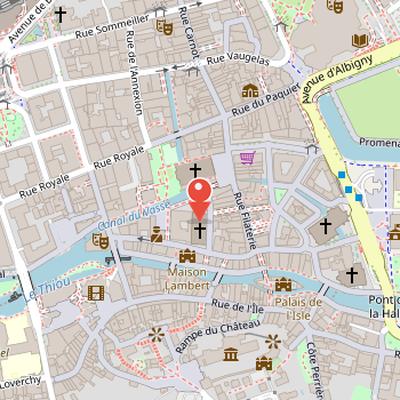
Nearby Objects
-
 Notre-Dame-de-Liesse Church 80 m away
 -
 Église Saint-Maurice 200 m away
 -
 Château d'Annecy 200 m away
 -
 Saint-François-de-Sales Church 250 m away
 -
 Bonlieu Cultural Center 350 m away
Status and Location
St. Peter's Cathedral is the main Catholic place of worship in Annecy, in the department of Haute-Savoie. It serves as the seat of the Diocese of Annecy, giving it a central role in the religious life of the city and surrounding area. The cathedral has also been recognized as a historic monument of France since 1906, underlining its cultural and heritage value.
History and Transformations of St. Peter's Cathedral
St. Peter's Cathedral was built by Jacques Rossel before 1526. It first served as a Celestine convent until 1534, after which it became a Franciscan convent. The facade was completed in 1535, and the building was consecrated in 1539. In 1771, the convent was suppressed, and the episcopal palace was built adjacent to Storia in the same year. The building then became a cathedral from 1782 to 1792. During the French Revolution, it was transformed into a place of worship dedicated to the goddess Reason. It became a cathedral again in 1822. After 1885, it was highly decorated, and in 1936 it was cleaned and restored.
Facade and Exterior Features
St. Peter's Cathedral has an exceptional facade dating from 1535, inspired by a Romanesque church. The facade is organized with three pediments over the doors, supported by Tuscan pilasters. The main door is topped by a large pediment, and a clear glass Gothic rose window appears above it. The Lambert family coat of arms is placed above the rose window, reflecting the family that financed the facade project. The rest of the building is mostly not visible. Beside the choir stands a low bell tower turret in a different color, and two bells from Fonderie Paccard are located near the choir side.
Interior Features of St. Peter's Cathedral
The interior of St. Peter's Cathedral has a Gothic style with three naves divided into five bays. In the central nave, a wooden pulpit stands on the left side and rests on an eagle with spread wings. Its central carving depicts the Assumption of the Virgin, while the pulpit itself shows Saint Francis de Sales praying. The left nave contains an altar dedicated to Saint Francis de Sales dated 1864, and the right nave ends with the Chapel of the Blessed Sacrament.
The cathedral also includes a neoclassical choir from 1771 and two wooden sculpted music stands, one marked by an eagle symbol and the other showing an angel holding the Book of the Word. The polygonal apse has five stained glass windows depicting Saint Francis de Sales. Among the artworks preserved inside are Liberazione di San Pietro by Mazzola, the Descent from the Cross from the Caravaggio school, and the Adoration of the Magi by Fabbrizi. Other stained glass windows depict Saint Bernard of Mentone dated 1865 and the Baptism of Christ dated 1860, and there is also an eighteenth century painting of Saint Francis Borromeo.
The Chapel of Saint Joseph contains a painting by Clerc dated 1857, statues of Saint Teresa of Avila and Saint Francis de Sales, and a bas-relief of the Flight into Egypt. The side altars are dedicated to the Immaculate Conception dated 1857, the Sacred Heart dated 1886, Our Lady of Lourdes, Saint Teresa, and the Child Jesus dated 1934.
The Interior Organ
Inside the cathedral, the counterfacade is dominated by a large organ dated 1842. The instrument rises up to the rose window, making it a prominent feature of the interior. It was restored in 1994, preserving its role as an important element of the cathedral's historic setting.