Église Notre-Dame-de-Liesse is a French Catholic church in Annecy, in the department of Haute-Savoie. It is one of the former collegiate churches of the diocese of Geneva. The church was founded and built in the second part of the medieval period by the counts of Geneva and Robert on the site of an ancient oratory and a medieval square near a hospice. It was a modest Marian oratory cited earlier before being truly founded in 1360 by a count who intended it to serve as the necropolis of his lineage. Construction was continued by count Robert and completed in 1394, and the sanctuary was consecrated in 1398.
The church was later altered during the revolutionary period, when its choir was destroyed in 1793. It was reconstructed between 1846 and 1851 after the return to Savoy rule in 1815, while retaining some original elements. The building has a Latin cross plan with a nave, side aisles with barrel vaults, and a central dome. Its neo-classical Sardinian façade dates from 1846, and the church preserves a bell tower from the period, along with a Gothic window on the south wall. The side aisles contain altars dedicated to Saint Francis de Sales and Our Lady of the Rosary.
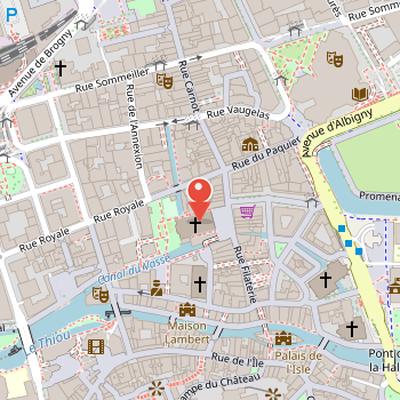
Nearby Objects
-
 St. Peter's Cathedral 80 m away
 -
 Église Saint-Maurice 200 m away
 -
 Bonlieu Cultural Center 250 m away
 -
 Saint-François-de-Sales Church 250 m away
 -
 Château d'Annecy 300 m away
Notre-Dame-de-Liesse in Annecy
Notre-Dame-de-Liesse is a French Catholic church in Annecy, located in the department of Haute-Savoie. It stands within the city of Annecy and is identified as one of the former collegiate churches of the diocese of Geneva. Its significance lies in this historical ecclesiastical status, which places it among the religious buildings associated with the earlier organization of the diocese.
Origins and Early Development
The history of the church begins with a site that already had a religious character. It was built on the location of an ancient oratory and a medieval square near a medieval hospice, and it had been known as a modest Marian oratory since an earlier period. The church was truly founded in 1360 by a count who intended it to serve as the necropolis of his lineage. Construction was then continued by Count Robert and completed in 1394. The sanctuary was later consecrated in 1398. This sequence of foundation, building, and consecration shows the site's long association with religious use and dynastic memory.
Reconstruction and Civic Role
The church was rebuilt between 1846 and 1851 after Savoy returned to rule in 1815, with some original elements retained from the earlier building. Its choir had been destroyed in 1793 by the revolutionary municipality to make room for large popular gatherings, while the bell tower survived with only its spire and watchtowers lost, unlike other bell towers in Annecy that were destroyed. The reconstructed church has a Latin cross plan with a nave, side aisles covered by barrel vaults, and a central dome. Its facade, completed in 1846, is in a neo-classical Sardinian style. The building also preserves a bell tower from an earlier period and a Gothic window on the south wall. Inside, the side aisles contain two altars, dedicated to Saint Francis de Sales and to Our Lady of the Rosary. The baptismal fonts date from 1852, and the main altar from 1854. The square in front of the church was largely preserved and became a major civic setting, surrounded by cafes and shops. It served as the political center of Annecy in the early period, and it also hosted a market for eggs, cheese, and vegetables until 1854, when the market moved to Sainte-Claire street. In 1859, the municipality installed an obelisk fountain with lions and turtles in the square under Aime Levet.
The Bells of the Church
The bell tower of Eglise Notre-Dame-de-Liesse d'Annecy contains a notable set of bells from different periods. One bell dates from 1655 and rings every angelus. Another bell, cast by Aubry, weighs 400 kilos. The smallest bell, weighing about fifty kilos, dates from 1699 and is no longer used. An earlier bell from 1606 is mentioned in the archives, while two other bells cast by Louis Leonard de Morteau in 1768 are now missing. The largest bell cast in 1768 had an unspecified weight.
The tower also includes a bourdon named La Salesienne, cast in 1878 and honoring Saint Francois de Sales. This bell weighs over five tonnes. A further bell, weighing one tonne, was cast in 1891 and accompanies the other bells.