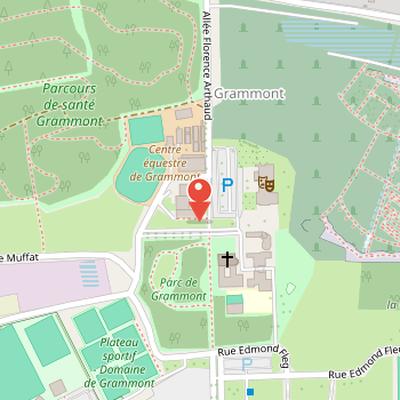
Domaine de Grammont is located on the left bank of the Lez river, east of Montpellier, at the boundary with Saint-Aunès. In the 1980s, it remained isolated from the city and was mainly surrounded by vineyards. Access was first via departmental road D24, now avenue Albert-Einstein, and later via avenue Pierre-Mendès-France, which connects Antigone and the A9 motorway interchange. The surrounding area was gradually shaped by the Millénaire district, developed for high technology, and by Odysseum, planned for commerce and leisure.
The site began as the seat of the priory Notre-Dame-de-Montaubérou of the order of Grandmont. Grandmontains settled there in 1174 on a domain dependent on the cathedral chapter of Maguelone. A chapel and convent buildings were built around 1180, and the choir was rebuilt in 1225. The priory was partially ruined during the Wars of Religion, then given to the Montpellier seminary in 1701. Sold as national property in 1790, the domain later changed hands several times. The west wing was rebuilt in the first quarter of the 19th century, with sculptures by Auguste Baussan and stained glass by Louis-Charles-Marie Champigneulle. The gardens at the center of the domain have been preserved and maintained, and the castle is used as a town hall annex for civil wedding ceremonies.
Nearby Objects
-
 Zénith Sud 400 m away
 -
 Château de Flaugergues 1000 m away
 -
 Planet Ocean Montpellier 1800 m away
From Monastic Seat to Cultural Venue
Domaine de Grammont was originally the seat of the prieuré Notre-Dame-de-Montauberou of the order of Grandmont. It later became a viticultural property in the east of Montpellier, reflecting a major change in its function and landscape use. Since the 1980s, the site has been designated as a space for spectacles and sports, giving it a public role that differs from its earlier religious and agricultural history.
Location and Urban Setting of Grammont
Domaine de Grammont is located on the left bank of the Lez river, east of Montpellier, at the boundary with Saint-Aunès. In the 1980s, it was described as isolated from the city and mainly surrounded by vineyards. Access was initially provided by departmental road D24, now avenue Albert-Einstein, which connects Montpellier to Mauguio. Later, avenue Pierre-Mendes-France was built to connect Antigone and the A9 motorway interchange near Grammont. Nearby urban development also changed the area, with the Millenaire district planned for high technology and Odysseum for commerce and leisure. Even so, Grammont remained relatively isolated from urbanization because several vineyards survived in the area. To the west are the vineyards, or folies, of chateau de Flaugergues and Montauberou.
Historical Development of the Domaine de Grammont
The Domaine de Grammont began as a religious settlement when the Grandmontains established themselves on land dependent on the Maguelone cathedral chapter in 1174. The chapel was built around 1180 together with convent buildings, and the choir was rebuilt in 1225. The priory was known as Notre-Dame-de-Montauberou. It was partially ruined during the Wars of Religion, then transferred to the Montpellier seminary in 1701. In 1790, the Grammont domain was sold as national property. From 1796 to 1821 it belonged to General Charles de Fregeville, and from 1821 it belonged to Ambroise-Jacques Bricogne. During the first quarter of the 19th century, the west wing was rebuilt, with sculptures by Auguste Baussan and stained glass by Louis-Charles-Marie Champigneulle included in the reconstruction.
Cultural and Sporting Uses at Domaine de Grammont
Domaine de Grammont combines preserved historic grounds with a wide range of public uses. The gardens of the castle at the center of the domain are preserved and maintained, and the castle itself serves as a town hall annex for civil wedding ceremonies. The domain chapel, Sainte-Philothee, is used for Orthodox Christian worship by the Greek Orthodox Metropolis of France. In addition, Activites et amenagements developed the Saint-Etienne cemetery and built a funeral complex to the east of the domain.
The domain is also an important venue for performance and large-scale events. Its flagship facility, Zénith Sud, was inaugurated as the first Zenith-type concert hall constructed outside the Paris regions. It accommodates 3800 spectators on 2,700 square meters, and its gray metal canopy was replaced by a yellow canopy during renovations in 2000. To the north, Espace Grammont is reserved for concerts and festivals attracting several thousand people, and has served since the early 1990s as a replacement for the old Richter stadium site for major events. Between the castle and the Espace rock, there is also a theatre used for performances by Theatre des Treize Vents.
Sports uses occupy the western half of the domain and some eastern grounds near Zénith Sud. Montpellier Herault Sport Club is headquartered there and trains in the domain, while the Mosson stadium remains at the city's west end. The domain's parking lot is also noted as more accessible than the downtown parking lots where the town hall is located.
Art Installations and Park Layout
At the highest point of the fitness trail park, Domaine de Grammont features the marble statue Hecate and Cerbere by Marcello. The work was originally commissioned by Napoleon III in 1866 and was relocated several times before being installed on the site in 1986. It remains visible in the park, although it is described as mutilated. The domain also includes a composting center located between the football fields and the fitness trail.