Château de Flaugergues is located in the French commune of Montpellier, in Hérault. Built in 1696, it is a folly from the end of the 17th century and is classified as a historical monument. The château belongs to the Colbert family and serves as the center of a vineyard exploitation now situated in an urban area. It can be visited all year round.
The domain was bought in 1696 by Étienne de Flaugergues, conseiller à la Cour des Comptes, Aides et Finances of Montpellier, who embellished the property for nearly half a century. The estate then passed by succession without ever being sold. In 1811, it became the property of Jacques-Joseph de Boussairolles, owner of the neighboring château de La Mogère, before passing into the Barthélémy de Saizieu family. During the Second World War, the château was requisitioned by the Luftwaffe while René de Saizieu was a prisoner in Germany. After his death in 1972, the estate was inherited by Henri de Colbert, his nephew.
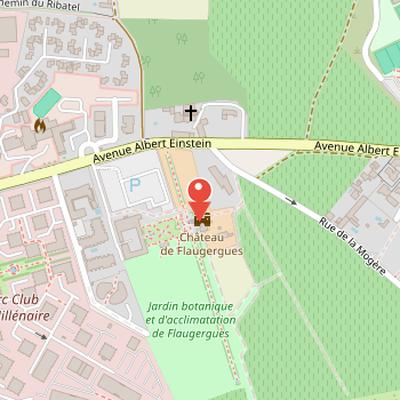
Nearby Objects
-
 Planet Ocean Montpellier 800 m away
 -
 Zénith Sud 900 m away
 -
 Domaine de Grammont 1000 m away
Chateau de Flaugergues in Montpellier
Chateau de Flaugergues is located in the French commune of Montpellier, in Herault. It is a folly dating from 1696, at the end of the 17th century, and is classified as a historical monument. The property belongs to the Colbert family and serves as the center of a vineyard exploitation that is now situated within an urban area. The site can be visited all year round.
Ownership History of the Chateau de Flaugergues
The domain of Flaugergues was bought in 1696 by Etienne de Flaugergues, conseiller a la Cour des Comptes, Aides et Finances of Montpellier. He embellished the property for nearly half a century, establishing the basis of its long family history. The estate was then transmitted by succession and was never sold until 1811, when it became the property of Jacques-Joseph de Boussairolles, who also owned the neighboring chateau de La Mogere. It later passed into the family Barthlemy de Saizieu. During the period when Rene de Saizieu, baron and infantry officer in the Troupes coloniales, was a prisoner in Germany, the chateau was requisitioned by the Luftwaffe. After his death in 1972, the property was inherited by Henri de Colbert, nephew of Rene de Saizieu.
Architecture and setting of the exterior
The exterior of Chateau de Flaugergues is arranged as a central body flanked by two lateral bodies, forming a two-story construction with a ground floor in dressed stone masonry. It presents the appearance of a monumental 17th century Italian villa, with wide bands marking the levels of the floors. The roof is made of hollow tiles and is crowned with ridge spikes shaped like balls on pedestals, together with glazed tiles manufactured in Saint-Jean-de-Fos in the 19th century. These roof elements contribute to the Mediterranean nobility of the building.
The main facade opens onto the gardens and the city of Montpellier, while the rear facade is almost blind, using false windows to create the illusion of openings. It faces a private courtyard and, beyond that, the vineyard. In front of the building, the terrace is bordered by two statues by the sculptor Jean-Louis Guyon, named La Paix and L'Abondance, both dating from 1728. The exterior overlooks a terraced garden bordered by vines, reinforcing the relationship between the building, its landscaped setting, and the surrounding vineyard.
Interiors and Furnishings
The interiors of Chateau de Flaugergues preserve a varied collection of historic furnishings and decorative objects. A staircase with suspended keys rises over three floors without pillar support, creating a distinctive structural feature. The walls are covered with tapestries from Flanders dated 1670, showing scenes from the life of Moses. The salons are furnished with Louis period sets and decorated with family paintings, alongside a collection of porcelain and faience. Among the notable objects is a table service bearing the Saizieu family arms, created in 1872 by Emile Galle.
The large salon contains a Louis period zograscope optical box, while the library holds a series of ancient scientific instruments. The Eagle room includes a mural on the Egyptian Campaign, painted in 1990 by Diane de Montbron, as well as objects connected to Emperor Napoleon. Another rare item is a marble sample table made up of 177 different tiles from the Gobelins hard stone workshop, reflecting the range and craftsmanship of the interior collections.
The Park and Gardens of Flaugergues
Le Parc et les Jardins at the Chateau de Flaugergues includes several distinct garden areas. The French garden at the foot of the cour d'honneur was restored with landscape architect Emmanuel de Sauveboeuf, and ten thousand boxwood plants were planted there with the current owners and their children. The park also maintains a 200 meter long olive tree alley leading to a belvedere. To the southwest, the English garden covers three hectares and was developed from 1847 by the Boussairolles with the construction of the orangery. The Saizieu family planted and acclimated several palm varieties in this garden, and an exceptional Chilean coconut palm was planted in 1874 to the right of the chateau. Since 2018, the site has also hosted l'Oasis citadine, a collaborative urban permaculture farm near the olive tree alley by the vineyard. In 1997, a study was conducted by a team from the Ecole d'Architecture de Versailles. Since 2004, the park and gardens of Flaugergues have held the label Jardin remarquable.
The Vineyard Development at Chateau de Flaugergues
Vine cultivation at the vineyard is locally attested since the Gallo-Roman era, and its agricultural history shows a gradual concentration on wine production over time. In 1725, the estate covered 32 hectares, of which 8 hectares were planted with vines. The remaining land was used for cereals, olive trees, and various fruit trees. By 1876, the vineyard had expanded to 20 hectares of vines.
At the end of the 19th century, phylloxera decimated the vines and the estate stopped selling wine for about ten years. A new cellar was built by the de Saizieu family in 1897, marking a phase of recovery. The vineyard later grew to 50 hectares planted with vines in 1926. In 1952, it produced its first 300 hectoliters of wine under the vin de qualite superieure appellation.
The estate continued to move toward formal recognition and reorganization in the 1960s and 1970s. In 1962, 14 hectares obtained the AOC Coteaux du Languedoc out of 24 hectares. After Henri de Colbert inherited the estate in 1973, he began a vineyard restructuring project. Bottled wine sales started with a cellar established in 1977, and by the late 1970s the agricultural activity had become exclusively vine cultivation.
The Vignoble of Chateau de Flaugergues
The vineyard at Chateau de Flaugergues has developed as a structured production area tied to several appellations. All of its vines attained AOC Coteaux du Languedoc status on the La Mejanelle terroir in 1985, and the Flaugergues vines belong to the Gres-de-Montpellier appellation. In 2015, the vineyard covered 25 hectares divided into two viticultural zones. Of this area, 16 hectares were classified as AOP Languedoc in the commune of Montpellier, while 3 hectares were in AOP and 6 hectares in IGP Pays d'Oc zones in the commune of Mauguio. The estate also adopted sustainable agronomy, marked by the construction of an eco-responsible cellar near the chateau in 2016. This cellar is open to visitors throughout the year, adding a public dimension to the vineyard's present-day activity.
Historic Protection of the Estate
The estate of Chateau de Flaugergues has received historic monument protection in stages. The sculpture and architecture elements of the park were registered as historic monuments on an unspecified date. In addition, the domain itself, apart from the parts already classified, was also registered as a historic monument on an unspecified date. These protections indicate official recognition of the heritage value of both the park features and the wider estate.