The Asian Arts Museum is located in Nice, in the Alpes-Maritimes, near Parc Phœnix and in the heart of the ZAC Arénas area. Designed by Japanese architect Kenzo Tange and opened in 1998, the building is attached to a floral park and placed above an artificial lake, creating the impression that it floats on water. Its architecture contrasts solid marble-covered forms with transparent walls, which are set back from the water to enhance the effect of weightlessness.
The museum’s collections were constituted ex nihilo after an initial donation failed. The project began with Pierre-Yves Trémois, who offered his Asian art collection to the City of Nice, and was supported by Jacques Médecin, then mayor of Nice. Later abandoned, the project was resumed and transformed by the Alpes-Maritimes general council into a museum of Asian arts, with support from the French museums directorate and collaboration from national museums. The museum presents court arts, popular or tribal expressions, and contemporary creations from Asian cultures, and also hosts performances, gesture demonstrations, and tea ceremonies.
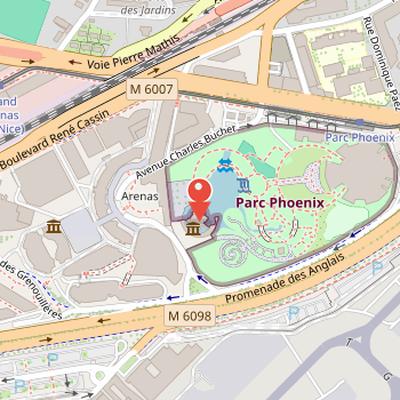
Nearby Objects
-
 Parc Phœnix 40 m away
 -
 Russian Cemetery in Nice 1100 m away
 -
 Palais Nikaïa 1800 m away
Architecture and Setting in Nice
The Asian Arts Museum, known as the Musee departemental des arts asiatiques, is located near Parc Phoenix in Nice, in the Alpes-Maritimes, and in the heart of the ZAC Arenas area. It houses collections of Asian arts and was inaugurated on an unspecified date. The museum's collections were constituted ex nihilo after a donation failed, although the project was first initiated by Pierre-Yves Tremois, who offered his Asian art collection to the City of Nice. The scheme also received support from Jacques Medecin, who served as mayor of Nice from 1966 to 1990.
The building was designed by the Japanese architect Kenzo Tange. It is attached to a floral park and positioned above an artificial lake, creating the impression that it floats on water. This effect is reinforced by the way the walls are set back from the water. Its architectural aesthetic combines solid marble-covered forms with transparent walls, producing a strong contrast between mass and lightness. The museum's setting and design give it a distinct presence within the park landscape.
From Abandoned Project to Asian Arts Museum
The Asian Arts Museum in Nice opened in 1998 near Parc Phoenix and was designed by the Japanese architect Kenzo Tange. The project began under Jacques Medicin, mayor of Nice from 1966 to 1990, who wanted to display works by Pierre-Yves Tremois alongside Asian art pieces proposed for donation to the city. Tremois encouraged political leaders to select Kenzo Tange rather than a local architect. However, after Medicin fled abroad and was convicted for corruption, the initial plan was abandoned and the building remained unoccupied for several years.
The project was later resumed and transformed by the Alpes-Maritimes general council into a museum dedicated to Asian arts. Its development also received support from the French museums directorate, with loans and deposits provided through collaboration with several national museums. Marie-Pierre-Foissy-Aufrere served as the first curator of the museum.
Architecture and Cultural Program
The Asian Arts Museum evokes major Asian civilizations within a very small space and serves as a place of encounters and exchanges between Asian arts and Western culture. Its collections bring together court arts, popular or tribal expressions, and contemporary creations from Asian cultures. Throughout the year, the museum also hosts live art performances, Asian gesture demonstrations, and tea ceremonies.
Kenzo Tange stated that the plan is based on two fundamental Japanese geometric forms: the square as earth and the circle as sky. This combination of square and circle forms evokes a Tibetan mandala. Four cubes overhanging the lake are dedicated to Indian, Chinese, Japanese, and Southeast Asian civilizations. On the first floor, a cylindrical rotunda topped by a glass pyramid is dedicated to Buddhist statuary.
The museographic presentation was designed by Francois Deslaugiers to highlight the displayed objects through glass supports and refined lighting.
Collections and Cultural Dialogues
The museum's collections consist of a selection of emblematic works representing Asian cultures. They combine court arts, religious creations, everyday objects, and popular expressions, while also reconciling genres traditionally divided among history, ethnography, and decorative arts museums. The collections also include certain contemporary creations.
In the section dedicated to China, the color green harmonizes the space. Jade is presented as the first material worked from the Neolithic era, and its forms and multiple color shades are echoed in bronzes, glazed earthenware, and celadons. Over a long historical period, traditional artists and craftsmen sought to create the same forms in different materials.
The Japanese space associates several objects that demonstrate ancestral craftsmanship. Materials, colors, and motifs contribute to a balance between tradition, custom, and aesthetics. Indian art generally follows textual and traditional rules, often repeating themes through interpretation and miniaturization. It uses materials ranging from stone to ivory to represent lush forms through sensual shapes.
Southeast Asia in the collections includes Laos, Vietnam, Thailand, Malaysia, Burma, the Philippines, and Indonesia. The countries of this region were influenced by Chinese and Indian civilizations while developing unique cultures. In these collections, Southeast Asian cultural phenomena involve reproduction more than mere impregnation.
Buddhism in the Museum Collections
The museum's collections present the historical Buddha as the Indian prince Siddhartha Gautama Shakyamuni. According to the facts provided, he received athletic, warrior, and religious education before leaving the palace at age 29. He later attained Enlightenment, and the name Buddha means Enlightened in Sanskrit. The collections also trace the spread of Buddhism, which expanded quickly in northern India and throughout the subcontinent. It reached China in the 2nd century CE and later Korea and Japan in the 6th century CE. This diffusion is described as an important unifying factor among different civilizations.
Origins and Regional Influences
The museum's collection includes objects from several Asian cultural and religious traditions, showing a wide range of materials, motifs, and historical periods. Among the pieces are a zoomorphic sarcophagus called an erong from the Toraja Sa'dan people of Sulawesi in Indonesia, shaped to represent a water buffalo, and an ossuary made entirely of wood with a real pair of buffalo horns and carved decoration. The collection also features ornaments inherited from the Dong Son civilization of Vietnam, with buffalo head motifs, broken keys, solar circles, braided bags, and banyan tree leaves.
From Cambodia, the museum holds a sandstone male deity statue and another statue likely representing the Hindu god Vishnu. One statue dates to the beginning of the 12th century and was created under the reign of Suryavarman II. It displays markers of Angkor Vat style, including incised eyes extending to the temples, a cylindrical bun, and a specific costume. The original statue was painted in bright colors, clothed in brocades, and adorned with jewelry in the earlobes.
The collection also includes Buddhist works. One deer couple was originally accompanied by a Dharma wheel above a Tibetan monastery entrance. Large Buddhist emblems shown in the museum have been used since the early centuries CE in India to represent Buddha Sakyamuni's first sermon in Sarnath near Benares. A sculpture dated to the 2nd century represents one of the oldest human depictions of Buddha. The museum also preserves art linked to the Gandhara style, developed from the 1st to 3rd century in a region between Afghanistan and Pakistan, including artworks that synthesize Indian and Greco-Roman art styles.