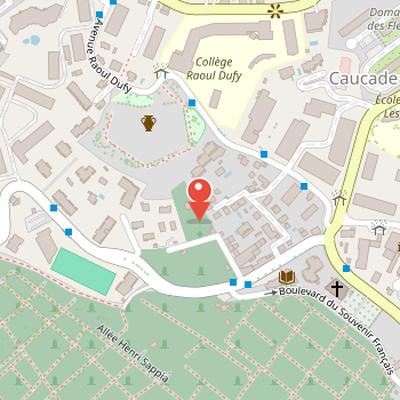
Located on Caucade Hill southeast of Nice, the Russian Orthodox Cemetery was established following the Russian community's right in 1866 to create a cemetery for its members. It covers an area of 3303 square meters and features the chapel Saint-Nicolas, dedicated to Tsarevich Nikolai Alexandrovich Romanov who died in Nice in 1865. The cemetery serves as the parish cemetery of the church Saint-Nicolas-et-Sainte-Alexandra and expanded as Nice became a center for Russian exiles. Notable burials include members of Russian noble families such as the Romanovs, Obolenski, Zereteli, and Gagarin. Initially accessible by a narrow path, a driveway through a neighboring Anglican cemetery was later granted. It stands as a significant cultural and historical landmark reflecting the Russian émigré presence in Western Europe.
Nearby Objects
-
 Parc Phœnix 1100 m away
 -
 Asian Arts Museum 1100 m away
 -
 Palais Nikaïa 1400 m away
 -
 Musée international d'art naïf Anatole Jakovsky 1600 m away
Overview and Names of the Russian Orthodox Cemetery in Nice
The Russian Orthodox Cemetery in Nice is also known as Cimetière (russe) de Caucade, Русское кладбище Кокад, and Николаевское кладбище. It serves as a burial ground catering specifically to the Russian Orthodox community, reflecting the cultural and religious heritage of Russian expatriates and visitors in Nice.
Establishment and Historical Development of the Russian Orthodox Cemetery in Nice
The Russian Orthodox Cemetery in Nice was established following the Russian community’s right to create a cemetery on August 4, 1866. Prior to this, Russian Orthodox residents in Nice had been buried in the castle cemetery. To serve the community’s burial needs, a large plot of land measuring 3303 square meters was purchased on January 5, 1867, located on Caucade Hill, southeast of the city center. This site became the dedicated Russian Orthodox cemetery, affiliated with the parish church of Saint-Nicolas-et-Sainte-Alexandra, which itself was built earlier in 1859 in the downtown area of Nice.
The cemetery was consecrated in memory of Tsarevich Nikolai Alexandrovich Romanov, who had died in Nice in 1865. To honor his memory, the Zarevich Memorial Chapel was constructed between 1867 and 1868. Initially, access to the cemetery was limited to a narrow path, but permission was granted in 1867 to create a driveway through the adjacent Anglican cemetery, improving accessibility.
As Nice became a key destination for Russian exiles, especially after the October Revolution and the establishment of the Soviet Union, the cemetery expanded to accommodate the growing Russian émigré population. This development coincided with the construction of a larger Russian Orthodox cathedral, Saint-Nicolas, between 1903 and 1912, further establishing the area as a focal point of Russian cultural and religious life in Western Europe. Recognized as the oldest Russian cemetery in the region, the cemetery holds significant historical and cultural importance as a symbol of Russian presence and heritage in Nice.
Notable Burials and Historical Usage of the Russian Orthodox Cemetery in Nice
The Russian Orthodox Cemetery in Nice serves as the final resting place for several prominent members of Russian nobility and notable individuals associated with the Russian émigré community. Among those interred here are Leonid Sabanejew, who passed away in Antibes; Nikolai Nikolajewitsch Judenitsch, who died in Cannes; and Serge Voronoff, who died in Lausanne. The cemetery also holds the remains of Prince Rostislav Alexandrovich (1902–1978), son of Alexander Mikhailovich Romanov and Xenia Alexandrovna Romanova, as well as Princess Marina Petrovna (1892–1981), daughter of Peter Nikolaevich Romanov and Militza of Montenegro. Members of other distinguished Russian noble families, including the Obolenski, Zereteli, and Gagarin families, are also buried within its grounds. The majority of interments took place during the 1940s and 1950s, reflecting the cemetery's role as a significant site for the Russian diaspora during that period.
Conflict Over Ownership and Management of the Russian Orthodox Cemetery in Nice
Since 1927, the Russian Orthodox Cemetery in Nice has been cared for by ACOR-Nice, a community of immigrants that independently purchased the land, paid property taxes, and managed security, maintenance, and administration. This long-standing stewardship was challenged beginning in 2014 when Alexander Orlow ordered a notarized document change to transfer ownership of the cemetery, the Nicolas-Chapel, and the Church Saint-Nicolas-et-Sainte-Alexandra to Russia's possession. The act was executed on April 29, 2014, but ACOR-Nice only became aware of it nearly a year later, on April 27, 2015. Despite invitations for clarification, neither Russian authorities nor the responsible notary responded to ACOR-Nice's inquiries in 2015.
Tensions escalated on February 18, 2016, when a pro-Russian faction forcibly broke the cemetery locks, replaced them, and declared the cemetery under the ownership of the Russian Federation. This act was asserted to be authorized by the Russian embassy, with the cathedral rector claiming a mandate to authorize the lock changes and access to the house administration. Moreover, the Russian ambassador had transferred control of the cemetery to the Korsun Diocese of the Moscow Patriarchate a few weeks earlier, on February 5, 2016. This transfer conflicted with ACOR-Nice's affiliation with the Patriarchate of Constantinople since 1930, leading the Archdiocese of the Russian Orthodox Churches in Western Europe to condemn the takeover on February 19, 2016.
Following the conflict, ACOR-Nice's signage, opening hours, and service notices were removed and replaced with new signs stating Russian ownership dating from 1867. A temporary compromise introduced a new lock with shared keys, but the cathedral community soon demanded exclusive keys to the chapel and caretaker's building. Suspicions arose after the disappearance of keys and the grave directory, reportedly involving a Russian cathedral community member. Efforts in Paris to establish an association aimed at protecting the cemetery and assuming control further underscored the dispute.
In February 2021, the Nice court ruled that Russia's claims were illegal and recognized ACOR-Nice's adverse possession. The court affirmed that no lease existed between Russia and the community and highlighted ACOR-Nice's independent purchase and long-term management of the cemetery. This decision legally reinforced the community's stewardship despite the contested attempts by Russia to assert ownership.