Parc Phœnix is a botanical and zoological park in Nice, Alpes-Maritimes, France, located at the southwest entrance of the city in the Arénas district along the Promenade des Anglais. It extends over seven hectares arranged around a central body of water and was inaugurated after 26 months of construction. The site is named after the Phoenix canariensis palm species and is adjacent to the Museum of Asian Arts of Nice, founded in 1993 and designed by Japanese architect Kenzo Tange.
The park includes about twenty themed zones, such as a tropical greenhouse, ponds, and Mediterranean gardens, with nearly 9,000 plant species in total. Its ornamental spaces combine Mediterranean and succulent plants, including oleanders, Phoenix, Washingtonia, lavenders, bulbous plants, cactuses, euphorbias, aloes, and agaves. The garden also includes vegetable plants such as olive trees, orange trees, and aromatic herbs. A basin-side area known as the island of bygone times contains primitive species like araucarias, and a bamboo grove is located nearby.
The greenhouse covers 2,600 square meters, rises to 16 meters, and has a glass roof area of 3,000 square meters. It contains seven distinct spaces that recreate seven climates using computer technology, including a tropical humid atmosphere with a forest of tree ferns and a large collection of orchids, as well as hybrids and botanical bromeliads.
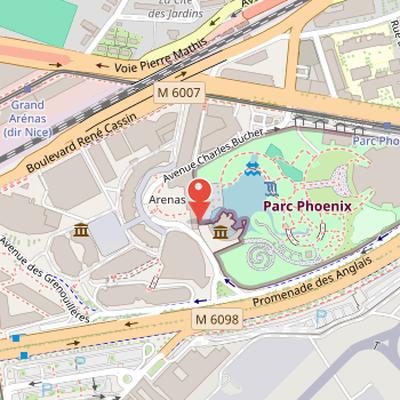
Nearby Objects
-
 Asian Arts Museum 40 m away
 -
 Russian Cemetery in Nice 1100 m away
 -
 Palais Nikaïa 1800 m away
Parc Phenix in Nice
Parc Phenix is a botanical and zoological park located in Nice, in the Alpes-Maritimes department of France. It is also labeled as a remarkable garden. The site combines botanical and zoological functions within a single public park setting, giving it a place within the urban and cultural landscape of Nice.
Location and History
Parc Phoenix is located at the southwest entrance to Nice, in the Arenas district along the Promenade des Anglais. It extends over seven hectares arranged around a central body of water. The park was inaugurated after 26 months of construction, with a budget of 308 million francs, or 47 million euros. Its name refers to the Phoenix canariensis palm species. Parc Phoenix is also adjacent to the Museum of Asian Arts of Nice, which was founded in 1993 and whose building was designed by the Japanese architect Kenzo Tange.
Landscape Zones and Plant Collections
Parc Phoenix is organized into about twenty themed zones, including a tropical greenhouse, ponds, and Mediterranean gardens. These areas contain nearly 9,000 plant species in total. The garden spaces combine Mediterranean plants with succulent plants in ornamental settings. The Mediterranean planting includes oleanders, Phoenix, Washingtonia, lavenders, and bulbous plants, while the succulent collection includes cactuses, euphorbias, aloes, and agaves. The vegetable plants include Mediterranean species such as olive trees, orange trees, and aromatic herbs. In the garden area overlooking the basin, primitive species such as araucarias are grouped in a section called the island of bygone times. A bamboo grove is located nearby.
The Greenhouse Interior
The greenhouse at Parc Phoenix covers 2,600 square meters and rises to a height of 16 meters, with a diameter of 56 meters and a glass roof area of 3,000 square meters. It is arranged into seven distinct spaces, each designed to recreate a different climate using computer technology. This structure allows the building to present a varied sequence of plant and animal environments within a single enclosed space.
One of the main areas is a tropical humid atmosphere with a forest of tree ferns. It also contains a large collection of orchids, including vanda, dendrobium, phalaenopsis, paphiopedilum, and oncidium, as well as hybrids and botanical bromeliads. Other planted sections include a Louisiana garden with spectacled caimans, a Thailand garden, and areas with hibiscus, palms, araceae, aristolochia, carnivorous plants, ficus, heliconia, bananas, and acacias. A garden of southern Africa presents arid and hot Mediterranean climate plants such as aloes, euphorbias, stapelias, bulbous plants, and proteaceae.
The basement contains a series of aquariums and terrariums with tropical freshwater and saltwater fish, insects, myriapods, and arachnids. Animals living freely in the greenhouse include mandarin ducks, Chilean flamingos, and iguanas.