The Centre d’Histoire de la Résistance et de la Déportation is a military museum in Lyon dedicated to World War II history. It originated in 1965, when former resistance fighters and deportees created the association Origines du musée to establish a World War II museum. The first museum opened in two rooms of the Muséum d’histoire naturelle de Lyon on rue Boileau in the 6th arrondissement. In the 1980s, the association sought larger premises, and in 1989 Mayor Michel Noir assigned Alain Jacubowicz the mission of creating a municipal World War II museum. The institution was renamed Centre d’Histoire de la Résistance et de la Déportation and received the collections from the rue Boileau museum.
The museum is installed in a building constructed at the end of the 19th century for the École du service de santé militaire. During the Second World War, it served as Gestapo headquarters between spring 1943 and 1944, under lieutenant Klaus Barbie. Its cellars were used as jails before interrogations, and the building was damaged by the bombing of May 26, 1944. After the war, the City of Lyon restored the building, replacing the destroyed facade with a portico completed in 1962. The CHRD was inaugurated on February 15, 1992.
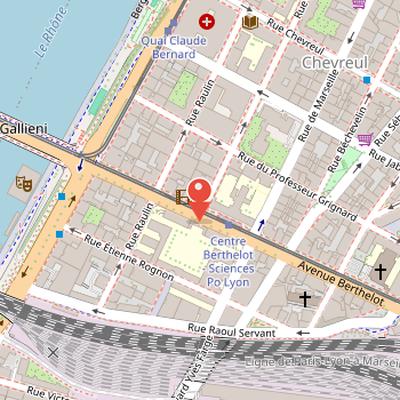
Nearby Objects
-
 Comoedia 120 m away
 -
 Centre Hospitalier Saint-Joseph et Saint-Luc 300 m away
 -
 Rue de Marseille 500 m away
 -
 Place Jean-Macé 500 m away
 -
 Brasserie Georges 600 m away
From Association Museum to Municipal History Centre
The Centre d'Histoire de la Resistance et de la Deportation grew out of Origines du musee, an association formed in 1965 by former Lyon resistance fighters and deportees to create a World War II museum. Its first museum opened in two rooms of the Museum of Natural History of Lyon on rue Boileau in the 6th arrondissement. In the 1980s, the association asked the City of Lyon for larger premises, a request that coincided with the Klaus Barbie trial before the Rhone court from May 11 to July 4, 1987. In 1989, Mayor Michel Noir assigned Alain Jacubowicz the mission of creating a municipal World War II museum. The institution was then renamed Centre d'Histoire de la Resistance et de la Deportation and received the collections from the rue Boileau museum. It was installed in the building that had served as the Gestapo headquarters between spring 1943 and 1944, and it was inaugurated on February 15, 1992, in the presence of Jacques Chaban-Delmas and Elie Wiesel. On December 10, 1994, the esplanade was named Pierre Robert de Saint-Vincent.
From Military School to Memory Site
Constructed at the end of the 19th century, the building was originally intended to house the Ecole du service de sante militaire. Its history changed sharply during the Second World War, when it was occupied by the Gestapo from spring 1943 to 1944 under lieutenant Klaus Barbie. During this period, the cellars were used as jails for prisoners before interrogation. The building was damaged by the bombing of May 26, 1944, which destroyed the facade building on avenue Berthelot. After the war, the City of Lyon entrusted architects Victor Clermont and Etienne Deschavannes with its restoration. Reconstruction was completed in 1962, when the destroyed facade was replaced by a portico. The Ecole du service de sante militaire left the site in 1981, after relocating to Bron. The building now forms part of the Centre Berthelot, a complex of scientific, cultural, and educational institutions that includes the CHRD.
Collections and Documentation
The collections of the Centre d'Histoire de la Resistance et de la Deportation originate from the initial collection of the former museum on rue Boileau. They are regularly enriched by donations from private individuals and by acquisitions made for a fee. The holdings include a significant fund from the CHRD, as well as nearly unknown items assembled from testimonies of former resistants and deportees collected by the CHRD. An additional corpus is completed by temporary campaigns carried out for temporary exhibitions on themes such as hidden children, civilians in war, Oradour-sur-Glane, women and children of prisoners of war, and daily life. The collections are accessible through the CHRD documentation center and INA consultation centers.
The Permanent Exhibition
The permanent exhibition at the Centre d'Histoire de la Resistance et de la Deportation was originally designed to provide general information about the war period, with a focus on engagement in the Resistance. Its scenography, created by Guy-Claude Francois, stage director of Theatre du Soleil in Vincennes, used an immersive approach built around metaphors of night and confinement. This design concealed the building's configuration and guided visitors along an oppressive path that included reenactments and an audioguide system with explanatory comments, songs, and audio for videos.
Closed in autumn 2011 for renovation, the exhibition later reopened as Lyon dans la guerre, 1939-1945, presented as a chrono-thematic route centered on the specificities of the Resistance in the urban context of Lyon. The former scenography was demolished to reveal the architecture of the building and allow natural light to enter. Some reenactments were preserved, including a small Place de la Croix-Rousse, an apartment interior, and a cellar arranged as a clandestine printing press. The exhibition also includes about thirty audiovisual testimonies from former resistants and deportees, together with large format images by Emile Rouge, Andre Gamet, and Charles Bobenrieth.
Temporary Exhibitions at the CHRD
The CHRD has presented temporary exhibitions on themes related to the Second World War, as well as exhibitions on contemporary subjects connected to the defense of human rights worldwide. Among its thematic cycles was a focus on daily life in wartime, including Pour vous, Mesdames ! La mode en temps de guerre in 2014 and Les jours sans, alimentation et penurie en temps de guerre in 2017. The institution also showed Tchetchenes hors-sol in 2009, on the situation in Chechnya from 2004 to 2009, and Rever d’un autre monde in 2016, on the representation of migrants in contemporary art. In 2022, for the museum's thirtieth anniversary, it presented Visages, which included 54 gouache portraits by Jean Billon painted in 1940 and originating from stalag VIII C.
Screening of the Barbie Trial Documentary
At the Centre d'Histoire de la Resistance et de la Deportation, the documentary Le proces Barbie, justice pour la Memoire et l'Histoire is shown under the title Diffusion d'extraits du proces Barbie. It presents exclusive excerpts from Klaus Barbie's trial and focuses on witness statements. The film was directed by judicial reporter Paul Lefevre, lasts 45 minutes, and is broadcast five times daily at the CHRD. Its screening received exceptional authorization from the tribunal de grande instance de Paris.
Documentation Center and Research Resources
The Centre de documentation is part of the CHRD project and serves as a research resource for the study of wartime history. It offers consultation of more than 27,000 books, along with microfilms of the official and clandestine press, periodicals, and DVDs. The center also makes available more than 700 audiovisual testimonies from resistants and deportees. Its holdings document all aspects of the Second World War as well as the history of the 20th century, making it an important reference point for historical consultation and research.