Place Jean-Macé is a square named after Jean Macé (1815–1894), a politician, journalist, and teacher. The naming of the new square was recorded by a municipal council deliberation. The site developed from an earlier road junction: in 1892, avenue du Maréchal-de-Saxe was extended south to the present avenue Jean-Jaurès, and the crossing with route de Gerland and rue d'Avignon formed an embryonic square north of the railway. The area also recalls the former fort du Colombier and the rempart connecting it to fort de la Vitriolerie, built in the first part of the 19th century and destroyed in the 1890s. The Second Empire transformed the junction into a public square, while the surrounding space remained open for a long time. Its current appearance dates mainly from the 1950s, with the construction of large buildings near rue Parmentier and rue Grignard. The square includes important buildings such as the mairie du arrondissement, completed in 1920 by architect Charles Meysson, the bibliothèque du Jean-Macé, the gare de Lyon-Jean Macé, two Vélo'v stations, and canéphores sculpted by Albert Poncin.
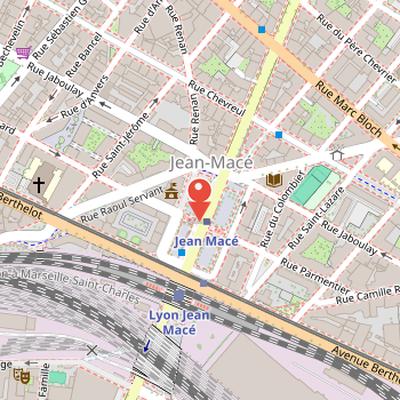
Nearby Objects
-
 Avenue Berthelot 350 m away
 -
 Gare de Lyon-Guillotière 350 m away
 -

-
 Rue de Marseille 600 m away
 -
 Place Saint-Louis 600 m away
Naming of Place Jean Mace
Place Jean Mace is named after Jean Mace, who was a politician, journalist, and teacher. He lived from 1815 to 1894. The name of the place reflects his personal and public identity through this commemorative reference.
Naming of the Square
Odonymie reports that the new square was named after Jean Mace, a journalist and teacher who lived from 1815 to 1894. The naming was recorded by the municipal council deliberation, which formally established the name of the new square.
Formation of Place Jean-Mace
The area that became Place Jean-Mace was shaped by several stages of urban change. In the first part of the 19th century, the fort du Colombier and a connecting rempart to the fort de la Vitriolerie were built here. During the Second Empire, the junction of roads was transformed into a public square, while the surrounding space remained free for a long time. Avenue du Marechal-de-Saxe was extended south to the present avenue Jean-Jaures in 1892, and it crosses route de Gerland and rue d'Avignon north of the railway, where the crossing forms an embryonic square. The fort du Colombier and the rempart were destroyed in the 1890s. The current appearance of the place dates from the 1950s, when large buildings were constructed near rue Parmentier and rue Grignard.
Important Buildings and Public Features
Place Jean-Mace hosts several important buildings in the center of the arrondissement. It includes the mairie du, completed in 1920 by architect Charles Meysson, which houses decorations by painter Pierre Combet-Descombes. The square also contains the bibliotheque du Jean-Mace, located at the corner of rue Domer, as well as the gare de Lyon-Jean Mace. In addition to these buildings, the site has two Velov stations. The space is also decorated with canephores sculpted by Albert Poncin.