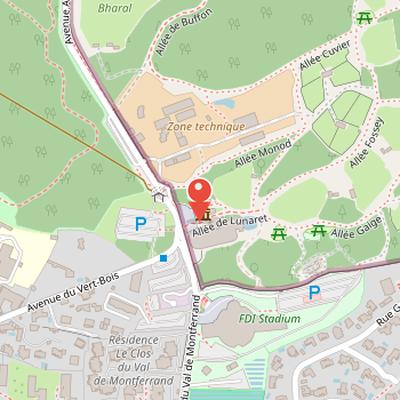
Parc zoologique de Montpellier is a French zoological park located in the Lunaret park area, north of Montpellier, in the Occitanie region. It is situated in the Hôpitaux-Facultés district, within the Aiguelongue sub-district, and includes the Lez natural reserve within Lunaret park. Founded in 1964, the park covers 80 hectares and presents approximately 170 animals from 29 species.
The zoo is owned and fully financed by the city of Montpellier. It offers free entrance to most of the park area and is among the ten most visited zoological parks in France. It is also counted among the five largest zoos in the country. Since 1997, it has been a permanent member of the European Association of Zoos and Aquaria and participates in ex situ conservation through European programs for endangered species (EEP: EAZA Ex-situ Program). Marine Baconnais has directed the park since early 2023.
Nearby Objects
-
 Saint-Lazare Cemetery 2000 m away
Location, size, and institutional role
The Parc zoologique de Montpellier is a French zoological park located in the Lunaret park area in the Occitanie region, north of Montpellier city. It is situated in the Hôpitaux-Facultes district, within the Aiguelongue sub-district, and includes the Lez natural reserve within the Lunaret park. Founded in 1964, the park covers an 80-hectare area and presents approximately 170 animals from 29 species. It is owned and fully financed by the city of Montpellier, and since early 2023 it has been directed by Marine Baconnais.
The park has been a permanent member of the European Association of Zoos and Aquaria since 1997. It participates in ex situ conservation through European programs for endangered species, known as EEP, or EAZA Ex-situ Program. Most of the park area offers free entrance, which contributes to its public accessibility. The Parc zoologique de Montpellier is also one of the ten most visited zoological parks in France, with approximately annual visitors, and it is among the five largest zoos in France.
From Seigneural Estate to Municipal Heritage
The Parc zoologique de Montpellier is associated with the former La Valette domain in Montpellier, whose history can be traced to the 16th century, when Historique held land properties in Montpellier, Castelnau-le-Lez, and Montferrier-sur-Lez. During the religious wars, La Valette belonged to the Protestant Tremolet family. Antoine Tremolet, identified as the first physician to Francois, lived there, and the domain was also a place where supporters of the Reformed religion met in nocturnal assemblies.
The property changed hands several times over the following centuries. Etienne Planque bought it from Antoine Tremolet's son in 1604, and the Planque family kept the domain for nearly a century. Pierre Chirac acquired it in 1720, and in 1732 Francois Chicoyneau inherited both the domain and Chirac's title. In 1778, Francois Farrel purchased the property and its seigneurial rights, and his son later gave it as a wedding gift to Paul-Louis Hours in 1821. The domain was resold in 1851 because of family bankruptcy.
From 1851 to 1906, the estate passed through the hands of Euphemie Dyany, Eugene Dubois, and Hippolyte Parazol and his eldest son. Each of these owners went bankrupt and resold the property. Henri de Lunaret bought the domain in 1906 as a financial investment. When he died in 1919, he left La Valette to Montpellier with usufruct to Madame Busson de Lavevre, and his will required that the property become an orphanage or another charitable institution.
Renovation Plans and Early Public Display
The first animal displayed to the public in Historique's park was a zebra named Francois. Between 2014 and 2016, new structures were built at Historique's domain to support cheetah breeding. In 2016, Montpellier decided to modernize Historique's zoo through a five-year renovation plan valued at 6 million euros. However, the renovation plan was eventually abandoned.
Enclosures and Educational Spaces
The Parc zoologique de Montpellier is arranged across about forty enclosures along paths of garrigue and Mediterranean forest. Its preserved area is delimited by cliffs and the Lez river, and this riverside zone formerly contained mills. Among its installations was a greenhouse that was inaugurated on an unknown date and covered an unknown surface area; its doors were closed in 2021, and a project to reopen it in another form was announced in a Facebook post, with the process expected to take a long time. The park also includes an educational farm created in 1982 for children from schools or leisure centers. This farm presents farm animals and reflects the park's educational role alongside its zoological function.
2025 Controversy Over Bat Euthanasia
In summer 2025, the Parc zoologique de Montpellier became the subject of a controversy after Sciences et Avenir and Libiration reported that around 200 bats had been euthanized at the zoo. The decision was linked to a lack of space and to the closure of the Amazonian greenhouse. According to the available facts, the mass euthanasia was carried out by authorized veterinarians and followed a municipal decision. That decision was also denounced within the council by the deputy in charge of animal welfare.