Hôpital Édouard-Herriot, formerly known as Grange-Blanche, is located at 5 place d'Arsonval in Lyon. It is one of the centres of the Centre hospitalier universitaire de Lyon and part of the Hospices civils de Lyon. It is also the largest hospital in the Auvergne-Rhône-Alpes region. Designed by architect Tony Garnier, it was built between 1913 and 1933 according to a pavilion hospital organization. A large part of the complex is listed as a historic monument.
The hospital was created at the initiative of Édouard Herriot, who wanted a large modern hospital east of the Rhône to serve the growing population of these districts and to place Lyon at the forefront of modernity, on a level with other European countries. In 1909, the city acquired the domaine de Grange-Blanche for one million francs, and Tony Garnier was tasked with developing the plans. The commission visited recent hospital structures in Germany, Denmark, and Paris, and Garnier adapted a pavilion hospital from his industrial city project. Construction began in 1913 and was slowed by the war and later delays. The hospital opened with 32 pavilions, including 22 for care, linked by underground galleries.
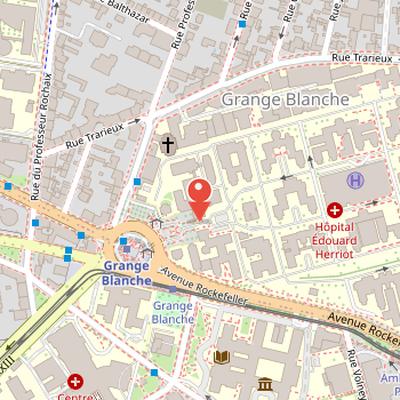
Nearby Objects
-
 Place Ambroise Courtois 700 m away
 -
 Villa Lumière 750 m away
 -
 Institut Lumière 800 m away
 -
 Hôpital Desgenettes 900 m away
 -
 Grande Mosquée de Lyon 1100 m away
Architecture and History of the Hospital
The Hopital Edouard-Herriot, formerly called Grange-Blanche, is one of the centers of the Centre hospitalier universitaire de Lyon and belongs to the Hospices civils de Lyon. Located at 5 place d'Arsonval in Lyon, it is the largest hospital in the Auvergne-Rhone-Alpes region. The hospital was built between 1913 and 1933 and was designed by architect Tony Garnier. Its layout follows a pavilion hospital organization, reflecting the planning principles used for the site. A large part of the hospital is listed as a historic monument, underlining its heritage value within the city and the regional hospital network.
Planning and Construction of the Edouard-Herriot Hospital
The Hopital Edouard-Herriot was initiated by Edouard Herriot, mayor of Lyon, who wanted a large modern hospital east of the Rhone to serve the growing population of these neighborhoods and to give Lyon a hospital at the forefront of modernity, comparable to those in other European countries. In 1909, the city acquired the domaine de Grange-Blanche for one million francs, and Tony Garnier was assigned to design the plans. He adapted a pavilion hospital from his industrial city project, following the ideas developed by the commission, which included Jules Courmont and visited recent hospital buildings in Germany, Denmark, and Paris. Garnier's first plan did not include chapels, but Herriot accepted the administrators' view that the hospital sisters should have a place for worship. The chapel was later consecrated and blessed, and one bell was sponsored by Blanche Herriot, the mayor's wife.
Construction began in 1913 and was strongly slowed by the war, despite the participation of German prisoners of war. Delays continued after the war and the cost increased. After opening, the public noted that the cost per bed was high compared with the Hotel-Dieu. The hospital opened with 32 pavilions, including 22 for care, linked by underground galleries. It had 1544 beds and 23 medicine, surgery, and specialty services, mostly transferred from Hotel-Dieu and Charite, with two from Antiquaille. In 1935, the inauguration of the anticancer center increased capacity to 1723 beds. On the rue Trarieux side were the heating plant, workshop, store for hospital equipment, laundry processing up to of laundry weekly, and a mattress factory.
Pavilion Layout and Hospital History
The hospital was designed by the architect for 1544 patients, and its capacity increased regularly to reach 2723 beds and 82 cradles in 1953. The pavilions were arranged in a U shape, with openings facing south to allow light to enter. They were built on two levels and divided into large medical pavilions with 220 beds and smaller surgical pavilions with 140 beds. In the surgical pavilions, a septic ground floor was separated from the aseptic upper floor for operations, and the complex also connected the hospital to university facilities, the photography service, and the medico-legal institute.
Near the center, the sisters' hospital dwellings were progressively transformed into a restaurant, alongside the general kitchen, pharmacy, analysis laboratories, and the Pavillon des concours. The Pavillon des concours hosted all hospital contests for twenty years. Early chiefs of service included Eugene Villard for gynecology, Gabriel Nove-Josserand for pediatric surgery, Frederic Collet for ENT, Georges Mouriquand for pediatric medicine, Joseph Nicolas for dermatology, Georges Gayet for urology, and Leon Berard for the cancer center.
During the early hospital period, few heavy works were carried out. Four pavilion names changed twice, including surgeon Paul Santy moving from pavilion O to D in 1941, carrying the letter with him. Neurosurgeon Pierre Wertheimer moved from pavilion G to F in 1945, and the administrative acceptance of this change caused inconveniences including loss of patients, visitors, and staff. The logical pavilion order was restored only in 1980. During the German invasion of the free zone, the hospital was requisitioned alongside the Croix-Rousse hospital. The infectious disease clinic was transferred to pavilion H and the surgery service to pavilion F to make room for military use.
Medical Equipment and Modernization at Histoire Hospital
Histoire hospital was marked by a series of technical additions that reflected changing medical practices and a continuing effort to modernize its facilities. In the 1980s, the hospital possessed a scanner mandated by the government, but its radiology services judged it completely insufficient. This machine was the only one in Lyon capable of full-body radiography, while the second scanner at the neurological hospital of Lyon could only take skull images. The Histoire hospital scanner was an EMI brand machine, it broke down for several weeks in 1984, and it was replaced in 1985.
The hospital also developed expertise in laser-based treatment and diagnostics. A laser was installed in pavilion U of the ENT service under Professor Morgon in 1980, and other lasers were acquired over the decade, including a dye laser in 1984. This dye laser was installed in pavilion D in a new surgical service directed by Professor Lambert, and its acquisition was made possible through a regional cooperation concerning lasers. At the time, it was the first dye laser of its type in France.
In another field of medical technology, the hospital received a magnetic resonance spectrometer in 1989 and installed it in a new Metabolic Study Center in pavilion P. The renovations for this center cost several million francs, and the installation was funded by Hospices civils de Lyon, university Lyon I, INSERM, CNRS, private industry, and the Rhone cancer league.
The hospital also appears in the history of experimental medical devices. Histoire states that while Professor Dubernard's team worked on creating its own device, another was purchased from a German company. The device developed by Professor Dubernard and M. Cathignol from CETAC was then put into service the following year under an INSERM program. Its principle was based on ultrasound localization of calculi.
Later, the hospital's kitchen building was renovated into a fast-food place between 1993 and 1994. In 2012, a modernization project began under the mayor of Lyon. Estimated at 500 million euros and scheduled from 2013 to 2025, the plan aimed to end the dispersal of services through the construction of two 20,000 square meter buildings after demolishing several pavilions.
The Burn Center at h pital Edouard Herriot
The major burns treatment center at h pital Edouard Herriot began operating on September 22, 1957 under Professor Jean Creyssel. It was the second burn center in France, after the Saint-Luc hospital center established in 1952, and it remained active from 1957 onward. During its first years, the hospital studied and gradually introduced several improvements to the service. In 1959, it initiated a thermal therapeutic center in Saint-Gervais-le-Fayet for the scar sequelae of burns. In 1961, it strengthened its anti-infectious policy by introducing individual isolation rooms.
Further changes followed in 1964 and 1965, when visitor, staff, equipment, and waste circuits were improved. The second version of the center was inaugurated in 1966. That year, the service gained an external gallery for visitors, a heliport on the roof, a second bathtub with an elevator for burn patients ready for grafting, and improved individual aseptic and air-conditioned enclosures with a mattress blower for drying surfaces. The center also carried out heterograft trials with Institut Merieux in order to expand the skin bank with 80 volunteer donors, and collaborated with Prunieras for epidermal cell supply, with Carraz for anti-infectious efforts, and with Guyotat and Brun for patients psychological comfort.
An adjacent laboratory provided 24-hour analysis. The center produced numerous articles and theses in France and abroad, and it received repeated visits from foreign specialists and hospital staff from France and elsewhere. From 1957 to 1971, it performed 674 excisions and grafts for burn patients and 101 plastic surgeries, mainly for face repair and scar release. It also treated patients with old infected, non-healed burns and deformities referred from outside sources. The service received orthopedic support from the neighboring department and admitted burn victims from several major incidents, including soldiers from Algeria, twenty victims from the Plichon Shaft dust explosion in 1957, five victims from the Sainte Fontaine Shaft dust explosion in 1961, and thirty victims from the Feyzin refinery explosion in 1966.
Hospital Services in 2016
In 2016, hopital Edouard-Herriot operated as a large multi-service hospital with a broad range of medical, surgical, and diagnostic departments. Its emergency-related functions included a medico-psychological emergency unit, dental emergencies, medical reception, post-emergency consultations, psychiatric emergencies, and visceral surgical emergencies. The hospital also provided anesthesia and intensive care, a hyperbaric medicine center, and mobile palliative care support.
Its clinical activity covered a wide spectrum of specialties. These included general and digestive surgery, digestive surgery, vascular surgery, orthopedic surgery for both upper and lower limb trauma, urology and transplantation surgery, maxillofacial and facial plastic surgery, and stomatology. Medical departments included endocrinology consultations, family planning, audiology and oro-facial explorations, renal and metabolic functional exploration, digestive functional explorations and consultations, neurological functional explorations and epileptology, hematology biology, hepato-gastro-enterology, clinical immunology and rheumatology, medical oncology, ophthalmology, orthogenesis, otorhinolaryngology and cervicofacial surgery, dermatology and venereology, sports medicine, geriatric medicine, internal medicine, forensic medicine, nephrology and dialysis for arterial hypertension, and transplantation nephrology and immunology.
The hospital also maintained several diagnostic and technical services. These included digestive radiology, osteo-articular radiology and neuroradiology, urinary-vascular diagnostic and interventional radiology, hospital hygiene, epidemiology and prevention, and a molecular genetics unit. Additional services listed in 2016 were general medical care for emergencies, general and digestive surgery with visceral emergencies, and a service of clinical immunology and rheumatology. Together, these departments show the hospital functioning as a major center for care across urgent, specialized, and interdisciplinary fields.
Plans for a merged burn center
Between 2007 and 2008, Fonctionnement launched a project to merge the burn centers of HEH and Saint-Joseph-Saint-Luc hospital. The project was abandoned in 2010, then reactivated in 2013 by the regional health agency. After discussions between the two services, the agency decided to locate the merged burn center at HEH.
The plan called for the renovation of pavilion I, including a new block with two operating rooms. The renovated pavilion was to contain thirty beds, divided into ten intensive care beds, ten continuous care beds, and ten surgery beds. This represented a reduction compared with the thirty-six beds in the two existing burn centers combined, but the new unit was expected to treat more than seven hundred patients a year. It was also projected to become the largest burn center in Europe and to employ over one hundred full-time staff with different statuses. The opening of the new center was initially scheduled for 2016.
Outpatient Clinic and Medical Recognition
In 2011, Fonctionnement opened an outpatient medical clinic at pavilion R. The clinic offered day hospitalization and consultations in ten specialties, mainly for patients with chronic diseases. It employed seventy doctors and forty paramedical staff, and its organization allowed patients to remain in one room while doctors rotated to see them individually. The clinic was designed to reduce the number of patient visits by combining several specialist consultations and possible surgeries into a single visit. Fonctionnement also attempted to digitize all processes in order to eliminate paper use. An initial evaluation after a few months reported an increase in consultation numbers at the outpatient clinic. In 2014, Fonctionnement's medical oncology service was recognized by ENETS as a European center of excellence, one of only twenty-six centers in Europe and two in France to receive the label. The institution is associated with CNRS and INSERM.