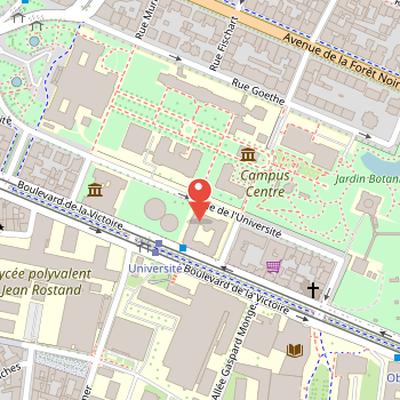
The Musée zoologique de la ville de Strasbourg presents the zoology collections belonging to the City of Strasbourg. It is part of the network of museums of the City of Strasbourg and is located on boulevard de la Victoire, near the historic campus of the University of Strasbourg. The museum holds more than 1.2 million specimens and displays a certain number of them to the public. It was closed for renovations and later reopened to visitors.
The history of the collection is closely linked to Jean Hermann, whose curiosity and determination led to the first collections and the future museum. After obtaining a medical doctorate from the University of Strasbourg in 1762, he traveled to Paris and visited scientific establishments and curiosity cabinets. He also built his own natural history cabinet in Strasbourg. Although he did not travel much, he corresponded with scientists such as Georges Cuvier, Carl von Linné, and Alexander von Humboldt, and belonged to many learned societies. After his death in 1800, the cabinet was managed by his family and later sold to the city in 1804 to prevent its dismantling.
Nearby Objects
-
 Hôtel Brion 400 m away
 -
 Haute école des arts du Rhin 400 m away
 -
 Saint-Maurice Church 450 m away
 -
 Saint William's Church 500 m away
 -
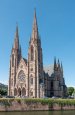 St. Paul's Church 500 m away
Collections and Location
The Musee zoologique de la ville de Strasbourg presents zoology collections belonging to the City of Strasbourg and is part of the network of museums of the City of Strasbourg. It is located on boulevard de la Victoire, near the historic campus of the University of Strasbourg. The museum holds more than 1.2 million specimens, although only a certain number of them are displayed to the public. It was closed for renovations and later reopened to visitors.
Jean Hermann and the Origins of the Museum
The origins of the museum are tied to the curiosity and determination of Jean Hermann, whose first collections developed into a substantial natural history cabinet. Hermann obtained a medical doctorate from the University of Strasbourg in 1762, then traveled to Paris, where he visited scientific establishments and well known curiosity cabinets. He built his own collection in an apartment on place Saint-Thomas at the corner of rue Salzmann.
Although he did not travel extensively, Hermann maintained correspondence with scientists such as Georges Cuvier, Carl von Linne, and Alexander von Humboldt, and he belonged to many learned societies. His cabinet became an important scholarly resource. It contained 900 birds, more than 200 mammals, reptiles, worms, fishes, insects, and shells. He also assembled a herbarium and, at his death in 1800, his collection included minerals arranged in 150 drawers. His natural history library was also significant, with more than an unspecified number of volumes.
Between 1762 and 1800, the collection attracted more than an unspecified number of visitors from France and Europe. Among them were the zoologist Lacepede, the naturalist Lamarck, the physicist Volta, the mineralogist Dolomieu, prince Ferdinand de Wurtemberg, and the primate archbishop of Poland. After Hermann's death in 1800, the cabinet was first managed by his family and then sold to the city of Strasbourg in 1804 to prevent the dismantling of the collections during the early development of natural history museums. His son-in-law Frederic Louis Hammer and his brother Jean Frederic Hermann helped preserve the cabinet, and Schimper later succeeded its management.
From War Damage to Reopened Displays
During the 1870 war, the museum was bombed, its collections were moved and left disorganized, and the association connected to it was dissolved. After the conflict, the annexation of Alsace-Lorraine brought major changes in the scientific world. In this context, the Kaiser-Wilhelms-Universitat was organized into specialized institutes following Wilhelm von Humboldt's model in Berlin, and the collections in botany, geology, mineralogy, and paleontology came under university control. Only the zoology collections remained city property, and they were transferred to a new museum built in 1893.
Ludwig Doderlein became conservator and then director of the zoology museum. He oversaw the move, the scientific conception, the museography, and the interior layout of the building. He chose to display all specimens without reserves. His universalist approach and German expansionism led to major acquisitions and specimens brought back from scientific explorations around the world, including Dar-es-Salam, the Bismarck Archipelago, Tsingtao, Neubritannien, Ponape, New Guinea, and Deutsch-Ostafrika. He also assembled an important collection of marine animal specimens during his stay in Japan. Doderlein left in 1919, when Alsace became French again, but his pieces remained integrated into the museum holdings.
In 1920, Emile Topsent was appointed professor of zoology at the University of Strasbourg. He lightened the display cases, created reserves on the third floor, and introduced a bolder museography centered on animal-human relations. After he left in 1927, the museography changed little during the interwar period.
Later, Guy Hildwein, who took charge in 1977, and Elisabeth Lang, who led from 1988 to 2002, renovated the museum presentations and replaced family-specimen displays with dioramas. These showed environments such as the shores of Lake Tanganyika, savanna, the Andes, and polar regions. Although popular in the 1980s, the dioramas were later abandoned. In 2018, the museum was the least visited in the city. At a later stage, collections were conserved at the Pole of Study and Conservation of the City of Strasbourg Museums. The planned renovation was first expected to last three years, but the museum reopened six years later. Among the main changes were the removal of Jean Hermann's working cabinet from the new museography and the reinterpretation of some collections in a contemporary installation.
Naturalist Decoration by Bütiment
The scientific and artistic decoration of the Zoological Museum of Strasbourg is linked to Bütiment, an artist from Munich and a main representative of the naturalist trend of Jugendstil. He was director of the Kunstgewerberschule, later the Ecole superieure des arts decoratifs de Strasbourg, from 1850 to 1916. For the museum, he supervised the creation of eight large oil paintings on plaster panels between 1894 and 1896, working closely with Georg Hacker. His decoration was associated with nature-inspired motifs, especially marine environments and jungles.
Collections and Notable Specimens
In 2019, during the museum closure, the collections occupied exhibition space with public displays and reserves arranged in mobile shelving. The holdings comprised specimens representing all zoological groups in dry or fluid naturalized states, as well as osteological pieces and skins. They included material from almost all world regions, with particular representation from Jakarta, Chile, Madagascar, Japanese bays, Egypt, and Abyssinia. The display collections were said to number approximately specimens, mainly dry naturalized examples, with more than half consisting of passerines arranged in display cases.
The collections were also the basis of scientific work in 2023, when a project used museum resources and paleontological collections from the Jardin des sciences of the University of Strasbourg. That project produced a new inventory that identified missing or destroyed pieces and linked different parts of the same specimen. The collections also included eight remarkable pieces described as animals totem, which were the subject of a special exhibition from to .
Among the notable specimens was a coelacanth (Latimeria chalumnae) caught in 1967 at Salimani Hambou off Grande Comore at depth meters. It was acquired from the Comoros Ministry, funded by war damage reparations, and transported to Strasbourg in a zinc-lined coffin wrapped in formol-soaked fabric. The specimen was reconditioned in 2015 after its aquarium conditions failed compliance, requiring five months and the closure of the museum. Other recorded specimens included a Nile crocodile (Crocodylus niloticus) measured in length, possibly sent by Dr. Alexandre Willemin in 1850; a young Asian elephant (Elephas maximus) from eastern India around 1900; a male southern elephant seal (Mirounga leonina); a kakapo (Strigops habroptila); a juvenile moa (Dinornis) skeleton and other 19th-century specimens collected by Sir Johann Julius von Haast; a pink-headed duck (Rhodonessa caryophyllacea) from India; a laughing owl (Ninox albifacies); a piopio tanagra; and a pair of passenger pigeons (Ectopistes migratorius) donated from North America in 1854.
Blaschka Marine Models and Anatomical Teaching Objects
The museum holds a notable set of scientific models that were used for both teaching and display. Among the most distinctive are 53 marine organism models made by Leopold Blaschka and Rudolf Blaschka, forming a unique collection in France. These glass models were acquired in 1890 through Alexander Goette, director of the Strasbourg museum and zoology institute, and were selected according to his zoological and comparative anatomy interests. The set preserves the form and color of gelatinous marine invertebrates in a way that alcohol preservation cannot, while also reproducing translucency and transparency more effectively than cardboard or wax techniques. The collection includes species such as Geryonia proboscidalis, Loligo vulgaris, Octopus vulgaris, Aplysia depilans, Berthella aurantiaca, Lymnaea stagnalis, and Sepia officinalis, as well as examples shown at life size or enlarged scale, such as Clathrulina elegans. Some of the models represent anatomy, dissection, and embryonic development stages, including the starfish Asteracanthion pallidus. The museum also retains the last animal models manufactured by the Blaschka artisans before their exclusivity contract with Harvard University.
Alongside these glass works, the Strasbourg collection includes anatomical models associated with Louis Auzoux, who created clastic models for medical and veterinary education. Auzoux developed a resistant molding preparation made of papier-mache, paper pulp, flour, and cork powder, and his models were designed as several detachable pieces to clarify anatomical relations. The Strasbourg collection acquired in 1860 contains about fifteen enlarged models of human and animal organs, including human ears, hearts, eyes, brains, a snake head, a chicken egg showing four chick development stages, an aepyornis egg, a caterpillar, and closed and opened cockchafer beetles.
Semi-Permanent Exhibition Program
Since its reopening, the museum has organized thematic semi-permanent exhibitions under the name Expositions. These displays are renewed by rotation, allowing the museum to present different subjects over time. Among the themes mentioned are ecosystems of the Upper Rhine, the Bay of Sagami in Japan, and Nature at the Laboratory, a space dedicated to mosquitoes and bees. This exhibition program shows a focus on rotating natural history topics and on presenting them in thematic form.