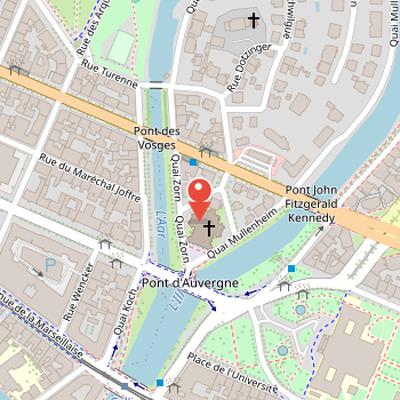
St. Paul’s Church is a Protestant church in the historic center of Strasbourg, located in Place Eisenhower at the confluence of the Ill river and the short Aar watercourse. Dedicated to Saint Paul the Apostle, it was built in 1894 as a chapel for German Lutheran military personnel. The building is a neogothic pastiche inspired by the Church of Saint Elizabeth of Hungary in Marburg. It has a Hallenkirche plan with a central Greek cross layout and can accommodate up to 3,000 worshippers.
The church became the seat of a reformed parish from 1918. Its interior history includes changes to the altar arrangement, with the original altar reredos donated to the Lutheran parish of Sarreguemines and replaced by a large wooden cross. The church is also known for five contemporary stained-glass windows by Brother Eric de Saussure from the Taizé Community, after the original windows were destroyed in an American bombing in 1944. The spires and facade were completely restored between 2009 and 2014. The church has two spires reaching 76 meters.
Nearby Objects
-

-
 Palace of the Alsace-Lorraine Diet 350 m away
 -
 Musée Tomi Ungerer 350 m away
 -
 Monument aux morts 450 m away
 -
 Place de la République 450 m away
Location and Main Features
St. Paul's Church is a Protestant church in the historic center of Strasbourg. It is dedicated to Saint Paul the Apostle and stands in Place Eisenhower, at the confluence of the Ill river and the short Aar watercourse. The church is notable for its two spires, which rise to a height of 76 meters. Its location and prominent silhouette make it a visible element of the urban landscape in this part of the city.
Architecture and Parish History
St. Paul's Church in Strasbourg was built in 1894 as a chapel for German Lutheran military personnel. It is a neogothic pastiche inspired by the Church of Saint Elizabeth of Hungary in Marburg. The building is a Hallenkirche with a central plan in the shape of a Greek cross, and it can accommodate up to 3,000 worshippers. Galleries were installed to allow more people to participate, including galleries for the German emperor and the local representative of the Second Reich.
From 1918, the building became the seat of a reformed parish. When the temple passed to the reformed confession, its altar reredos was donated to the Lutheran parish of Sarreguemines, and a large wooden cross was installed in its place. The church is also known for five contemporary stained-glass windows made by Brother Eric de Saussure from the Taize Community. Its original stained-glass windows were destroyed by an American bombing in 1944. The spires and facade were completely restored between 2009 and 2014.
The Great Tribune Organ
The great tribune organ was built in 1897 by Eberhard Friedrich Walcker in Ludwigsburg. Its design was prepared by the organists Ernest Munch and Wilhelm Sering. The organ was subsequently modified by Wilhelm Sering in 1899, 1907, and 1912. During the First World War, the facade pipes were requisitioned by German authorities in 1917. From 1918 onward, the organ received a provisional zinc facade.
The Church Organ and Its Later Transformations
St. Paul's Church in Strasbourg was once fitted with one of the largest organs in Eastern France, housed in a large neo-Gothic case. The instrument was expanded by Organi a canne in 1933-1934, when an electric motor was also added. After World War II, Organi a canne described its musical quality as mediocre and noted that repeated modifications had destroyed the instrument's original homogeneity. A major failure occurred during a concert in 1957, after which the organ was restored and given a new console. That restoration removed at least twenty-one stops.
In 1983, Organi a canne decided to return the organ to its 1934 state. Restoration work began in 1993 and was carried out by Walcker over six months. The church also received a smaller organ in 1976, installed in place of the ancient imperial lodge. This smaller instrument was designed in a Northern style inspired by seventeenth-century instruments and was intended primarily to accompany singing. It was also presented as the first modern mesotonic organ. Its exterior was designed to recall the triforium organ of Metz Cathedral by Marc Garnier, and the design incorporated several aesthetic and technical choices previously experimented with in San Paolo temple.
Interior and Decorative Features
The available images show both the exterior and interior of St. Paul's Church in Strasbourg. The facade is documented in a photograph taken on 2007-09-23, and the exterior rose window of Tempel St. Paul is also shown. Inside the temple, the images depict rib vaults, chandeliers from the late 19th century, and stained glass windows in the apse from the 20th century. The interior rose window includes German Empire armorials from the 19th century. Several furnishings and liturgical elements are visible as well, including a wooden cross, a baptismal font, a table for the Holy Communion, and the pulpit. The temple also contains a large Walcker organ on the gallery and a choir organ in the transept. In addition to architectural and decorative views, the interior is shown during a youth prayer meeting, and images also depict a children's choir in Strasbourg.