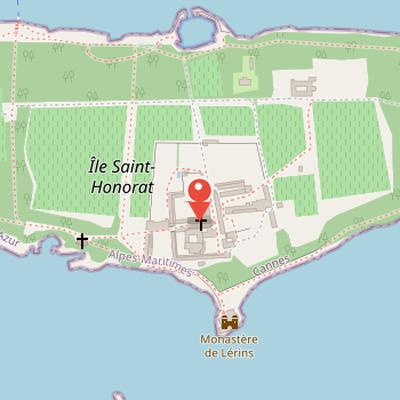
Abbaye Saint-Honorat de Lérins is located on the island of Saint-Honorat in the Lérins islands, within the commune of Cannes in the Alpes-Maritimes, Provence-Alpes-Côte d'Azur region. Founded by Honorat d'Arles around 400–410, it was established as a monastic community on an island known in Roman times as Lerina. Archaeological remains from the chapel of Saint-Sauveur indicate a 5th-century monastic establishment, and excavations around the chapel have also shown that the site had been occupied since prehistoric times.
The abbey became one of the major Christian sites in Europe during the early Middle Ages and provided a large number of southern bishops. Its current buildings were constructed between the 11th and 14th centuries. The abbey was a Cluniac abbey for a long time and now houses a community of Cistercian monks from the Congregation of the Immaculate Conception. Its history is associated with figures such as Honorat d'Arles, Caprais de Lérins, Vincent de Lérins, and several bishops and monks linked to Lérins.
Nearby Objects
-
 Fortified Monastery of the Abbey of Lérins 150 m away
 -
 Museum of the Iron Mask and Fort Royal 1900 m away
History and Monastic Significance
The Abbaye Saint-Honorat de LErins is located on the island of Saint-Honorat in the Lerin Islands, within the Cannes commune in the Alpes-Maritimes department of the Provence-Alpes-Cote d'Azur region. It was founded by Honorat d'Arles around 400-410. Archaeological remains from the chapel Saint-Sauveur indicate a 5th-century monastic establishment, and the abbey was one of the major Christian sites in Europe in the early Middle Ages. It also provided a large number of southern bishops during that period. The present buildings were constructed between the 11th and 14th centuries. The abbey was a Cluniac abbey for a long time, and it is now home to a community of Cistercian monks from the Congregation of the Immaculate Conception.
Monastic Origins and Early Influence
According to the Histoire, the island of Lerins was known to the Romans as Lerina and was described as uninhabited and infested with snakes. In spite of this, Honora t d'Arles and the hermit saint Caprais de Lerins founded a monastery there. Honorat settled on the island between 400 and 410, first living as a hermit with disciples who formed a cenobitic community. The monastery was under the protection of Saint Leonce, bishop of Frejus, and Honorat codified the community's life with the Rule of the Four Fathers, described as the first of its kind in France. Jean Cassien stated that the island of Lerins had become a large monastery by 427.
Excavations around the Saint-Sauveur chapel have shown that the site had been occupied since prehistoric times, placing the monastery within a much longer history of use. During the 5th and 6th centuries, the abbey attracted monks who contributed to its renown. Several figures associated with the monastery later became important in the Church: Saint Patrick studied there before evangelizing Ireland, while Maxime de Riez and Fauste de Riez served as abbots before becoming bishops of Riez. Eucher de Lyon sent his sons to Lerins before joining the monastery himself. Other monks from the abbey included Saint Quenin, bishop of Vaison-la-Romaine, as well as Saint Loup de Troyes, Saint Jacques de Tarentaise, and Saint Apollinaire. The abbey also provided three bishops of the Arles diocese during the 5th and 6th centuries: Honorat, Hilaire d'Arles, and Caesaire d'Arles.
The most famous monk of the abbey was Vincent de Lerins, author of the Commonitorium, written at Lerins. He opposed Saint Augustin's views on grace by affirming that divine grace cooperates with man, a position later condemned as semi-pelagianism at the Council of Orange in 529. Later, Saint Nazarius, the fourteenth abbot, probably served during the reign of Childebert II from 584 to 629 and opposed paganism on the southern coast of France.
Monastic History and Fortification
At the end of the 7th century, the monks adopted the Benedictine rule and renounced the rule of Honorat. Monastic life on the island was repeatedly interrupted by raids over the following centuries, especially by Umayyad troops. After the defeat at Poitiers, Muslims retreated to Provence and attacked the abbey of Lerins. Around 732, about 500 members of the community, including Abbot Saint Porcaire, were massacred on the island by invaders. Saint Elenthere then rebuilt a new monastery on the ruins of the old one.
Between 978 and 1020, the monastery followed the Cluniac reform. It received many donation charters and founded about 100 priories in Provence. In 1047, the island was invaded by Saracen pirates and the monks were taken captive to Spain, before Abbot Isarn of Marseille ransomed them. Fortified buildings were constructed on the island between the 11th and 13th centuries, and in 1327 a fire signal system was installed between the fortified monastery tower and the Suquet tower.
The return of the relics of Honorat from Arles in 1391 made the island a very popular pilgrimage site, and the monk Raymond Feraud wrote a legendary life of Saint Honorat to encourage pilgrimage. The monastery was then pillaged by Genoese pirates in 1400, after which servants initially defended the fortified monastery. In 1437 Provenzal soldiers occupied the upper floors of the buildings to protect the monks, and French soldiers did the same in 1481. The monastery was subject to the commendatory regime from 1464 until 1510.
Modern history and monastic revival
In 1510, Augustin Grimaldi resigned from the commendatory regime and reformed the monastery by uniting it to the Mont-Cassin congregation. Pope Leo X approved the union of Lerins with Sainte-Justine of Padua and the Mont-Cassin congregation in 1514, but the association with Sainte-Justine was revoked in 1533 and restored again in November 1547. The abbey was later united with the congregation of the old observance of Cluny in 1756.
The monastery was closed by a royal commission in 1788 because there were not enough monks, and its domain was attached to the bishopric of Grasse. During the French Revolution, the island was declared national property and became state-owned, then sold to a wealthy actress, Mademoiselle de Saint-Val Cadette, who lived there for twenty years and transformed the monastery into reception salons. The island was later bought by the bishop of Frejus, who sought to restore a religious community in 1859. Ten years later, Cistercian monks from Senanque Abbey settled on the island.
The present community manages monastic life, hospitality, and vine cultivation. By decree of the pope, the parishes in the Grasse district were attached to the diocese of Nice, except for the Lerins islands, which remained in the diocese of Frejus. During the 1903 expulsion of congregations, the Cistercian monks were among the five male Catholic congregations allowed to continue activity in France. In 2014, the abbey and its 22 monks generated a turnover of 4 million euros, mainly from an eight-hectare vineyard producing mandarine grapes. Since 1988, the congregation has held a concession giving it a monopoly on ferry connections between Cannes port and the island, under a promise to preserve the monastic vocation and protect the environment. The monopoly later led to competition with water taxis and legal disputes with the main local maritime company. Since 2011, the abbey has also hosted the annual Festival of Silence alongside the Cannes Film Festival, and since 2014 it has received support from the Heritage Foundation for restoration work on Saint-Sauveur chapel and the monastery tower.
Fortified Monastery and Cloister
The Abbey Saint-Honorat de Lerin developed as a fortified monastic complex whose architecture combined religious, domestic, and defensive functions. Around 1073, Abbot Adalbert II began construction of a fortified tower intended as a refuge for monks, and the site may also have been associated with the initial construction of the Tour du Suquet in Cannes. In the 12th century, the tower was expanded with additional features, including two superimposed cloisters.
The cloister became the heart of monastic life, while two large halls were built on its sides in different centuries. The chapter room was created to organize community life, and the refectory served as the place where monks took their meals. The first cloister, called the work cloister, was arranged around a courtyard with a cistern and used Roman monument columns. Above it, the second cloister, or prayer cloister, was dedicated to prayer and was built with twelve octagonal marble columns. From this upper cloister, access led to three chapels, including the 13th century Sainte-Croix chapel.
In the 13th century, the basement was excavated and contained large caves for food storage, an oil mill, and a bread oven. The first level was assigned to work and common life, while the upper levels were reserved for soldiers, including a garrison room and signaling and defense terraces. The monastery comprised eighty-six rooms, four chapels, and two cisterns, but it was never fully protected because of its size. The abbey fortress was listed as a historical monument in the 1840 list, and the island site has been classified since 1941. The fortified monastery is currently undergoing extensive restoration.
The Island Chapels of Saint-Honorat
On the island of Saint-Honorat, seven chapels are scattered across the site and are described as stations for pilgrimages from Ascension to Pentecost in the Middle Ages. Four of these chapels are accessible to the public. Their distribution reflects both devotional use and the organization of the island landscape around monastic life.
Among the best documented is the Trinity chapel, probably built in the 12th century in the southeast of the island. It reflects the monks' devotion to the Trinity. Its roof later received a cannon battery installed by the Spanish when they took the island in 1635, showing a later military reuse of the structure. To the northwest, near the current landing stage, stands the chapel Saint-Sauveur. Built on an octagonal plan, it has a star vault covering its central part dated to the 13th century. Archaeological excavations around it have revealed occupation of the site since the Iron Age.
Other chapels are linked to specific places and figures on the island. The chapel Saint-Caprais is located to the west, near the place where Caprais de Lerin lived as a hermit. The chapel Saint-Pierre stands to the south near the monastery, and medieval burials surround it. Another chapel is located to the northeast near the vineyards, while one is inside the ramparts of the abbey monastery at the south of the island. A now disappeared chapel to the north survives only in ruins and is associated with a cemetery containing a tomb made of Roman tiles.
Together, these chapels illustrate the historical depth of the abbey site, combining medieval pilgrimage practice, monastic devotion, burial areas, and traces of earlier occupation.