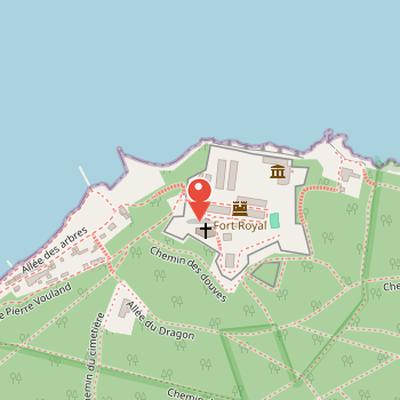
The Museum of the Iron Mask and Fort Royal is an archaeological museum located in Fort Royal on Île Sainte-Marguerite near Cannes, in Alpes-Maritimes, Provence-Alpes-Côte d'Azur, France. It is a Musée de France, with reference number 0602902 and identification number M0873. Originally named musée de la Mer, it was renamed museum du Masque de fer et du Fort Royal in 2020 and is linked to the site of the fort itself, including the large building known as le Vieux Château. Built around Roman cisterns and developed in the 16th and 17th centuries, this structure is divided into prison and museum spaces on multiple levels. The museum, officially created in 1977, presents archaeological remains from land and underwater excavations, explanatory models, temporary exhibition rooms, and terraces. The site also includes historic prison spaces associated with prisoners held on the island, as well as an archaeological trench visible to visitors.
Nearby Objects
-
 Abbaye Saint-Honorat de Lérins 1900 m away
Name and Museum Status
The museum was originally named musee de la Mer and was renamed musee du Masque de fer et du Fort Royal in 2020. It is classified as a Musee de France, with reference number 0602902 and identification number M0873. The museum is an archaeological museum devoted to the study of land and sea, reflecting a broad scope in its collection and interpretation.
Fort Royal and the Museum Spaces
The museum du Masque de fer et du Fort Royal is located in Fort Royal on the ile Sainte-Marguerite near Cannes, in Alpes-Maritimes, Provence-Alpes-Cote d'Azur, France. It is labeled Musee de France and was renamed from Musee de la Mer in 2021 by the city of Cannes. The museum was officially created in 1977, and from 1978 it presented archaeological remains from land and underwater excavations. Its displays include archaeological remains, explanatory models, temporary exhibition rooms, and terraces, and the institution is arranged on multiple levels.
The main building of the fort is Le Vieux Chateau, the largest structure in the fort. It was built around Roman cisterns and underwent major developments in the 16th and 17th centuries. In its 16th century form, Le Vieux Chateau was divided into prisons and museum spaces. Among the historical elements associated with the site is the prison built to incarcerate the man in the iron mask from 1687 to 1698.
Prison History and Archaeology
The Fort Royal on ile Sainte-Marguerite has a long history of imprisonment. In the 16th and 17th centuries, Protestants were held there for religious crimes, and later the site accommodated numerous prisoners after the Iron Mask, including Protestant pastors, prisoners of family, Mameluks of Napoleon, and Algerians from 1841 to 1850. Hundreds of Algerians arrived on the island in 1843, and by 1847 the fort included separate quarters for men and women. A cemetery was also built for those who died on the island during incarceration, which ended in 1856.
The fort later became a place of remembrance and research. In 1950, a Huguenot memorial was established in an old cell to honor six Protestant ministers imprisoned for life in the fort. Archaeological excavations began in 1972 and uncovered important ancient remains. Fourteen campaigns led by Georges Vindry followed between 1973 and 1986, and Annie Arnaud studied the structures and materials uncovered in 1995. In 2007, Terranova carried out a non-destructive survey that produced a subsurface map inside the Fort. The museum also preserves an archaeological trench with a wooden barrier so visitors can see the rampart wall and house outlines, and it hosts annual summer temporary exhibitions.