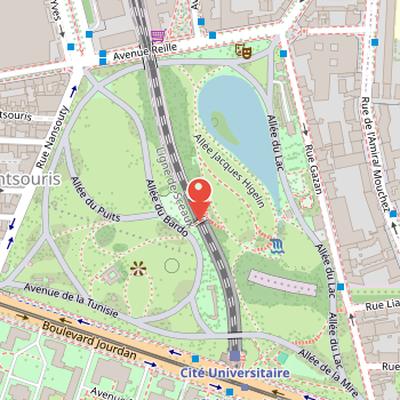
Parc Montsouris is one of the large urban parks in Paris, located in the extreme south of the city in the 14th arrondissement, opposite the Cité Universitaire de Paris. Established in the late 19th century and inaugurated in 1869, it was built under the impulse of Napoléon III. The park covers 15 hectares and is laid out in the English style, with a lake, lawns, shrubs, flower beds, and about 1,400 planted trees.
The park also contains statues, monuments, a restaurant, and hosts various animal species. Its features include the Observatoire météorologique de Montsouris and a water reservoir, which can be visited once a year during the European Heritage Days and supplies one third of Parisians’ potable water consumption. Between May and September, free music concerts are offered at the music kiosk. The park’s name is linked to older local toponymy, with explanations that connect it to the former name of the locality and to historical references to the Bièvre and the mills known as Moque-souris.
Nearby Objects
-
 Stade Charléty 750 m away
 -
 Catacombs of Paris 1400 m away
 -
 Cimetière de Montrouge 1400 m away
 -
 Denfert-Rochereau Square 1400 m away
 -
 Lion of Belfort 1400 m away
Parc Montsouris: design and uses
Parc Montsouris is one of the large urban parks in Paris, located in the extreme south of the city in the 14th arrondissement, opposite the Cite Universitaire de Paris. It is an English-style park established at the end of the 19th century and inaugurated in 1869 under the impulse of Napoleon III. The park covers 15 hectares and includes a lake, lawns, shrubs, flower beds, and 1400 planted trees.
The site contains statues, monuments, and a restaurant, and it hosts various animal species. It also includes the Observatoire meteorologique de Montsouris, a meteorological observatory, as well as a water reservoir that can be visited once a year during the European Heritage Days. This reservoir supplies one third of the potable water consumption of Parisians.
Parc Montsouris also has a music kiosk that offers free music concerts between May and September, adding to its role as a public leisure space.
Name and legends of Parc Montsouris
The name Parc Montsouris is linked to the old name of the locality. One explanation given by toponymy connects it to the Bièvre, a stream that flowed through Paris until the late nineteenth century. Less abundant than the Seine and a tributary of it, the Bièvre had a section near the present park that was lined with many water mills used for grinding grain. These mills were popularly called Moque-souris, a name said to refer to mills so poorly supplied with grain that they deceived rats. According to this account, Moque-souris gradually evolved into Montsouris.
A second hypothesis proposes that Montsouris is a corruption of Mont Ysore. In this version, the park was the burial place of Ysore, who is described as king of Coimbra in Portugal. The story places him in the ninth century, when he led an army of Saracens and Saxons to Paris with the aim of conquering it from King Louis I, son of Charlemagne, who ruled from 814 to 840. A French count named Guillaume d'Orange is associated with this account. This legend later inspired an urban tradition about the ghost of Ysore haunting the park.
Underground Layers of Parc Montsouris
According to Historia, the area now occupied by Parc Montsouris has a long underground history. In antiquity, the entire park was crossed below ground by the Aqueduto de Lutecia, also known as the Gallo-Roman aqueduct, built during the reign of Emperor Septimio Severo. At that time, most Roman buildings were located on the left bank, south of the Seine, and the aqueduct supplied water to palaces, fountains, and baths, including the Thermes de Cluny.
During the Middle Ages, the park area became a large limestone quarry. Stone extracted there was used to build many Paris monuments. Limestone was first quarried in the open air, then extraction became subterranean in order to preserve soil for agriculture. This shift left behind tunnels and underground corridors following the excavation paths of the limestone banks. A marble statue by Henri Bouchard has commemorated quarry work since 1910, and the work is also represented by the sculpture Accident de carriere, which depicts two limestone mine workers carrying a dead third worker.
The underground spaces later took on other roles. In the early 15th century, the region became a hideout for thieves and killers. In the 16th century, French army scrap from the Battle of Pavia was abandoned in the underground corridors of Montsouris. The park area was also used by smugglers in the 18th century, who entered Paris through mining tunnels with contraband goods. This continued while Paris was surrounded by the mur des Fermiers Generaux and goods from outside the city had to be taxed before they could be sold. Smuggling ended in 1777, when the quarry inspection service was founded to provide permanent supervision of the underground galleries.
Another important underground feature is the Aqueduto Medici, which started operating in 1623 and crossed the entire Parc Montsouris. It was resumed by Maria de Medici after the assassination of King Henrique IV, who had been concerned about the citys growing water supply needs. Maria de Medici was also building the Luxembourg Palace with fountains and water games. Remaining parts of the aqueduct have supplied the parks lake since 1904, and the aqueduct ends at a stone and cement waterfall mouth in the park. A small ruin segment can be visited at 44 Avenue Reille near the parks rear exit gate, where the aqueduct crosses below the RER bridge.
Creation and Early Public Use of Parc Montsouris
Parc Montsouris was created by order of Emperor Napoleon III and Baron Haussmann as part of a program intended to provide green space and recreation for city residents. Its conception reflected the hygienist ideas current in late 19th-century Paris, and Haussmann's gardens were meant to transmit bourgeois values of cleanliness, respect, and elegance to the wider public through parks. Montsouris, like Buttes-Chaumont, was established in a populous suburban area considered dangerous at the time. The neighborhood was described as full of cabarets and malefactors, and residents even petitioned for a military post because of the level of insecurity.
The park land was acquired largely by expropriation in 1866 after an imperial decree. Construction was difficult: around 800 human skeletons were removed from tunnels, the Petite Ceinture railway line crossed the interior, and a large amount of earth had to be brought in to permit planting on chalky soil. Young trees were planted directly on the construction site, which was considered remarkable. An artificial lake of one hectare was dug, supplied by a stream from an artificial waterfall made of rocks and cement, using the Medicis aqueduct, which is 400 years old and coincides with the waterfall's present end.
Park regulations were strict. Visitors were forbidden to touch plants or walk on the grass, and a dress code was required. These rules, together with the care given to the vegetation, were intended to instill respect and order, with the aim that park decorum would extend into everyday behavior. The park was initially frequented by local residents such as greengrocers, horticulturists, millers, small merchants, artisans, cabaret owners, and inn proprietors. It also hosted numerous public parties and mafuas held outdoors to raise charity funds. Early flower arrangements were described by Edouard Andre as sparse because of the poor neighborhood location. The park had a simple metal mesh fence rather than the golden fences associated with Parc Monceau, and it received its first statue only in 1883. Later features included a puppet theater, a carousel with wooden horses built in 1894, and opportunities for fishing and winter ice skating with valid permission.
Political Exile, Gentrification, and the Urban Model of Parc Montsouris
During the bloody week of the 1871 Paris Commune, the newly inaugurated Parc Montsouris served as an important operations site. História reports that the Lian brigade of the French second army corps, under General Courtot de Cissey, assembled and campaigned there. In the same context, journalist Camille Pelletan estimated in 1880 that 20,000 to 30,000 people were executed inside Paris by Versailles government troops.
In the years that followed, hopes that the park would bring neighborhood progress were disappointed until the early 20th century. A process of gentrification then began in the surrounding area, where a bourgeois and artist clientele settled among modest housing. The district became a stronghold of artists, intellectuals, and bourgeois residents. Many leftist militants exiled from Russia also lived near the park, and Paris became a refuge for the base of the Russian Social-Democratic Workers' Party. Several figures linked to the 1917 revolution settled in the area, including the best known residents, Leon Trotsky and Lenin. História notes that Lenin considered the park his private garden and edited speeches under the park's music kiosk. The restaurant Le Pavillon Montsouris also entered this history, hosting a farewell organized by Bolsheviks for Lenin and Kroupskaia before their departure to Cracow, and later receiving other historical figures such as Mata Hari.
After World War I, the Cite Universitaire de Paris was created in front of the park as a place of cohabitation for students from around the world. Its original concept depended on Parc Montsouris for its urban model, with the aim of creating a garden city around a large park as complementary spaces. Together, the Cite Universitaire and Parc Montsouris represent Ebenezer Howard's late 19th-century concept of an autonomous community surrounded by a green belt, based on the idea that city and countryside must be married to create a new civilization.
Parc Montsouris in Wartime
According to Historia, Paris was struck by a violent air attack on August 26, 1944, at 11 PM during World War II. The publication attributes the raid to the Luftwaffe, describing it as an act of revenge without strategic objective. The bombings affected residential border areas, including Montreuil, Bagnolet, and Charenton, and caused numerous fatal victims. Parc Montsouris, located on the southern edge of the city, was also bombed. During the attack, soldier Durand Pierre of the third colonial artillery regiment died while camped in the park. Today, a memorial dedicated to Durand Pierre stands near the park's lake.
The former Neo-Moorish Pavilion at Montsouris
Edificacoes Notaveis stood in Parc Montsouris for 122 years and was one of the park's most notable structures. It was built in Paris, first at Campo de Marte, where it represented Tunisia at the 1867 Universal Exposition. The building, in neo-Moorish style, reproduced on a reduced scale part of the residence of the Bei of Tunis, who was a governor representing the Ottoman Turkish Empire in Tunisia. In 1868, the City of Paris purchased the structure, dismantled it from its original site, and reassembled it at the park's highest point. Tunisian workers spent four months carrying out the reassembly.
After its installation in the park, the building was adapted for scientific use. The state installed meteorological observatory services inside it, along with an astronomical observatory and a chemical and bacteriological air analysis service for the capital. It also became associated with the measurement of temperatures: it recorded a maximum of 40.4 C on July 28, 1947, a record low of -23.9 C on December 10, 1879, and an average annual temperature of 12.1 C.
The building was evacuated and abandoned in 1974. The government of Tunisia later purchased it for a low price and committed to renovating it. It was registered as a national historical monument, and in the 1980s it was planned to be restored to house a Tunisian museum. However, it was completely destroyed by fire in 1991, leaving no traces at the site. It also materialized the passage of the Paris Meridian.
Meridian Marker and Railway Setting
Parc Montsouris is associated with the Paris Meridian, which served as the international zero longitude reference from 1667 until 1884, when it was replaced by the Greenwich Meridian at the International Meridian Conference in Washington. The position of the meridian was calculated with GPS in 2000, and the monument is located about 70 meters west of the actual meridian line. The relevant geodetic marker is Edificacoes Notaveis, a 4-meter-high monument designed by French architect Antoine Vaudoyer.
The park's layout reflects the presence of railway infrastructure. Edificacoes Notaveis crosses the park in a north-south direction and intersects the Petite Ceinture railway, which ran east-west around the edge of Paris and is now inactive. At this point, the Petite Ceinture passes in a trench under the Sceaux line through a tunnel. The Sceaux railway line, initiated in 1846, connected Paris from Denfert-Rochereau station to the city of Sceaux, and the construction of the park was organized around it. Sceaux-Ceinture station stood at the southern edge of the park facing Boulevard Jourdan, while passengers could continue on foot to Petite Ceinture Parc Montsouris-Gentilly station near the eastern end of the park. That station no longer exists, and its site is now a traffic island.
A new building was inaugurated in 1937 as part of city beautification projects for the 1937 Paris Universal Exhibition, whose theme was arts and techniques for building modern life. This cube-shaped structure, with geometric architecture and sober lines, was designed by Louis Brachet, an architect specializing in railway stations and founder of the French society of modern architects.
Statues and Open-Air Sculpture
Parc Montsouris received its first statue in 1883, and it later came to include an open-air gallery of statues in bronze or stone. Among the works listed in the park are La Liberte by Auguste Paris, created in 1891; Le Botteleur by Louis Pierre, created in 1894; La Lavandiere by Paul Francois Chopin, created in 1897; Les Carriers, or Accident de carriere, by Henri Bouchard, created in 1900; Le Premier frisson by Rene Baucour, created in 1921; La Mort du lion by Edmond Desca, created in 1929; Groupe de baigneuses by Maurice Lipsi, created in 1952; and La Purete by Costa Valsenis, created in 1955. The park also contains La Colonne de la Paix Armee by Jules Felix Coutan, created in 1887, and Les Naufrages by Etex, created in 1859. Le Drame au desert by Georges Gardet, created in 1891 when he was 20 years old, is another listed work; Gardet later became a member of the French Academy of Fine Arts. La Lavandiere represents a woman washing clothes in a lencol d'eau. La Purete was offered to Paris by the Greek community. Les Carriers honors the limestone mining activity where the park is located.
Sculptures and Memorials in Parc Montsouris
Parc Montsouris is associated with several sculptural works whose histories reflect wider political and cultural changes. One of the best documented is the Thomas Paine statue by Gutzon Borglum, created between 1934 and 1938. The statue was hidden during World War II because of the Nazi occupation, and it was installed in the park after the war. It stands in front of the American pavilion at Cite Universitaire. Borglum is also known for creating the Mount Rushmore sculptures in the United States, and he was a high-ranking member of the Ku Klux Klan.
Another work linked to the park is Colonne de Paix Armee by Jules Coutant, created in 1887. The monument depicts a winged female figure representing a Greek victory allegory, with victory leaning on a sword. It was erected between the Franco-Prussian War and World War I, and it formerly stood at Place d'Anvers in the Paris 9th arrondissement before being moved to Parc Montsouris in 1984.
Cultural Representations and Uses
Parc Montsouris has been represented in two paintings by Ludovic Vallee held at the Musee Carnavalet in Paris. It has also served as a location for several films and, in August, hosts one of the Paris city hall's Cinema a luz da lua project venues. The park inspired Jacques Higelin's 1988 song Parc Montsouris, which also appears on the album Tombe du ciel. The park is near Higelin's residence, which may explain its presence in his work.