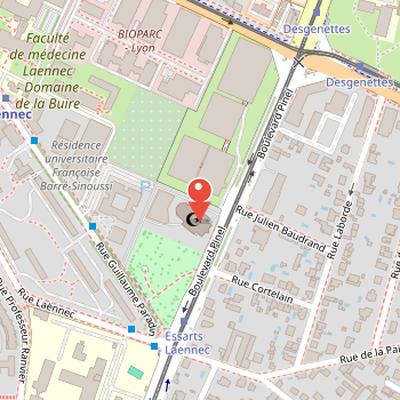
Grande Mosquée de Lyon is a Muslim religious building located on boulevard Pinel in the eighth arrondissement of Lyon, France. The project originated from the will of religious and civil leaders at the end of the 1970s, when the need for Muslims to gather in prayer rooms in Lyon was identified. The mayor Louis Pradel and Cardinal Renard suggested building a mosque in the city. In 1980, Rabah Kheliff, Kamel Kabtane, and Mohamed Tahar created the association culturelle lyonnaise islamo-française (ACLIF) to collect funds for the construction of the mosque. The project later underwent several site relocations. A first building permit was granted in 1984 and then annulled by the administrative tribunal. Designed by architect Robert Ballandras, the mosque includes prayer areas as well as cultural and leisure spaces. It also contains a library and a school, and its cultural and social role includes Arabic language teaching, a library service, an annual conference, and social assistance activities.
Nearby Objects
-
 Hôpital Desgenettes 500 m away
 -
 Hôpital Édouard-Herriot 1100 m away
 -
 Stade Vuillermet 1600 m away
 -
 Place Ambroise Courtois 1700 m away
 -
 Villa Lumière 1800 m away
Origins and Location History
The Grande mosquee de Lyon is a Muslim religious building in Lyon, France. Its origins date to the end of the 1970s, when it emerged from the will of both religious and civil leaders. The project went through several site relocations, influenced by appeals, apolitical movements, neighborhood politics, and associations. Despite these changes, the mosque was eventually officially inaugurated.
Location and Design
The Grande mosquee de Lyon is located on boulevard Pinel in the eighth arrondissement of Lyon. It was designed by architect Robert Ballandras. The building includes prayer areas as well as spaces for cultural and leisure purposes. It also contains a library and a school. A capacity is noted in the available facts, but no figure is provided.
Planning and Early Development
The need for Muslims to gather in prayer rooms in Lyon was identified at the end of the 1970s. At that time, Mayor Louis Pradel and Cardinal Renard suggested building a mosque in the city. In 1980, Rabah Kheliff, Kamel Kabtane, and Mohamed Tahar created the association culturelle lyonnaise islamo-francaise (ACLIF), whose mission was to collect funds for the mosque's construction. In 1981, Valery Giscard d'Estaing stated that the State would finance the construction of a cultural center for the Muslim community of Lyon. A first building permit was granted in 1984 by Francisque Collomb, then mayor of Lyon, but it was later annulled by the administrative tribunal for unknown reasons. The mosque later also became the subject of controversy in 2011, when leaked American documents described the site as one of Al-Qaeda's recruitment centers in Europe. Jean-Francois Carenco, the prefect of Rhone, denied the accusation, and the mosque rector described the suspicions as grave and destructive.
Cultural and Social Role
The Grande mosquee de Lyon has a cultural and social role through its library in Lyon. It also provides Arabic language teaching and instruction in the principles of Islam. Each October, it organizes an annual conference that brings together Muslim researchers and scholars. Beyond its educational activities, it operates a year-round social service for people in financial or social difficulty and has established a food bank to help those in need. The mosque also took part in heritage days for the first time in 2002.
Halal Certification Activities
At the Great Mosque of Lyon, halal certification is managed by the association rituelle de la grande mosquee de Lyon (ARGML). This certification is intended to provide secure access to products conforming to Islamic principles for the Muslim community. It covers the control and certification of halal meat, agro-food products, hygiene products, and cosmetics. The certification also authorizes the use of electronarcosis before animal slaughter, and it requires the presence of its certifiers at slaughter locations.