Musée des Confluences is a natural history and societies museum in Lyon, France, located at the confluence of the Rhône and Saône rivers. It opened on 20 December 2014 as the successor to the Musée Guimet de Lyon, which had been closed to the public since July 2007. The museum includes all collections of the Musée Guimet de Lyon and is intended to be completed with other acquisitions.
The project was launched in July 1999 by Historia, which led an international architecture competition in 2001 under the supervision of an 18-person jury. Seven teams took part in the competition, and the winning proposal came from the Austrian firm Coop Himmelb(l)au in February 2001. Their design was based on deconstructivist architecture and a large cantilever, and the project is described as having three parts: Base, cristal, and Nube. Construction of the building began in 2003. In May 2011, the museum was designated as a Museum of France by the Ministry of Culture and Communication.
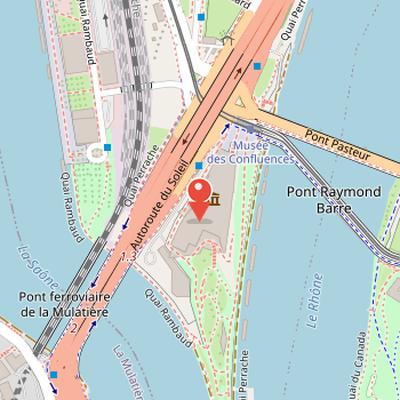
Nearby Objects
-
 Pont Raymond Barre 200 m away
 -
 La Sucrière 600 m away
 -
 Halle Tony Garnier 600 m away
 -
 P4 Laboratory - Jean Merieux 800 m away
 -
 Orange Cube 800 m away
Museum Building and Institutional History
The Musee des Confluences is a natural history and societies museum in Lyon, France, located at the confluence of the Rhone and Saone rivers. Its building was designed by the Austrian firm Coop Himmelb(l)au, and construction began in 2003. The museum opened to the public on December 20, 2014. In May 2011, it was designated a Museum of France by the Ministry of Culture and Communication.
The Musee des Confluences is the successor to the Musee Guimet de Lyon, which had been closed to the public since July 2007. It includes all of the collections of the Musee Guimet de Lyon and is planned to be completed with additional acquisitions.
Design Competition and Architectural Concept
In July 1999, Historia launched the project to create a new museum from the collections of the Museum of Lyon. The plan then moved into an international architecture competition in 2001, supervised by an 18-person jury. Seven teams took part, reflecting a wide range of proposals. Among them were a wavy structure crowned by two turns by Felice Fanuele, Peter Eisenman, and Arquitectos CRB; a single-piece glass block by Jacques Ferrier; a scheme by Steven Holl and Vurpas and asociados centered on a large cantilever; a block with a colored facade by Francois Seigneur and Sylvie Dure; and deconstructivist proposals by Carlos Ferrater and Bruno Dumetier, as well as Coop Himmelb and, in another case, Arquitecturas tectonicas and Drevet. Coop Himmelb won the competition in February 2001. Its project for Historia is described through three sets named Base, cristal, and Nube, and the design measures 90 meters wide.
Construction Delays and Site Challenges
The Musée des Confluences project obtained its first construction permit in 2003. In May 2005, the bowling alley on the museum site was destroyed, and construction later revealed that the alluvial site was unstable, floodable, and close to highway A7. These conditions led to reinforcement works costing 6,000,000 euros and caused delays.
Work began on October 10, 2006, under Bec Hermano, a subsidiary of the Fayat group. During the project, disagreements arose among Bec Hermano, Coop Himmelb, and SERL. As a result, work was stopped for seven months in 2007. Construction stopped again when Bec Hermano left the project by amicable agreement on December 4, 2008. Bec Hermano was indemnified for expenses amounting to 5 million dollars, and 8 million euros were returned to it from an advance of 14 million euros.
Construction Tender and Contract Award
In 2009, Construccion launched a tender under new conditions, but no offers were received. The company immediately relaunched the process, and the second tender attracted responses from 16 to 18 companies. Vinci and Leon Grosse were preselected for the project, and their offer deadlines were extended. Vinci submitted an offer of 117.89 million euros, while Leon Grosse submitted an offer of 99.5 million euros. In January 2010, Construccion awarded the museum construction to Vinci. SMB and Renaudat Centro Construcciones were involved in the design, production, and installation of the metalwork. Works resumed in April 2010.
Construction and Financial Controversy
The Musee des Confluences was opened by Construccion on December 20, 2014. Its inauguration took place without the President, the Prime Minister, or the Culture Minister, reflecting the tense circumstances around the project. The museum had faced repeated setbacks during construction, including a ten-year delay and a budget overrun of up to 500 percent.
The cost of the project was revised several times over the years. It was initially estimated in July 2000, then revised by the Conseil General du Rhone in 2009, and rose again in 2012 as the project moved toward completion. By the end of October 2014, the construction cost estimate had risen further, and the total cost finally became more than five times the initial expected cost. To address the enormous expense, the Conseil General had to quickly sell 63 million highway company shares in 2012. According to Lyon Capitale, these shares were valued by buyers at 460 million euros.
The financial dispute also involved a provisional penalty imposed on Vinci's construction group, which contested the amount and argued that difficulties resulted from insufficiently precise studies provided by the project administration and accepted by the Conseil General. The Conseil General temporarily showed a reduced balance that included this delay penalty. By the end of 2014, CANOL highlighted the lack of a detailed operational budget for the museum, while the Department assumed the museum would be self-sufficient despite no market study having been conducted.
Collections and Exhibition Spaces
The collections of the Museo de la Confluences originate from the Museo de Lyon, whose holdings focused on natural sciences, ethnography, and a colonial collection. The Museo de Lyon was founded in 1927 and closed in 1968. Today, the permanent exhibition of Colecciones includes the mammoth Choulans, discovered in 1859, masks from the Noh theater, a copy of Sputnik 2, and a particle accelerator. It is arranged in approximately four exhibition rooms, including Origenes, historias del mundo, Sociedades, el teatro de los hombres, Especies, la malla de los vivos, and Eternidades, visiones del mas alla. The first two temporary exhibitions were devoted to the idea of collecting, one centered on Emile Guimet and the other on the history of cabinets of curiosities. In 2002, more than 2 million objects from Colecciones were moved to the Centro de Conservacion y de Estudio de Colecciones (CCEC), which is located in a former telephone center in the 7th district of Lyon and is accessible only to researchers. During the period of construction completions, cultural programming also took place outside the museum, including the festival Mise en bouche in October 2011.
Management and Institutional Development
The administration project was initiated by the Conseil General du Rhone, which first managed it directly before it became an EPCCIC public industrial and commercial establishment. From January 2015, the project became the property of the future Metropole de Lyon. Its management cost was estimated at 13 million euros, of which 10 million euros was provided by the community. On March 19, 1999, the Conseil General du Rhone appointed Michel Cote director of Polo Science et Societe. His mission was to transform the Musee de Lyon into a museum of societies and science, and he moved from Quebec and the Musee de la Civilisation to Lyon to lead the project. Michel Cote left in May 2010 to return to Quebec and direct the Musee de la Civilisation from August 1. Hélene Lafont-Couturier then took charge of management, while also directing the Musee Galo-Romano de Fourviere and the Musee Galo-Romano de Saint-Romain-en-Gal. Bruno Jacomy became Executive Director in the summer of 2010.