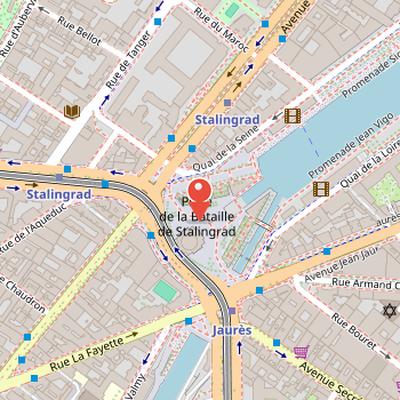
Place de la Bataille-de-Stalingrad is a square in Paris, located in the 10th and 19th arrondissements, in the quartiers of l'Hôpital-Saint-Louis and de la Villette. It was created in 1945 by detachment from boulevard de la Villette, first under the names place de l'Ourcq and rond-point de la Villette, before being renamed by municipal decree as place de Stalingrad and later place de la Bataille-de-Stalingrad. The square was redeveloped in 1988 by architect Bernard Huet. As part of this redesign, boulevard de la Villette was diverted under the elevated metro to connect the rotonde de Ledoux to the newly created place after the bus station transfer, and the rotonde was rehabilitated with restoration of the porch removed during metro creation. The square is bordered by a perimeter wall resembling the Fermiers généraux wall and contains landscaped slopes. It is also crossed by the canal de l'Ourcq bike path, described as the longest uninterrupted bike path in Île-de-France. A silver lime tree planted in 1969 to commemorate the Liberation of Paris stands on the place, surrounded by a carved marble pedestal. The square has also been identified as an important site in Paris for drug sales and consumption since the late 1980s.
Nearby Objects
-
 Cours Florent 250 m away
 -
 French Communist Party headquarters 650 m away
 -
 Théâtre des Bouffes du Nord 800 m away
 -
 Stade Bergeyre 900 m away
 -
 Hôpital Saint-Louis 1000 m away
Location in Paris
Place de la Bataille-de-Stalingrad is located in Paris, at the boundary of the 10th and 19th arrondissements. It lies within the quartiers of l'Hopital-Saint-Louis and de la Villette. This placement links the site to two administrative districts and two local neighborhoods in the city.
History and Layout of Place de la Bataille-de-Stalingrad
Place de la Bataille-de-Stalingrad was created in 1945 by detachment from boulevard de la Villette, first under the names place de l Ourcq and rond-point de la Villette. It was later renamed by municipal decree, first to place de Stalingrad and then to place de la Bataille-de-Stalingrad. In 1988, the place was redeveloped by architect Bernard Huet.
This redevelopment was linked to a reorganization of the surrounding circulation. Boulevard de la Villette was diverted under the elevated metro to connect the rotonde de Ledoux to the newly created place after the bus station was transferred. The rotonde de Ledoux was also rehabilitated, including restoration of the porch that had been removed during the creation of the metro.
The place is bordered by a perimeter wall resembling the Fermiers generaux wall, which forms landscaped slopes inside the site. It is also crossed by the longest uninterrupted bike path in Ile-de-France, known as the canal de l Ourcq path. This route runs approximately from Stalingrad to Claye-Souilly, and extends from quai de la Rapee through Stalingrad to Claye-Souilly, with some discontinuities at intersections and roundabouts.
The place also includes commemorative and artistic elements. Sculptor Georges Jeanclos received a commission for a fountain in 1988. In addition, a silver lime tree was planted on May 25, 1969, in the presence of General de Gaulle, to commemorate the Liberation of Paris. The tree is surrounded by a carved marble pedestal.
Drug Trafficking and Security
Since the late 1980s, place de la Bataille-de-Stalingrad has been described as an epicenter of the crack crisis in Paris and as an important site for drug sales and consumption, especially crack. The arrival of crack in the Halles and Pigalle neighborhoods is noted as preceding the place's rise in importance. The area is associated with so-called maudous, crack sellers mainly from West Africa who operate in the adjacent streets, on the place itself, and around and inside the Stalingrad metro station.
The physical layout of the place has also been linked to these activities. According to the provided facts, walls, narrow passages, and elevated benches around the square make it easier for sellers and users to avoid detection, while the tiered architecture allows them to anticipate police raids. The site has undergone multiple mass evacuations in the mid-1990s and early 2000s, yet it remains a significant trafficking location in Paris.
In 2013, the place and the surrounding streets were designated a priority security zone, and the presence of National Police personnel in the area increased. The facts also note a significant degradation of security conditions in the place and its surroundings.