The Unterlinden Museum is an art museum in Colmar, in the Alsace region, located in the buildings of the former Dominican convent Unter den Linden. The convent buildings were constructed in the first half of the 13th century, and the museum opened in 1853 in the remaining parts of the complex after the dissolution of the convent during the French Revolution. The museum holds a large collection of objects ranging from the Neolithic to the present, with a special focus on Upper Rhine sacred art from the Middle Ages to the Renaissance.
The history of the site includes preservation efforts by citizens of Colmar, who stored movable cultural assets in the Collège national, and later initiatives by Louis Hugot, who halted demolition in 1847 and promoted museum use of the ruins. The entire site was classified as Monument historique in 1854. In 2012, the museum underwent expansion by Herzog & de Meuron, including the former city bathhouse built in 1906 and an underground gallery beneath Rue des Unterlinden and the Mühlbach. The redesigned complex, connected to the new building Ackerhof, reopened on December 12, 2015.
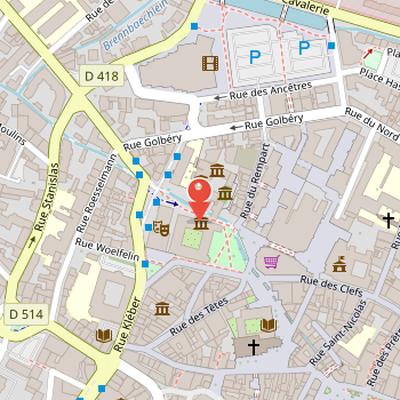
Nearby Objects
-
 Dominican Convent 160 m away
 -
 Dominikanerkirche 200 m away
 -
 Statue of Jean Rapp 350 m away
 -
 St Martin's Church 350 m away
 -
 Musée Bartholdi 400 m away
Historical Setting and Museum Site
The Unterlinden Museum is an art museum in Colmar, in the Alsace region. It holds a large collection of objects ranging from the Neolithic period to the present, and it is especially known for Upper Rhine sacred art from the Middle Ages to the Renaissance. The museum uses the buildings of the former Dominican convent Unter den Linden. These convent buildings were constructed in the first half of the 13th century. After the convent was dissolved during the French Revolution, most of the buildings were demolished. The museum opened in 1853 in the remaining parts of the convent complex.
From Monastery to Museum Complex
During the first year of the French Revolution, church properties were nationalized and the Colmarer Unterlinden Monastery was dissolved. Citizens of Colmar resisted the dissolution and stored movable cultural assets in the Collge national for preservation. In 1792, the monastery buildings became city property of Colmar, and the city then used them as military barracks. In the 19th century, the southern side nave of the church and almost all cloister buildings were demolished, but Louis Hugot stopped the demolition of the church and adjacent cloister in 1847. He also founded the Societe Schongauer to promote museum use of the monastery ruins. A Gallo-Roman mosaic found in Bergheim and stored in the monastery church helped support these plans. The new museum opened in the surviving old Dominican convent buildings on April 3, 1853, and the entire site was classified as Monument historique in 1854. In 2012, Herzog and de Meuron undertook a major expansion that included the adjacent former city bathhouse from 1906, with Art Nouveau and neo-Baroque elements. The project also added an underground gallery with three exhibition rooms beneath Rue des Unterlinden and the Muehlbach, linking to the new building called Ackerhof, named after the monastery's old farm. The redesigned complex reopened on December 12, 2015, after a project costing 44 million euros.
Collections and Expansion
The Unterlinden Museum, located at Rue d'Unterlinden No. 1 in the center of Colmar, is recognized as a Musee de France and is one of the most visited art museums in Alsace, with approximately 200,000 visitors annually. Its Sammlungen include the world-famous Isenheim Altarpiece by Matthias Grunewald from the early 16th century, along with paintings and sculptures from the late Middle Ages and Renaissance by Martin Schongauer, Caspar Isenmann, Cranach the Elder, and Holbein the Elder.
The museum also holds an encyclopedic collection of archaeological finds from the Neolithic to the Merovingian period, a collection of applied arts and folk art from the 16th to the 19th centuries, a diverse group of 19th-century paintings, and Far Eastern art from Florine Langweil. In addition, it has a large collection of modern and contemporary art that was rarely exhibited until 2012 because of limited space. After the museum reopened at the end of 2015 with 8,000 square metres of expanded exhibition space, modern and contemporary art became a permanent part of the permanent exhibition.
The expansion combines the adjacent former swimming pool, which has a neo-baroque facade, with a plain new building called Ackerhof. Designed by Herzog and de Meuron, Ackerhof has a brick facade and a gable roof.
The Former Dominican Convent of Unterlinden
The former Dominican convent of Unterlinden has historical and architectural significance, and its surviving buildings now house a museum. It was founded in 1232 by Agnes von Mittelheim and Agnes von Hergheim from Colmar, with support from Dominicans from Strasbourg, and was incorporated into the Dominican Order in 1245. During the 13th century, the convent developed an extensive monastery complex. Construction of the church began in 1252 and it was consecrated by Albertus Magnus in 1269; the church later served as a model for other monasteries. The cloister was completed in 1289.
The convent also left a written record in the sisters' book, likely written in Latin at the beginning of the 14th century by Prior Katharina von Gebersweiler. This text reports on striving for virtue, ascetic practice, and the graces of deceased nuns, reflecting mystical spirituality. In 1419, the convent joined the monastic reform movement and later contributed intellectually and personally to reforms in other monasteries. Its library expanded significantly during the 15th century. Despite historical changes in later centuries, the convent experienced no decline until its forced dissolution.
Key Works in the Collection
The museum's exhibited works include many pieces by the Colmar artist Martin Schongauer from the 15th century, including engravings that were admired by Albrecht Durer. The collection is centered on the Isenheim Altarpiece, painted by Matthias Grunewald between 1512 and 1516. Also included is the sculptural part of the altarpiece by Nicolas de Haguenau, made around 1515. The Isenheim Altarpiece was moved to the former Dominican church in Unterlinden in 1852, linking the museum's holdings to its historical setting.
Galeries and Artworks at Unterlinden Museum
The galleries of the Unterlinden Museum include a wide range of works spanning several centuries. Among the earliest are two Crucifixion works, one by the Meister der Colmarer Kreuzigung, Hermann Schadeberg, dated circa 1410 to 1415, and another created around 1480. The galleries also contain Portrait einer Frau by Hans Holbein der Aeltere from circa 1510 and Die Melancholie by Lucas Cranach der Aeltere from 1532. Later works include Le char de la mort / Der Streitwagen des Todes by Theophile Schuler from 1848, Portrait de Joseph Le Coeur by Auguste Renoir circa 1870 to 1872, and Vallee de la Creuse au soleil couchant / Tal der Creuse bei Sonnenuntergang by Claude Monet from 1889. The collection continues into the twentieth century with Nature morte au perroquet / Stillleben mit einem Papagei by Robert Delaunay from 1907, Chaumieres au printemps / Strohgedeckte Hauser im Fruhjahr by Henri Martin from 1910, Le Vase de fleurs / Die Blumenvase by Chaim Soutine from 1918, and Paysage normand / Normannische Landschaft by Pierre Bonnard from 1920. The galleries also include several works by Henri Lebert, among them Couvent des Unterlinden / Frauenkloster von Unterlinden from 1838, Vue du Haut-Landsbourg / Ansicht von Burg Hohlandsberg from 1833, and A la Wormsa / An der Wormsa from around 1828. In addition, the galleries feature important parts of the Isenheim Altar, including Heiliger Sebastian, Kreuzigung und Heiliger Johannes der Taufer, Heiliger Antonius, and Wehklage (Predella), as well as Konzert der Engel und Christi Geburt, Versuchung des Heiligen Antonius and Besuch des Heiligen Antonius beim Hl. Paulus, and sculptural figures representing Christus und die zwolf Apostel. Works from the Colmar Altarpiece by Isenmann are also present, including Die Verhaftung von Jesus, Auspeitschung, and Dornenkronung, along with Auferstehung and Verkundigung from Musee Unterlinden, Colmar.
Galerien and its Medieval and Later Works
The Galerien at the Unterlinden Museum present a wide range of works spanning from the 12th to the 19th century, with a strong concentration of medieval altar pieces and sculptures. Among the key works are the Stauffenberger Altar, created around 1454 to 1460, and Martin Schongauer's Verkundigung am Orlier-Altar from 1472. The galleries also include an altar image of the Dominicans by Martin Schongauer and workshop, the Bergheimer Altarbild from about 1510, and the Retable de Sainte Anne Trinitaire with an altar image of Saint Anne selbdritt. Other religious works include the Retable de Saint-Jean Baptiste, an altar of Saint-Georges from the 15th century, and a second altar of Saint-Georges from the same century.
The collection also preserves several earlier objects from the 12th century, including an eagle of Saint John the Baptist, the last communion of Saint Mary of Egypt, the righteous in Abraham's bosom, a lion of Saint Mark, and a Triton sculpture. Additional medieval pieces include carved oak fragments of choir stalls showing the martyrdom of Saint Lawrence from 1493 at Antoniterkomturei von Isenheim, a 14th century grave slab of a knight, and two 14th century sandstone statues from Martinsmunster, one of a prophet and one of a king. A polychrome wooden statue of the Virgin of Niedermorschwihr from around 1480 and two polychrome wooden reliefs from around 1520, one showing the Adoration of the Kings and the other the martyrdom of Saint Catherine, further reflect the museum's focus on sacred art.
The Galerien also contain later objects that broaden the historical range of the display, including a model of the high altar of the Basilica Saint-Epvre in Nancy by Theophile Klem around 1864, Auguste Rodin's Torso of a Desperate Youth from 1882 to 1899, a wardrobe from 1665, a glass harmonica from the 18th century, porcelain by Hannong in the ceramic collection, and faience by Theodore Deck from 1884.