St Martin's Church, also known as Saint-Martin de Colmar and frequently called the cathedral Saint-Martin de Colmar, is the most important religious building in the city of Colmar in Alsace. Built in the Gothic style with sandstone abundant in the Vosges, it is one of the largest Gothic churches in Haut-Rhin and the second largest Catholic building in Alsace after Strasbourg Cathedral.
The site has a long history. Before the year 1000, a provostship depended on the abbey of Munster in Colmar, and a chapel dedicated to Saint Martin was erected there. Excavations carried out in 1972 revealed earlier structures, including a sanctuary with a square apse, transept, and nave of undetermined length, dated to the 10th century. This sanctuary was destroyed by fire in 1106 and replaced by a Romanesque basilica. Master builder Humbert constructed the transept, three naves, and towers of the basilica, while architect Guillaume de Marbourg designed the choir and ambulatory. The excavations also confirmed the existence of buildings and an urban cemetery preceding the collegiate church.
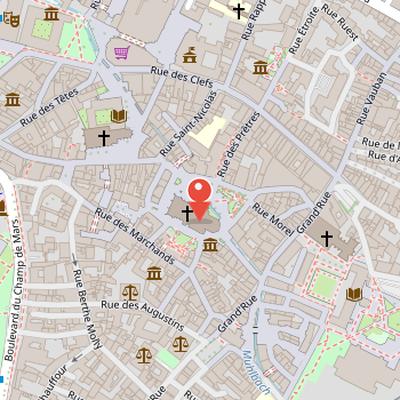
Nearby Objects
-
 Musée Bartholdi 80 m away
 -
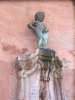 Manneken-Pis de Colmar 160 m away
 -
 Dominikanerkirche 150 m away
 -
 Dominican Convent 200 m away
 -
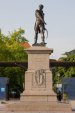 Statue of Jean Rapp 300 m away
Status and Importance
St Martin's Church in Colmar, also known as the collegial church Saint-Martin de Colmar and frequently called cathedral Saint-Martin de Colmar, is the most important religious building in the city of Colmar in Alsace. It is one of the largest Gothic churches in Haut-Rhin and the second largest Catholic building in Alsace after Strasbourg Cathedral. Its size and status give it a prominent place in the religious and architectural heritage of the city.
Early History and Medieval Development
Before the year 1000, a provostship in Colmar depended on the abbey of Munster. In this context, a chapel dedicated to Saint Martin was erected in the city. Excavations carried out in 1972 uncovered the remains of a sanctuary dated to the 10th century, with a square apse, a transept, and a nave of undetermined length. Historical accounts state that this sanctuary was destroyed by fire in 1106.
It was then replaced by a Romanesque basilica. Master builder Humbert was responsible for the construction of the transept, the three naves, and the towers of this basilica, while architect Guillaume de Marbourg designed the plans for the choir and ambulatory. Three years after its construction, part of the basilica was modified with the addition of an original bulb lantern.
Archaeological Findings Around the Church
The 1972 excavations confirmed that several buildings had existed before the collegiate church. Among the remains was an Ottonian plan structure dated to the 10th century. A preventive excavation campaign was launched in May in connection with the pedestrianization of Cathedral Square, and its first phase ended in September. Excavations on the south and north sides of the collegiate also confirmed the presence of an urban cemetery, which written sources place in the 12th century. In addition, archaeologists discovered a wall built of large cobbles and sandstone rubble bound with lime mortar. This structure may have been part of a fortification wall, and it is related to a cemetery enclosure wall said in written sources to have been built by the town's bourgeois in 1212. The newly found wall is described as the first of its type excavated in Alsace.
Architecture and Interior Features
St Martin's Church in Colmar is built in the Gothic style using sandstone abundant in the Vosges. The stone shows different shades, reflecting its origin in several quarries. The church has a nave with five elongated bays, separated by cylindrical piers with four colonnettes, and these colonnettes come from the Saint-Thomas church in Strasbourg. Its roof is covered with beaver tail tiles and a colored tiled surface reminiscent of the collegiate church Saint-Thiébaut of Thann.
The exterior is marked by many portals, some of them walled up, and the largest ones have richly decorated tympana. The central portal is especially notable for its tympanum with two registers showing the Adoration of the Magi and Christ of the Last Judgment, as well as an openwork gable. The facade also has massive pillars of a rather rare architectural style, which give the building a heavy appearance in contrast to the airy look of the apse windows.
Inside, the church was damaged during the French Revolution, and it now appears stripped because the furniture installed in the 18th century was removed. Despite this, it still preserves important works, including sculptures such as an altar and Virgin Mary figures from the Middle Ages, as well as stained glass windows, among them a beardless Christ's head above the north portal from the early 14th century.
The Virgin of the Rose Bush
For many centuries, St Martin's Church housed the Virgin of the Rose Bush, a painting created in 1473 by Martin Schongauer. The work remained associated with the church until it was stolen in 1972. It was accidentally found the following year, in 1973, and is now kept in the church of the Dominicans. This history links the church to one of the best known works connected with its interior.
The Bells of St Martin's Church
After the fire of 1572, the bells of the collegiate church of Colmar were recast by a founder from Bern. The bells were then removed and transported by water to Strasbourg for melting, although the Zwoelferglocke and Rathglocke were temporarily left in place. They were replaced by four new bells commissioned by priest Louis Maimbourg and made by Jean-Louis I Edel in Strasbourg. The present bell set reflects several later castings and additions from different foundries. The Christ et Eglise bell in G2 and the Marie bell in D3 were cast at the Bachert foundry in Karlsruhe, Germany, while the Martin bell in B flat 2 was cast in 1819 by Jean-Louis Edel in Strasbourg. Three bells, Anges et Archanges in F3, Jeanne d'Arc in G3, and the small bell Jeanne d'Arc in G4 in the bell turret, were cast at the Schilling foundry in Heidelberg, Germany, with the turret bell cast in 1979. Additional Schilling bells were added in 1978: Saints et Saintes de Dieu in B flat 3, Andre in C4, and Jean-Marie Vianney in D4. Together, these bells show a layered history of replacement and renewal spanning several centuries.