Musée Bartholdi is an art museum in Colmar, located in the birthplace of Frédéric-Auguste Bartholdi. Dedicated to the life and work of the painter and sculptor, it presents the largest collection of his works on 700 m² of exhibition space. The museum occupies the birth house of Auguste Bartholdi (1834–1904), at 30, Rue des Marchands, in a building that dates mostly from the second half of the 17th century and is listed in the Base Mérimée.
The building was transferred to the city of Colmar by Jeanne-Émilie Bartholdi on July 25, 1907, with the condition that it be converted into a museum after her death. She died in October 1914, and the First World War delayed the opening. The museum was inaugurated on November 18, 1922. Its collection is displayed on three floors and includes Bartholdi’s bronze group Die großen Stützen der Welt in the courtyard, Alsace-related exhibits, recreated living rooms from the Paris apartment at 82, Rue d’Assas, and a model hall with ceramic and bronze works. The second floor is dedicated to Bartholdi’s designs and models for the Statue of Liberty.
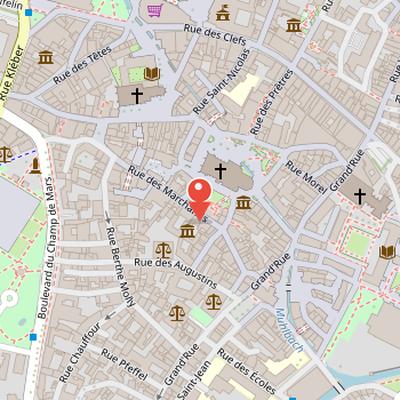
Nearby Objects
-
 St Martin's Church 80 m away
 -
 Manneken-Pis de Colmar 100 m away
 -
 Dominikanerkirche 200 m away
 -
 Dominican Convent 250 m away
 -
 Statue of Jean Rapp 250 m away
Musee Bartholdi in Colmar
Musee Bartholdi is a museum in Colmar dedicated to the life and work of painter and sculptor Frederic-Auguste Bartholdi. It is located in his birthplace and presents the largest collection of his works across 700 square meters of exhibition space. The second floor is devoted to Bartholdi's designs and models of the Statue of Liberty.
The Bartholdi Museum Building and Its Creation
The musee Bartholdi is located in the birth house of Auguste Bartholdi (1834-1904) at 30, Rue des Marchands in Colmar. The building dates mostly from the second half of the 17th century and is listed in the Base Merimee. Its transformation into a museum was linked to Jeanne-Emilie Bartholdi, who transferred the building to the city of Colmar on July 25, 1907 and required that it be converted into a museum after her death. She also specified that it should be furnished with sculptures, furniture, and artworks from 82, Rue d'Assas in Paris. After her death in October 1914, the First World War delayed the opening of the museum. The musee Bartholdi was finally inaugurated on November 18, 1922.
Exhibitions Across Three Floors
The museum presents its collection across three floors, with exhibits organized by theme and by floor. In the courtyard, it displays Bartholdi's bronze group Die großen Stutzen der Welt, which includes two male figures representing a worker and a soldier, together with a female figure symbolizing Justitia. The ground floor is devoted to Bartholdi's Alsace-related exhibits. On the first floor, visitors find recreated living rooms from the apartment at Rue d'Assas 82 in Paris, as well as a large portrait of Bartholdi's mother, Charlotte Bartholdi, painted by Ary Scheffer in 1855 in the reception hall. The same floor also includes a portrait of Auguste Bartholdi and Jeanne-Emilie by Jean Brenner, and a model hall with ceramic and bronze models and designs of French public monuments, including studies for the Lion of Belfort from 1880. The first room is dedicated to sculptures and models related to Bartholdi's work for the Statue of Liberty and his connections with the United States, including the Statue of La Fayette and a bronze group showing Washington and La Fayette. The second room focuses on Bartholdi's possible Freemasonry membership and on busts of key supporters of the Statue of Liberty, including Edouard Rene Lefebvre de Laboulaye, William Maxwell Evarts, and Pierre Eugene Secreta.
Models of the Statue of Liberty
In the third room, the museum presents the construction of the Statue of Liberty through models from several stages of development. It also displays an original-size plaster model of the statue's left ear and hair. This plaster model is described as the only surviving material evidence of the workshop manufacturing process. The original wood and plaster models used during the construction of the copper statue were destroyed during the work.