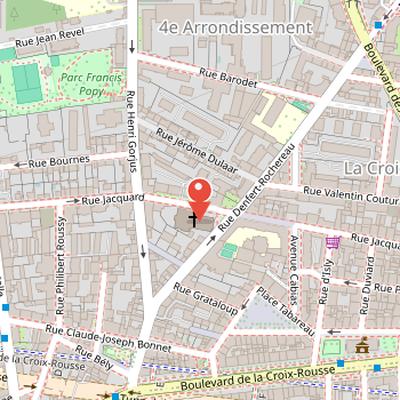
Église Saint-Augustin de Lyon is a church dedicated to Catholic worship in the 3rd arrondissement of Lyon, located at the intersection of rues Denfert-Rochereau and Jacquard. It is the most recent parish sanctuary in the district, apart from the church Sainte-Élisabeth. The Saint-Augustin parish was erected under the archiepiscopate of Cardinal de Bonald by decree of Prince-President Louis-Napoléon Bonaparte, before the attachment of Cuire-la-Croix-Rousse commune to Lyon. Its foundation reflected an archiepiscopal will to accompany the city’s worker and industrial development with clerical support, within a broader religious framework designed for the Canuts. The parish name recalls the installation of Discalced Augustinians on the Croix-Rousse plateau in 1624. The present church was built by architect Augustin Chomel from 1910 to 1912 on land acquired in the early 1880s, replacing an earlier church that had disappeared. It was renovated in 2017–2018. The building has a Latin-cross plan, follows a basilical model, and combines neo-Romanesque and Byzantine references with an economical use of materials and restrained ornamentation.
Nearby Objects
-
 Cité scolaire Antoine-de-Saint-Exupéry 500 m away
 -
 Gare de Lyon-Croix-Rousse 550 m away
 -
 Institution des Chartreux 550 m away
 -
 Church of Saint-Bruno des Chartreux 550 m away
 -
 Bon-Pasteur Church 600 m away
Location and Parish Role
Eglise Saint-Augustin de Lyon is a church dedicated to Catholic worship in the 3rd arrondissement of Lyon. It stands at the intersection of rues Denfert-Rochereau and Jacquard. Within the 3rd arrondissement, it is the most recent parish sanctuary apart from the church Sainte-Elisabeth, which places it among the newer religious buildings in this part of the city.
Parish Formation and Church History
The Saint-Augustin parish of Lyon was created under Cardinal de Bonald by decree of Prince-President Louis-Napoleon Bonaparte. Its foundation came before the attachment of the commune of Cuire-la-Croix-Rousse to the city of Lyon, and it was part of an archiepiscopal effort to accompany worker and industrial development in the suburb with clerical support. In this respect, Saint-Augustin joined other parishes in Lyon that formed a religious framework intended for the Canuts. The parish name recalls the installation of the Discalced Augustinians on the Croix-Rousse plateau in 1624. It also refers to the former Saint-Denis church, whose current nave was built by the Discalced Augustinians and which became parochial during the Revolution, temporarily taking the name Saint-Augustin.
The parish was equipped with a church at the corner of Denfert-Rochereau and Valentin-Couturier streets. The original church later disappeared after the construction of the current building, designed by architect Augustin Chomel and built from 1910 to 1912 on land acquired in the early 1880s. The first stone of the present church was blessed, and the church was later consecrated by Dechelette, auxiliary bishop of Lyon. The four bells were named Elisabeth, Michelle, Isabelle, and Amelie. Sainte-Elizabeth parish, founded in 1942 under a different historical and urban logic, was merged with Saint-Augustin parish in the early 1990s. The church building was renovated in 2017-2018.
Architecture and Interior Design
The Church of Saint Augustine in Lyon is laid out on a Latin cross plan and follows a basilical model in both elevation and spatial organization. It was designed to be economical while also recalling the primitive church associated with Saint Augustine through its basilical form. The building combines influences from Roman basilicas, Norman Romanesque art, and Byzantine decoration in a sober eclectic style.
Its construction used slag concrete for economic reasons, and the exterior relies on lines and layered volumes rather than rich ornamentation, a quality especially visible at the chevet. The facade includes a neo-Romanesque portal with a mosaic on the tympanum and a statue of the bishop of Hippo. It also features a serliana beneath a colossal round arch, recalling the church of Saint-Joseph des Brotteaux by Gaspard Andre, and it has similarities to the Saint-Pierre de Montrouge church in Paris by Joseph Vaudremer.
Inside, the church has a central nave with side aisles and a colonnade supporting round arches. Light enters abundantly through the lateral naves and the upper level of the main vessel. The roof is covered with exposed framework. The bell tower stands at the crossing of the transept and shows Romanesque influence. The apse once contained a golden fresco in the cul-de-four imitating the rich mosaics of Constantinople or Ravenna, and a ciborium over the main altar at the transept crossing was later removed, changing the perception of the liturgical choir.
Interior Artworks and Decorative Elements
The church contains several notable pieces of mobilier et oeuvres d'art. These include the mosaic in the tympanum of the entrance portal by J. Schultz, showing Christ visiting a silk workshop, as well as another mosaic in the tympanum of the main door by the same artist. Other works include a stained glass window of Saint Joan of Arc by the Nicod and Jubin workshop, an apse fresco by Philippe Repelin, and the painting Saint Augustin and the child with a shell by Louis Cretey. The interior also includes the Grandes Orgues Saby.