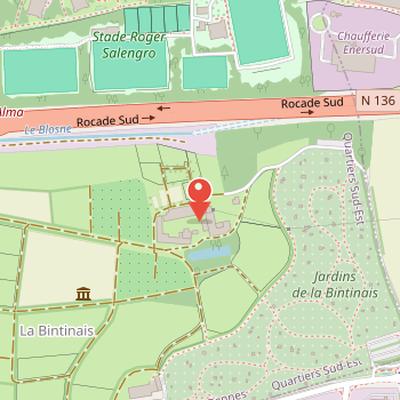
The Écomusée de la Bintinais is an ecomuseum in the south of Rennes, established in the old farm of La Bintinais near the capital of Brittany. Renamed by decree of the French Ministry of Culture in December 2020, it was known as the Ecomuseo del país de Rennes until that date. The institution holds the designation Museo de Francia.
Created in 1987 as part of the Museo de Bretaña, the ecomuseum shares collections and some services with that museum. It occupies the main building of the Bintinais farm, on a site covering 60 hectares. The farm is described as one of the most important agricultural exploitations in the department of Ille-et-Vilaine and one of the oldest, with a history spanning seven centuries. Its history reflects rural life and relations between the city and the countryside.
The museum’s exhibition traces the evolution of the country of Rennes to the present day. It presents themes related to people and history, architecture, agriculture, daily life, and rural-urban relations, using recreated artifacts, objects, machines, clothing, furniture, models, audiovisuals, interactive games, and films. It also includes two kitchens from 1866 and 1901, a large cider cellar, and old two-wheeled carts used for carrying goods. One temporary exhibition is organized each year, lasting an average of nine months.
Nearby Objects
-
 Église Sainte-Thérèse de Rennes 1700 m away
Location and Heritage Role
The Ecomusee de la Bintinais is an ecomuseum located in the south of Rennes, on the site of the old farm of la Bintinais near the capital of Brittany. It was known as the Ecomuseo del pais de Rennes until December 2020, when it was renamed by decree of the French Ministry of Culture. The museum holds the designation Museo de Francia. Its aims are to valorize the heritage of the country of Rennes, educate visitors, preserve heritage, and connect cultural actors in the territory.
History and Role of La Bintinais
La granja de la Bintinais covers 60 ha and is described as one of the most important agricultural exploitations in the department of Ille et Vilaine, whose capital is Rennes. It is also presented as one of the oldest agricultural exploitations, with a history spanning seven centuries. According to the provided facts, its history reflects rural life and the relationships between the city and the countryside. The Ecomusee was created in 1987 as part of the Museo de Bretana, and it shares collections and some services with that museum.
Exhibition and Collections
The museum occupies the main building of the Bintinais farm and covers an area of 1,200 square meters. Its exhibition traces the evolution of the country of Rennes up to the present day, with a focus on people and history. The display covers themes such as architecture, agriculture, daily life, and rural-urban relations. It presents recreated artifacts, objects, machines, clothing, furniture, and models that illustrate this evolution. The museum also uses audiovisual materials, interactive games, and films.
Among the preserved elements are two kitchens recovered from 1866 and 1901, a large cider cellar, and old two-wheeled carts used for carrying goods.
Temporary Exhibitions and Public Representations
The Ecomuseo de la Bintinais organizes one temporary exhibition each year, and these exhibitions last an average of nine months. Scenographers are involved in their preparation. The site also hosts parties and representations that are part of its public programming. These representations are described as authentic testimonies of popular practices and knowledge. Demonstrations invite attendees to take part and to explain techniques, making the activities participatory as well as educational. In addition, the animations help stimulate the recovery of activities such as cider production.
Genetic Reserve and Farm Animals
The Reserva genetica at the Ecomusee houses 19 native Breton and western French domestic animal breeds. Among them are the Poule de La Fleche chicken and the Breton Horse. Other breeds specifically identified at the site include the Cotentin donkey, the Ouessant sheep, and the Coucou de Rennes chicken. The animals are kept in stables, sheepfolds, henhouses, and pigsties, reflecting the agricultural setting of the ecomusee and its role in maintaining local domestic breeds.
The Genetic Reserve at the Ecomuseum
At the Ecomusee de la Bintinais, the Reserva genetica combines plant collections with interpretative themed routes as a plant genetic reserve. It covers 19 hectares and presents Breton agricultural practices alongside cultivated plants. The reserve focuses on crops and varieties that changed over time, including ancient plant varieties replaced by more productive or system-adapted ones. Its scope includes large crops, fruit trees, and vegetables at a local scale.
The reserve offers a tour showing more than twenty traditional and modern cultivated plants. Traditional crops on display include flax, hemp, and buckwheat, while modern vegetables introduced since the 1960s include maize, rapeseed, and phacelia. It also studies and conserves local cider apple varieties to prevent genetic loss. Three fruit tree orchards manage about 120 apple varieties from Rennes and the surrounding area, and the collection is completed by pear and cherry varieties.