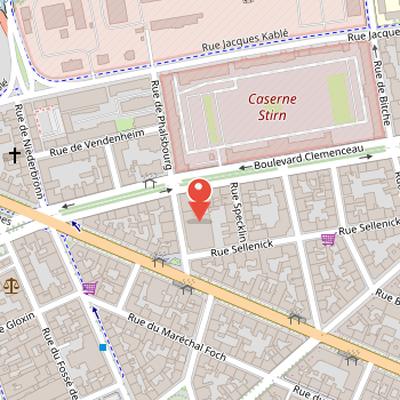
Palais des Fêtes is a concert hall in Strasbourg’s Neustadt district, located at the corner of 5 rue Sellénick, 2-4 rue de Phalsbourg, and 34 boulevard Clemenceau. Commissioned in 1897 by the Straßburger Männer Gesangverein, it was completed in 1903 and later became one of the central places for cultural life in Strasbourg and the surrounding region. The hall originally formed part of a larger Sängerhaus ensemble designed by Richard Kuder and Joseph Müller, with a planned concert hall, restaurant, rehearsal room, and library. Its architecture combines neo-Gothic and neo-Renaissance elements, including gables and corner turrets. Palais des Fêtes remained Strasbourg’s main concert hall until the Palais de la Musique et des Congrès opened in 1975. It has been listed as a historic monument since 2007 and underwent a complete renovation between 2012 and 2020. Concerts have resumed there after the works. The hall is also one of the rare venues in France with a pipe organ, inaugurated in 1909 and currently under restoration.
Nearby Objects
-
 Saint-Pierre-le-Jeune Catholic Church 300 m away
 -
 Palais du Rhin 400 m away
 -
 Place de la République 550 m away
 -
 Monument aux morts 550 m away
 -
 Synagogue de la Paix 550 m away
Palais des Fetes in Strasbourg
The Palais des Fetes is a 1,200-seat concert hall in the Neustadt district of Strasbourg, at the corner of 5 rue Sellenick, 2-4 rue de Phalsbourg, and 34 boulevard Clemenceau. It was commissioned in 1897 by the Straßburger Manner Gesangverein and served as the main concert hall in Strasbourg until the Palais de la Musique et des Congres opened in 1975. The building has been listed as a historic monument since 2007.
The hall underwent a complete renovation between 2012 and 2020, after which it once again began hosting concerts. It is also notable for having a pipe organ, a rare feature among halls in France, and this organ was inaugurated in 1909. The pipe organ is currently under restoration.
From Sängerhaus to Palais des Fetes
The history of the Palais des Fetes begins with the Strasbourg male choral singing association der StraBburger Manner Gesangverein, founded in 1872 in Elsass-Lothringen. The association later created the Federation des chanteurs d'Alsace-Lorraine in 1890 and, from 1897, received financial support from the German ministry and private donations to commission a Sängerhaus. The planned building was intended to include a concert hall with 1750 seats, a restaurant, a rehearsal room, and a library.
Designed by the architects Richard Kuder and Joseph Muller, the building ensemble was completed by September 1903 after the association obtained a construction permit. It was among the first reinforced concrete constructions in Strasbourg, with ceilings and floors made by the company of Edouard Zublin. After 1903, numerous modification permits were requested for the building by Muller, Zublin, Florent Rudloff, and Osterloff.
After completion, the Sängerhaus became a central place for cultural life in Strasbourg and the region. It hosted the Fete musicale d'Alsace-Lorraine in the 1920s. Since 1922, after reverting to France, the Palais des Fetes has belonged to the City of Strasbourg. The building also extends to 2 rue de Phalsbourg/34 boulevard Clemenceau in the Marseillaise wing, and this extension currently houses the Centre choregraphique de Strasbourg.
Architecture and Style of Palais des fetes
Palais des fetes was built in 1903 by Joseph Muller and Richard Kuder. The architects chose to combine several styles, including neo-Gothic and neo-Renaissance elements, giving the building gables and corner turrets in those styles. It also includes Art Nouveau features, such as its windows and balcony, and contains a large concert hall designed in Art Nouveau style. The building was closed from 2012 to 2020 and underwent a complete renovation during that period. After exterior restoration work, further renovations were carried out on the interior, roofing, and courtyard facade.
The Organ of the Great Concert Hall
In 1903, Dr Ehrissmann proposed adding an organ to the great concert hall at the Palais des fetes. A committee of experts, including Alexandre Guilmant, Eugene Gigout, Max Reger, Karl Straube, Louis Vierne, and Charles-Marie Widor, selected a pneumatic organ. Its creation was supervised by Marie-Joseph Erb, Emile Krupp, and Albert Schweitzer, and Dr Schweitzer entrusted the work to Dalstein-Haerpfer. The instrument was designed as a concert organ with 56 stops and 3912 pipes, including 3550 metal pipes.
The organ was inaugurated by two magistral concerts featuring a symphony by Erb and Widor's Sinfonia sacra, Op 81. Recitals by Gigout and Joseph Bonnet followed the opening events. In 1958, Muhleisen electrified the transmission and installed a mobile console, which was turned toward the audience and modeled after Saint-Sulpice in Paris. The manufacture carried out restorations in 1981 and 2001. Over time, the organ developed many silent stops and lost performance quality over about fifteen years, leading the city of Strasbourg to initiate a major restoration project.
Collectif Palais des Fetes
Collectif Palais des Fetes brings together about thirty cultural actors from Strasbourg and its region. The group works to promote and organize cultural events at Palais des Fetes, and it also aims to reopen the building to the general public. As part of these efforts, the collective will organize a festival for the 120th anniversary of the Palais des Fetes building. This festival is intended to correspond to the old Strasbourg music festival that was held at Palais des Fetes.