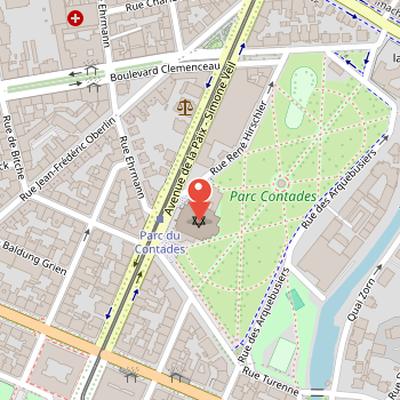
The Synagogue de la Paix is the great synagogue of Peace, a Jewish consistorial cult and cultural building in Strasbourg. It is located in the residential neighborhood of Parc du Contades in Neustadt, bordered by avenue de la Paix, rue du Grand-Rabbin-René-Hirschler, and rue de Turenne. The building also houses a community center, the seat of the Israelite community of Strasbourg, and the grand rabbinate of Bas-Rhin.
Built after the Second World War, it replaced the old consistorial synagogue on quai Kléber, which existed from 1898 to 1940 and was pillaged and burned by the Nazis. According to the history of the site, survivors of the Jewish community gathered in 1945 around grand rabbi Abraham Deutsch to rebuild a place of worship. After temporary oratories were used, negotiations with the municipality led to the exchange of the quai Kléber land for a plot southwest of Contades park. The new synagogue was entrusted to Claude Meyer-Lévy, assisted by Jean-Paul Berst and René Heller. Its modern style incorporates traditional symbols, including a vault supported by twelve concrete columns representing the twelve tribes of Israel, and a basilical plan.
Nearby Objects
-

-
 Monument aux morts 400 m away
 -
 Place de la République 400 m away
 -
 Palais du Rhin 400 m away
 -
 Palace of the Alsace-Lorraine Diet 450 m away
Location and Historical Background
The Synagogue de la Paix is a great synagogue and a consistorial Jewish building with both religious and cultural functions. It was built after the Second World War to replace the old consistorial synagogue on quai Kleber, which had existed from 1898 to 1940 and was pillaged and burned by the Nazis. The building is located in Strasbourg, in the residential neighborhood of Parc du Contades in Neustadt. It is bordered by avenue de la Paix, rue du Grand-Rabbin-Rene-Hirschler, and rue de Turenne, the last of which was inaugurated in 1962. The site also houses a community center, the seat of the Israelite community of Strasbourg, and the grand rabbinate of Bas-Rhin.
Rebuilding the Synagogue after 1945
After 1945, survivors of the Jewish community of Strasbourg gathered around Grand Rabbi Abraham Deutsch to rebuild a place of worship. Until 1948, the ORT vocational school and then the Palais des Fetes on rue Sellenick served as temporary oratories. In 1948, the city of Strasbourg provided the community with a building from the former arsenal at place Broglie. This Renaissance edifice, with a volute gable, stood in the courtyard of the former Franciscan convent of Sainte Claire, which had been converted into an arsenal and cannon foundry during the Reformation. A large hall with a gallery had been designed there by Lucien Cromback, architect and president of the Consistoire israelite, and since the construction of the great synagogue this hall has housed the Catholic Garrison Chapel of place de Strasbourg.
From 1948 to 1952, the municipality and the Jewish community negotiated the reconstruction of a permanent synagogue. The community exchanged the quai Kleber land for an equivalent plot southwest of Contades park, facing avenue de la Paix. The reconstruction project was entrusted to Charles Ehrlich, president of the Administrative Commission. After an architectural competition and brief participation by Charles-Gustave Stoskopf, Claude Meyer-Levy was selected as architect, with Jean-Paul Berst and Rene Heller assisting him. Construction began on the new building, which was later inaugurated and consecrated.
Architecture and Liturgical Features
The nouvelle grande synagogue is designed in a modern style that incorporates traditional symbols. Its basilical plan is organized around a vault supported by twelve concrete columns, each representing one of the twelve tribes of Israel. The facade includes starry openwork and a portal that also symbolizes the twelve tribes of Israel. Ironwork for the building was made by Gilbert Poillerat, and several interior and exterior elements, including the side doors on the parvis, the Holy Ark, candlesticks, the tevah, stalls, and mourning lamps, were produced in his workshops. The candlestick in the Youth Oratory was made by ORT Strasbourg students based on a design by Poillerat. The curtain of the Holy Ark is an Aubusson tapestry based on a cartoon by Jean Lurcat. The synagogue can accommodate worshippers and follows Ashkenazi and Judeo-Alsatian rites. Its liturgical music includes an organ and a men's choir called Le Chant Sacre.
Community Spaces and Later Renovations
The Synagogue de la Paix complex includes a community center and several oratories, making it more than a single worship space. The Rene-Hirschler Hall extends from the main nave and is separated from it by a movable partition. It is used for large festivals, conferences, and meals, showing how the building accommodates both religious and communal functions.
Several specialized spaces are integrated into the complex. The Leo-Cohn oratory is located in the basement party hall of the community center and was installed during the repatriation of North African Sephardic Jews. The Raphael-Weiler oratory is used for youth services with Ashkenazi rite and Judeo-Alsatian airs or those of Rabbi Shlomo Carlebach. The building also includes a Youth Center with chaplaincy services, classrooms, youth movement offices, and a foyer-bar, along with administration and social work offices for the Strasbourg Jewish community.
The site previously housed the Restaurant Chalom, once the only kosher restaurant in Strasbourg, which ended operations in the 1990s. In the 2000s, the community premises underwent major rehabilitation. During these renovations, the Grand-Rabbin-Max-Warschawski cultural space was created and named after Strasbourg's former chief rabbi, who served from 1970 to 1987. This space now hosts Jewish youth associations, including Radio Judaica, the Noah Center, Bnei Akiva, Eclaireuses Eclaireurs Israelites de France, and Jewish student associations.
The redevelopment also changed the layout of the complex: the new Sephardic synagogue Rambam was built on the former courtyard of the community center and replaced the Leo Cohn oratory.