Parc du Grand-Blottereau is an urban park whose history is tied to the former lordship of Grand-Blottereau. The area belonged for centuries to the bishops of Nantes, after earlier medieval changes in ownership, before lordships such as Grand-Blottereau and Petit-Blottereau were created in the prairie of Mauves. Over time, the domain passed through the hands of several families, including Robert de Sesmaisons, Guillaume Baborin, Pierre Raboceau, Pierre de Montigné, Jean du Ponceau, and the Juchault family.
In 1741, Louis Christophe Juchault sold the lordship to Gabriel Michel, who had a castle built between 1742 and 1747 from plans by an unknown architect. Later, the domain was sold to Guillaume Seigne in 1762, and in 1823 it belonged to Catherine Budan after succession. The site also includes historical references to Notre-Dame de Toutes-Aides, a chapel said to have been founded by Constance de Normandie and later rebuilt and replaced. The park therefore reflects a long sequence of ecclesiastical, seigneurial, and architectural history.
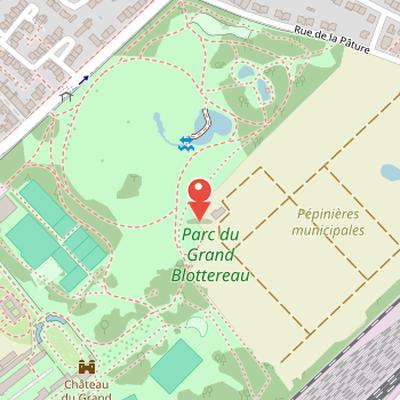
Nearby Objects
-
 Château du Grand-Blottereau 250 m away
From Episcopal Domain to Private Lordship
Since the barbarian invasions, the parish of Doulon, which included Grand-Blottereau, belonged to an episcopal domain. In the 11th century, Harscoet de Saint-Pierre, lord of Retz, appropriated a large part of this domain, but the threat of excommunication following the decisions of the Council of Rome in 1049 led him to return Doulon to the bishops in 1104. The parish remained property of the bishops until the Revolution. Under pressure from the Duke of Brittany, the bishops ceded their domains to wealthy families, and new lordships such as Grand-Blottereau and Petit-Blottereau were created, extending into the prairie of Mauves.
In the second half of the 12th century, Constance de Normandie, Duchess of Brittany, owned the manor of Petit-Blottereau. She is also said to have founded a chapel dedicated to the Virgin Mary, Notre-Dame de Toutes-Aides. This small chapel was rebuilt around 1610 and later replaced by a new church at the end of the 17th century. The lordship itself is documented under a series of owners: Robert de Sesmaisons in 1405, Guillaume Baborin from 1428 to 1443, Pierre Raboceau in 1453, Pierre de Montigne in 1505, Jean du Ponceau in 1560, Bertrand, then Guy Glee and Jeanne de Bouille in 1602, and Christophe Juchault de Lamoriciere in 1635. In 1741, Louis Christophe Juchault sold the lordship to Gabriel Michel for 300,000 livres.
Castle and Park History
The castle at parc du Grand-Blottereau was constructed between 1742 and 1747, but the original architect plans are unknown. The plans have been said to have been wrongly attributed to Jean-Baptiste Ceineray, who was about 20 years old at the beginning of the construction. Jacques V Gabriel and Germain Boffrand are also mentioned in connection with the castle. In 1762, the domain was sold by Historique to Guillaume Seigne, whose family was present in the forges of the country of Chateaubriant. Guillaume Seigne then built large outbuildings to the west of the castle.
By 1823, the property belonged to Catherine Budan through succession. She was the spouse of Jean Augustin-Joseph Sioc'han de Kersabiec, mayor of Doulon under the Empire. Catherine Budan later sold the castle and the adjacent park to Louis-George Law de Lauriston. Thomas Dobree bought the domain in 1835 and gave it to Jane Wilhelmine Walsh in 1836.
The setting of the park changed in 1851, when the inauguration of the railway line from Paris took place at the southern limit of the park. This railway line isolated the park from the Mauves meadow and caused the castle to lose its unobstructed view of the Loire after 1851.
Inheritance and Ownership
In 1895, Thomas DobrEe died without an heir and named Hippolyte Durand-Gasselin as his legatee. Durand-Gasselin was an industrialist and banker born in 1839 and died in 1929. He was also the son of the architect Hippolyte Durand, who lived from 1806 to 1888. This succession marked an important stage in the history of the parc du Grand-Blottereau through its transfer to a new owner.
Early 20th-Century Uses and Transformations
In 1902, Meunier built a tropical greenhouse at Historique according to the wishes of Durand-Gasselin. The greenhouse was placed under the responsibility of the agronomy colonial chair at the Nantes business school, linking the site to teaching and colonial agricultural studies. In 1905, Hippolyte Durand-Gasselin donated the castle and park to the city of Nantes, on the condition that an exotic garden and a colonial museum be created at Historique. During World War I, part of the lands was used by the municipality to help with food shortages. Potato plots were planted on the site, and the operation made use of German prisoner-of-war labor. In 1917, the American army installed a military hospital at Historique, adding another temporary function to the park during the war years.
Historical Uses and Later Redevelopment
Parc du Grand-Blottereau has a history marked by repeated changes of use. In 1927, the city created a floral nursery called the fleuriste municipal. During the interwar period, the barracks were occupied by needy families, and at the beginning of World War II the site housed two British companies. During the occupation, the Germans constructed a blockhouse near the chateau. After the Liberation, the barracks sheltered bombing victims from Nantes, and from 1962 they housed repatriates from Algeria.
The chateau also had several institutional functions. From 1945 to 1961, it housed a maison de l'Enfance managed by an association helping orphaned children. A horticultural training center created in 1933 moved in 1957 to the castle dairy premises, while a gymnasium was built near the main park entrance in 1957 for the Societe de Gymnastique et des Sports Athletiques of Doulon and was named Gymnase Raphael Lebel in 1968.
The educational and museum functions of the site continued to evolve in the late 1960s and early 1970s. The colonial museum collections were transferred to the chateau des ducs de Bretagne in the late 1960s, and the chateau was classified as a historical monument by an official decree in the same period. In 1970, the municipality took over the tropical greenhouses after the closure of the agronomy section of the School of Commerce. The horticultural training center became a private horticultural high school in 1971, later joining the lycee Jules-Rieffel of Saint-Herblain by fusion, with 230 students recorded in 2004.
The barracks were demolished in the 1970s, and 80 families were relocated to new HLM housing estates. After these demolitions, the park was expanded to its current size.
Current Uses and Facilities
The Parc du Grand-Blottereau forms part of a municipal domain in Nantes and is described as the largest park in the city. Today, the site houses the Service des Espaces Verts et de l'Environnement (SEVE) of the city of Nantes, as well as the lycee horticole Le Grand Blottereau. This school is part of the green education center shared with the lycee and CFA Jules Rieffel in Nantes metropolis. It welcomes middle school students for agricultural education, trains students for CAP, professional baccalaureates, and BTS in horticultural production and landscaping except BTS, and also receives early education classes and adults for training.
The park has been developed with an exotic design related to tropical greenhouses, and it is planned to eventually host environments from the five continents. Alongside these educational and landscape functions, the site also includes several sports facilities. These comprise the Raphael-Lebel gymnasium, two football fields, one rugby field, one cricket field, five tennis courts, one petanque field, two basketball courts, and one handball court. The combination of horticultural education, municipal services, landscaped design, and sports infrastructure gives the domain a varied public role within Nantes.