École supérieure d'art et design Le Havre-Rouen is an art academy and public cultural cooperation establishment linked to the historic art schools of Rouen and Le Havre. In Rouen, the regional art school was created by painter Jean-Baptiste Descamps in 1741, officially recognized in 1750, closed during the Revolution, and reopened in 1804. After a fire destroyed the school and Philippe Zacharie's workshop in the Rouen antiquities museum, it moved to Place de la Haute-Vieille-Tour. Following World War II bombings, it was temporarily housed at Aître Saint-Maclou, a former burial place for plague victims from the Middle Ages, before moving in 2014 to a former college in the Grand’Mare district.
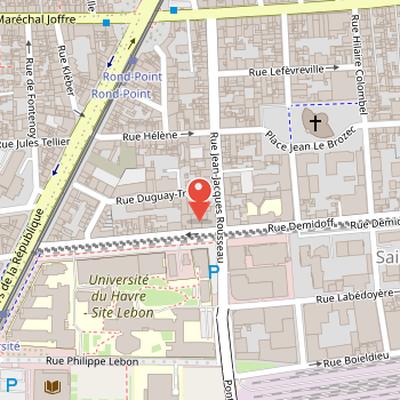
In Le Havre, the free drawing and architecture school was created on 15 Frimaire of year IX, or 6 December 1800, on the proposal of city architect Antoine-Marie Lemaître and under the protection of First Consul Bonaparte. The school closed in 1811 after Lemaître's death and reopened in 1824. It later moved through several locations, including Rue de Bordeaux at Rue Caroline, Rue Bernardin-de Saint-Pierre, and Rue de la Mailleraye, before settling in new buildings constructed in the late 1980s at 65 Rue Demidoff.
Historical Development of the Rouen and Le Havre Art Schools
The regional art school of Rouen was created by painter Jean-Baptiste Descamps in 1741 and received official recognition in 1750. It was closed during the Revolution, then reopened in 1804. At a later stage, the school and Philippe Zacharie's workshop, located in the Rouen antiquities museum, were damaged by a fire, after which the school moved to Place de la Haute-Vieille-Tour. Following the World War II bombings, it temporarily relocated to Aitre Saint-Maclou, a former burial place for plague victims from the Middle Ages. The school remained there until summer 2014, when it moved to a former college in the Grand'Mare district. Rouen city later announced that management of the school would be transferred to Metropole Rouen-Normandie because of financial problems. In Le Havre, the free drawing and architecture school was created on 15 Frimaire of year IX, or December 6, 1800, on the proposal of citizen Antoine-Marie Lemaître, the city's architect.
The Lemaître Family Background
The history section notes that Antoine-Marie Lemaître lived from 1768 to 1809. His son, Antoine Louis Prosper Lemaître, was born in 1800 and later became known as Frédérick Lemaître. Frédérick Lemaître went on to become one of the most renowned actors of the 19th century.
School Locations and Relocations
The history of the Le Havre school begins with its foundation under the protection of First Consul Bonaparte. The free drawing school of Le Havre closed in 1811 after the death of Lemaistre, then reopened in 1824. Over time, the school occupied several different addresses, moving successively from Rue de Bordeaux at Rue Caroline to Rue Bernardin-de Saint-Pierre and then to Rue de la Mailleraye. In 1881, it was transferred to the former Masonic temple at 44 Rue Jules-Lecesne. Another move followed in 1927, when the school settled on Rue Anatole-France. In 1973, it was installed in a disused primary school on Rue Dume-d'Aplemont. New buildings were then constructed in the late 1980s at 65 Rue Demidoff, and the new building was inaugurated in 1991.
A Two-Campus Art School Structure
The history of the school follows a national movement that brought art schools together under the status of public cultural cooperation institutions. In this context, the cities of Le Havre and Rouen administratively merged their two art schools into a single entity divided across two campuses. The Rouen campus includes an art department, while the Le Havre campus has an art department, a graphic design department, and a master's degree in literary creation created with the University of Le Havre.
The two sites share a common administrative structure, with most administrative services grouped on the Rouen site. Almost all teachers and students are affiliated with either the Rouen or Le Havre campus, but exchanges between the two are regular and take place through workshops, juries, and research projects. The institution is under the pedagogical supervision of the Ministry of Culture and Communication and is mainly financed by the cities of Rouen, replaced in 2018 by Metropole Rouen-Normandie, Le Havre, the State, and the Normandy region.
The school is also an associate member of COMUE Normandie Universite, and it belongs to both the conference of higher education of the Rouen agglomeration and the Havre conference of higher education and research institutions. Thierry Heynen served as general director from the creation of the institution in 2010 until 2021, after having directed the Le Havre art school from 2005. He was succeeded by Ulrika Byttner in 2021.
Teaching, Research, and Student Production
The school offers a three-year first cycle leading to the Diplome national d'art in Art at the Rouen site and in Design at the Le Havre site. It also provides second-cycle study leading to the Diplome national superieur d'arts plastiques in Arts at Rouen and in Design at Le Havre. At the Le Havre site, students can follow three pathways: Design edition, Design numerique, and Art/media/environment.
Since 2012, the school and the University of Le Havre literature department have jointly offered a two-year Master of literary creation. The institution also manages a doctoral program in artistic creation within a college that includes ENSAN, esaam Caen, and doctoral school 558. In addition, it offers complementary training programs.
Research is carried out in the ESADHaR RECHERCHE laboratory, which includes about ten research groups, among them EDITH, Cabinet des ecarts singuliers, EDGAR, VOIR, CLUB, IDeA, Reseau Peinture, and Mapping. Students regularly take part in the Un ete au Havre monument festival, with works by Emma Ertzcheid, Arthur Gosse, Lorene Dengoyan, Baptiste Leroux, Antoine Dieu, and Alice Baude. Student projects and works were also shown in a retrospective at the Theatre de l'hotel de ville from June 15.