The Muséum d'histoire naturelle d’Angers has been open to the public since 1801. Its initial collection dates from the French Revolution, when Gabriel Eleanor Merlet de la Boulaye was assigned to gather books and natural history collections seized in national houses. These objects were recovered across the region, especially from emigrants’ houses, and first stored in Saint Sergius’ Abbey in Angers. After the abbey was plundered during the siege of Angers in December 1793, the collections were reorganized for teaching at the Central School of Maine-et-Loire, established in 1795 in the Barrault House. Joseph-Étienne Renou, appointed professor of Natural History, formed a natural history collection with the remaining material and later received further objects from the National Museum of Natural History. The museum opened to the public as the Museum of Natural History on 5 May 1801 and became municipal in 1805, while remaining in the Barrault House with the Museum of Fine Arts. Its history also includes additions by Étienne Geoffroy Saint-Hilaire in 1806 and enlargement under Alexandre Boreau, with new halls inaugurated in 1849.
Nearby Objects
-
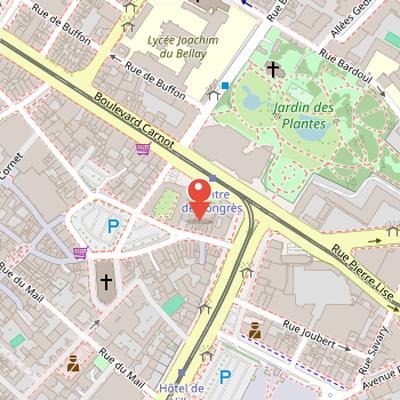
 Jean Monnier Congress Center 120 m away
 -
 Église Notre-Dame-des-Victoires 150 m away
 -
 Abbaye Saint-Serge 300 m away
 -
 Place du Ralliement 500 m away
 -
 Grand Théâtre d'Angers 500 m away
From Revolutionary Collections to a Municipal Museum
The Musaeum d'histoire naturelle d'Angers has been open to the public since 1801, but its origins go back to the French Revolution. Its initial nucleus came from collections gathered under the Decree of 22 November 1790, when Gabriel Eleanor Merlet de la Boulaye was assigned to collect books and natural history materials seized in national houses. These holdings were recovered from across the region, especially from emigrants' houses, and were first stored in Saint Sergius' Abbey in Angers. Much of this early stock was then plundered by the Vendeans during the siege of Angers in December 1793.
A new phase began in 1795 with the establishment of the Central School of Maine-et-Loire in the Barrault House. Joseph-Etienne Renou, appointed professor of Natural History, formed a teaching collection from the remaining materials at Saint Sergius' Abbey. The collections were further enriched by Louis-Marie de La Revelleiere-Lepeaux, who invited Renou to Paris in 1798. On that occasion, Renou received objects from the National Museum of Natural History, including 12 fossil fish from Monte Bolca in Italy, brought by Bonaparte in 1797. The collection opened to the public as the Museum of Natural History on 5 May 1801.
After the Central School was abolished in 1805, the museum became municipal while remaining in the Barrault House alongside the Museum of Fine Arts. In 1806, Etienne Geoffroy Saint-Hilaire sent important fossils and casts on behalf of the National Museum. Visitor numbers were high before Renou's death in 1809, after which the administration entered a troubled period. Guilloteau managed the museum during the administrations of directors Bastard and de Tussac, though Bastard, as director of the Jardin des plantes d'Angers, was less attentive to the museum, and de Tussac worked in Paris.
A period of reorganization followed when Auguste Nicaise Desvaux replaced Guilloteau as naturalist's assistant in 1821 and was appointed museum director in 1822. He attempted to organize the collection, but disputed logistics with the municipality. Later enlargement took place under Alexandre Boreau, with new halls inaugurated in the Barrault House in 1849. That same year the museum acquired Pierre-Aime Millet de la Turtaudiere's fossil collection from Anjou, made up mainly of fossils from tuffeau limestone and faluns of Anjou, although this collection has almost entirely disappeared. A temporary geology exhibition became permanent in 1864. The museum's scientific role continued to expand, with the Society of Scientific Studies of Anjou established in 1871 in connection with the museum. Further additions included 65 birds donated by Alphonse Milne-Edwards in 1883 and the purchase of the Soye fossil collection by the town of Angers in 1885. Barrault House remained the museum's main site.
From Specialized Collections to a Reunited Museum
The history of the Musuem d'histoire naturelle d Angers is marked by the gradual gathering of several specialized collections into connected museum spaces. Palaeontological specimens became so numerous that they were placed in the Old Town Hall as a Palaeontological Museum. Geological collections were added there soon after 1885, following the purchase in 1885 of a Holzmaden ichthyosaur cast from the Cantonal Museum of Geology in Lausanne. An original ichthyosaur fossil from Holzmaden was added later. The expansion of objects and specimen classification was associated with the direction of Georges Bouvet, while Olivier Couffon donated 12,000 local geological and palaeontological samples from his own collection. Prehistory collections also began at the end of the 19th century, notably from Roc-en-Pail and Chalonnes-sur-Loire in Maine-et-Loire.
Botanical collections had developed in Angers since the creation of the Society of Botanophiles in 1777. Herbaria were preserved in the Jardin des Plantes during most of the 19th century, then re-housed in 1895 in the Old Mansion House, the north wing of the Old Town Hall, next to the Palaeontological Museum. The SESA followed this move, and in 1898 these collections formed the Botanical Museum, which remained in this form until 2005. Alexandre Boreau's herbarium was bought by the municipality in 1875, and James Lloyd's herbarium was bequeathed to the city in 1897. In 1964, all herbaria were grouped at the Arboretum Gaston Allard, with the SESA accompanying the move. In 2005, the Botanical Museum was absorbed by the Museum of Natural History and renamed the Museum of Natural Sciences.
Zoological material followed a separate path. In 1958, Philippe Maury directed zoological items to move from the Barrault House to the Demarie-Valentin House, which became the Zoological Museum near the Paleontological Museum. The Zoological Museum opened on 29 April 1963. In 1990, the Zoological and Paleontological Museums were reunited to recreate the Museum of Natural History, and in 1991 the two buildings were connected by a path along the ancient walls of Angers, allowing visitors to move continuously between the zoological rooms and the palaeontology gallery.
Continuity and Survival of the Collections
The Muséum d'histoire naturelle d'Angers and its collections have retained a rare continuity and integrity for a museum that is more than 200 years old. Its history has been marked less by large-scale destruction than by gradual losses: many pieces have been lost or stolen over time, and the greatest hazard to the collections was the Vendean pillage in 1793. According to the available records, the museum was not damaged by either of the two World Wars in France, and no fire, flood, or other disaster destroyed or damaged its collections. On 1 January 2017, it was administratively attached, under the same directorship, to five other museums in Angers.
Museum Missions and Public Role
The museum's missions center on the curation of collections, the dissemination of knowledge, expertise, pedagogy, and scientific research. These aims are carried out through mediation, object loans, and by hosting trainees and external researchers in Angers. The museum also sets up scientific projects under its own purview when needed, and it participates in networks dedicated to museums. In addition, its work contributes to national and international patrimonial databases used by both scientists and the general public.
The museum aligns itself with ICOM's definition of a museum. In this view, a museum is a non-profit, permanent institution serving society and its development, open to the public. It acquires, conserves, researches, communicates, and exhibits the tangible and intangible heritage of humanity for education, study, and enjoyment. The institution holds the label Musee de France under law nr 2002-5 of 4 January 2002.
Museum Sites and Heritage Buildings
The Muséum d'histoire naturelle d'Angers is established on two sites: the museum's central site and the Arboretum Gaston Allard. Its buildings house the reception desk, the laboratory for taxidermy-restoration, and part of the reserves. The site also includes the Demarie-Valentin House, which has been registered as a national heritage site since 28 August 1995. The Arboretum Gaston Allard was donated to the Pasteur Institute in 1916 and bought back by the town of Angers from the institute in 1959. The site is also home to the Societe d'etudes scientifiques de l'Anjou and the Society of Horticulture of Angers and Maine-et-Loire.
Behind the Scenes at the Musuem d'Angers
Museum life at the Musem d'histoire naturelle d'Angers includes many activities that are not always visible to the public. A welcome team handles ticket sales, supervises exhibition rooms, and monitors the exhibits, acting as a link between visitors and the professionals working behind the scenes. Curators are responsible for the preservation and management of collections, as well as the preparation of exhibitions.
The museum also has a laboratory where a taxidermist-conservator prepares specimens for exhibitions, conservation, and research. A technical team produces showcases, shelves, storage units, and transport equipment. The institution accepts donations from individuals and institutions that seek long-term conservation of collections, and professionals then decide whether these collections should be accepted, restored, or displayed.
Its collections are regularly used by researchers, trainees, students, and teachers. The museum also welcomes volunteers and temporary staff who are scientists or amateurs specialized in particular fields. In addition, campaigns of proofing, inventory, and digitization are carried out in herbaria, entomology, and malacology. Specimens are also loaned regularly for exhibitions, research, or teaching.
A scientific library of about 6,000 documents is available at the central site and the Arboretum site. Public outreach is organized by a mediation team through workshops and guided tours supported by teaching materials. The museum offers themes and pedagogical cards adapted to all school grades as part of an environmental education program, as well as activities for young people, especially during school holidays. It also organizes scientific and cultural mediation activities such as animations, conferences, and artistic events, and takes part each year in events including the European Heritage Days and the Long Night of Museums.
Scientific Collections and Herbaria
The collections at the Musueum d'Angers are organized around botany, zoology, earth sciences, and prehistory, with smaller holdings in ethnology, technology, and fine arts. They continue to grow through donations, customs seizures, and new acquisitions. Most of the objects date from the 19th and 20th centuries, but the museum also preserves older material of notable heritage value, including 18th century herbarium specimens, a few examples from the 17th century, and pre-19th-century herbaria and animal taxidermy.
Botany makes up more than half of the museum objects, and the herbarium holdings are especially important. These are arranged into three main collections: the general herbarium, the Alexandre Boreau herbarium, and the James Lloyd herbarium. Together, these three herbaria account for about 80 percent of the samples in the collections. The general herbarium includes several type-specimens, including types from the island of Reunion, as well as collections gathered by Philibert Commerson during the voyage of Bougainville, Jacques Labillardiere during the Entrecasteaux expedition, and Pierre Antoine Poiteau from Santo Domingo. It also contains some rare samples from the 17th century.
The Boreau herbarium contains probably more than samples used for Flore du centre de la France and contributed to the most famous regional flora of its time. The Lloyd herbarium contains 100,000 collections and formed the species basis for Flore de l'ouest de la France; its bequest also included Lloyd's imposing library. Other botanical holdings include herbaria of mosses, lichens, fungi, and algae, as well as specialised herbaria in Angers, including an important collection devoted to the genus Rubus.
The museum also preserves a seed library with pedagogical samples of about French and 200 tropical species. This includes the Vilmorin collection of early 20th century tree seeds, with samples from the National Museum and Roland Bonaparte, and the total seed holdings amount to approximately 1,100 samples. In addition, the collections include a xylotheque with wood specimens from the Jardin des Plantes and the Gaston-Allard Arboretum in Angers, along with 69 samples of French Guyanese precious woods collected in 1802.
Beyond botany, the museum holds several type-specimens in zoology and palaeontology, including Asteraceae, Lepidoptera, and Trilobita. Among its best-known objects is a trilobite fossil of the genus Paradoxides from the Cambrian period, about 500 million years old.
Zoology and Paleontology Collections
The zoology collections at the Muséum d'histoire naturelle d'Angers cover a broad range of fields, including entomology, malacology, ornithology, mammalogy, herpetology, and ichthyology. They also include more than one hundred marine invertebrate specimens. Among the malacology holdings, the museum retains the Servain and Surrault collections in freshwater malacology and the Letourneux collection in world malacology; together, these form a remarkable ensemble. In 1999, the collections were further enlarged by the Boursicot legacy, which added tens of thousands of zoology specimens, including insects and shells.
The ornithological collections are especially varied. They include eggs, nests, and taxidermy of birds from Maine-et-Loire, as well as specimens of extinct species such as a Carolina parakeet and a passenger pigeon. The museum also displays casts of an Aepyornis egg and a moa's leg bones. Historical zoological material includes one of the last sturgeons fished in the Loire in 1811 and cetacean bones from the early 19th century. More recently, the collections acquired an okapi and its skeleton.
The paleontology collections are also significant. They include fossils in palaeobotany, paleozoology, and paleoichnology, and trace the history of life since the Cambrian period, around 500 million years ago. The holdings include Maine-et-Loire fossils, mainly from local Cretaceous tuffeau limestone and Tertiary faluns, as well as fossils from Armorican levels such as the Ordovician and Devonian. A composite skeleton of the Miocene fossil sirenian Metaxytherium medium is among the notable pieces.
Mineral and Meteorite Collections
The Muséum d'histoire naturelle d'Angers holds a mineral collection that is especially broad in scope. Its holdings include mineralogy samples from Maine-et-Loire, around 600 petrography samples, and specimens representing all mineral families. The collection is described as consisting mainly of French regional minerals, but it also includes minerals from Madagascar and Chile.
Among the notable pieces is a monumental block of sharp acicular quartz, together with samples of native gold and meteorites. The museum preserves the meteorite of L'Aigle, which fell in 1803 at L'Aigle, Orne, Normandy, as well as the meteorite of Angers, which fell on 3 June 1822 at 8:15 pm in Angers, La Doutre. The Angers meteorite is classified as L6, a chondrite with olivine.
Other significant specimens include a native gold nugget found at Blaison-Gohier in Maine-et-Loire and a sample of native apatite lamellar gold found around 1858 on the road from Rennes to Nantes. Together, these objects give the museum a collection profile that combines regional geological heritage with specimens of wider scientific interest.
Prehistory and Human Evolution
The Musaeum d'histoire naturelle d Angers holds prehistoric collections of about objects, mainly from the Paleolithic site of Roc-en-Pail in Chalonnes-sur-Loire. The site has yielded mammoth teeth, reindeer antlers, various bones, and lithic tools, and it also provides evidence of ancient human occupation. Systematic excavations were carried out there by Michel Gruet from the 1940s to the 1980s. These excavations uncovered Neanderthal remains, including a maxilla, an isolated tooth, and a humerus. Part of this material is exhibited at the Musaeum d Angers.
New excavation campaigns are currently underway at Roc-en-Pail, and the material recovered will become part of the museum collections. The permanent prehistory exhibition has also been expanded with display cases relating to human evolution. Among these are fossil skull casts arranged on the human phylogenetic tree, as well as a primatology installation. Together, these elements place the prehistoric collections within a broader interpretation of human evolution and the long history of occupation represented by Roc-en-Pail.
Temporary Exhibitions at the Museum
The Musee d'histoire naturelle d'Angers hosted a regular program of temporary exhibitions throughout the 2010s, covering themes linked to animals, plants, collections, and visual art. In 2011, the museum presented Safari urbain, a photography exhibition by Laurent Geslin, and Abriter les papillons at the Arboretum Gaston-Allard. The following years continued with exhibitions such as Ecorces by Cédric Pollet and Art d'ici : univers singuliers by the Societe des Artistes Angevins in 2012, then Especes en folie and Alarme et camouflage in 2013.
In 2014, the program included Zoos humains : l'invention du sauvage, Traces des absents, works by Helene Gay, Recolement ? ... ca colle ! 10 ans de recollement des collections, Portraits de famille, works by Helene Benzacar, and Flore, paintings by Catherine Brasebin. The museum also continued in 2015 with Bestioles d'Anjou, photography by Sylvie Mercier, Gravex naturalis : espece en voie d'exposition, and Sols fertiles, vie secretes. In 2016, it presented L'aventure botanique des Caraibes aux bords de la Loire.
The 2017 program included Les animaux du noir, photography by Katrin Backes and Sylvain Tanquerel, and Droles d'oiseaux. In 2018, temporary exhibitions included Hungry Planet, photography by Peter Menzel and Faith d'Aluisio, HerbEnLoire : tresors retrouves, and La grande parade des animaux at the Musee des Beaux-Arts d'Angers. In 2019, the museum presented Insula Utopia / Inventaire du Ciel, works and installations by Richard Rak. Together, these exhibitions show an emphasis on natural history subjects interpreted through photography, painting, installations, and archival or scientific themes.
Temporary Exhibitions at the Musuem d'histoire naturelle d'Angers
The Musuem d'histoire naturelle d'Angers has presented a regular program of temporary exhibitions covering natural history, science, geography, and artistic collaborations. In 1994, it showed Baleines en vue, followed by Ages et images de la terre in 1996. Later exhibitions included Rveur au long cours, installations by Richard Rak in 1998, and several exhibitions in 1999 such as Trsors botaniques d'Angers and Le petit peuple des champs et des bois, photography by Michel Beucher. In 2000, the museum presented Le ptrole dans tous ces tats, connected with Fte de la Science, and La mnagerie du roi Ren. The 2001 program included Rue des Sciences : les noms de rues dedies aux scientifiques, La Nature, quelle artiste, and Paysage du monde, paysage d'Anjou. In 2002, the museum hosted Flins du monde and Lumires Polaires et aurores borales, photography by Rmy Marion. The following years continued with exhibitions such as Madagascar : l'le aux trsors and Algrie, deux millions d'annes d'histoire : les premiers habitants in 2003, La faune du Mali, Histoires naturelles, works by Sylvie Mercier de Flandre, and Fort ou le frmissement des limbes, photography by Laurent Vergne in 2004. In 2005, the museum presented Rserves, photography by Hlne Benzacar, Voyage dans la troisime dimension, holograms, Photographes de nature, photography by BBC Wildlife Magazine, and Chauves-souris de chez nous. The 2006 exhibitions included Amazone nature, Ligne du Monde, and Naturellement Loire... une escale en Anjou. In 2007, it showed Double visite : 5 artistes au Musum and Nom : Carl v. Linn, Profession : naturaliste, tricentennial. In 2008, the museum presented L'Anjou sous nos pieds, geology of Anjou, Curieuses invites, works by Juliette Vicart, and L'animal griff, drawings and sculptures by Delphine Izzo. In 2009, the program included Darwin : mission Galpagos, bicentennial and J'ai captur dans mes filets, writing by Thrsse Bonnatt and tapestries by Muriel Crochet. In 2010, the museum presented Biodiversit : le Musum sort de sa rserve. Across these years, the temporary exhibitions show a strong emphasis on natural sciences, regional themes, and the inclusion of photography, drawing, sculpture, tapestry, and installations.
Temporary Exhibitions and Archaeological Displays
The Muséum d'histoire naturelle d'Angers has presented temporary exhibitions with a strong link to archaeology and prehistoric research. In 1990, it showed Roc en Pail - 50 000 ans de prehistoire angevine, an exhibition presenting the results of archaeological excavations by Michel Gruet at Roc-en-Pail. Parts of this exhibition were also integrated into the museum's permanent exhibition. In 1993, the museum presented Point Info dinosaures. These exhibitions reflect the museum's role in displaying scientific and historical material to the public.