Le Musée de la mer is located at L'Aquarium de Biarritz in Biarritz, in the Pyrénées-Atlantiques, facing the Rocher de la Vierge. The idea of a musée de la Mer in Biarritz was initiated by marquis Léopold de Folin in 1871. Its current building is in Art Déco style and adjoins the cliff of the plateau de l'Atalaye. The museum building was inaugurated on an unspecified date and is constructed on four levels.
The museum presents marine species and the life of the Gulf of Gascogne. It underwent a first renovation in 1992 to house a large collection of marine animals and naturalized birds. From 2009 to 2011, it was extended to double the visiting area and significantly increase the number of tanks. This extension required excavation under the Atalaye plateau and was limited by a road tunnel and three German bunkers from World War II. The expansion also led to changes in display spaces, including the removal of the naturalized bird room and the relocation of some exhibits. The museum’s emblem is a white octopus on a blue background.
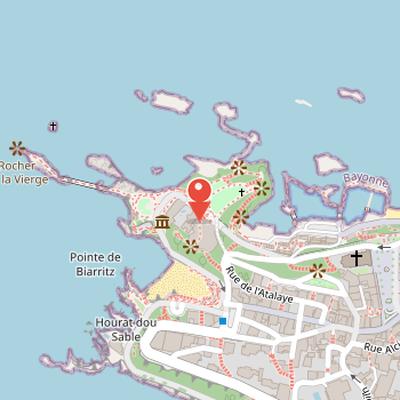
Nearby Objects
-
 Église Sainte-Eugénie 250 m away
 -
 Casino municipal 650 m away
 -
 Gare du Midi 850 m away
Architecture and Development of Le Musee de la Mer
Le Musee de la Mer is located at L'Aquarium de Biarritz in Biarritz, in the Pyrenees-Atlantiques, facing the Rocher de la Vierge. The idea of a musee de la Mer in Biarritz was initiated by Marquis Leopold de Folin in 1871. Its current building is in Art deco style and adjoins the cliff of the plateau de l'Atalaye. The building was inaugurated on an unspecified date.
The site underwent a first renovation in 1992 to house a large collection of marine animals and naturalized birds. From 2009 to 2011, it was extended to double the visiting area and significantly increase the number of tanks. This extension also led to the removal of space for naturalized birds. The museum's emblem is a white octopus on a blue background.
Expansion and Reorganization of Le Musee de la Mer
Le Musee de la mer is constructed on four levels and presents marine species and life of the Gulf of Gascogne. In 2008, the municipality of Biarritz launched the Biarritz Ocean project to expand Le Musee de la mer and to build the Cite de l'ocean et du surf. The museum extension was designed to represent a route from the Gulf of Gascogne toward the Caribbean zone, following the Gulf Stream, then continuing with aquatic fauna from Cape Horn to the Pacific and ending in Indonesia.
The expansion required excavation under the Atalaye plateau and was constrained by a road tunnel beneath the plateau as well as three German bunkers from World War II. Construction was carried out by Groupe Coutant and completed in 2011, after which the museum reopened. The extension doubled the visitor area surface and also reserved additional space for technical facilities.
Several parts of the museum were reorganized during the works. The grotte des squales was renamed the aquarium des tortues et des raies, while the former sharks were moved to the aquarium des requins. The naturalized bird room was removed and became the starting point of the extension. Le Musee de la mer was later named Biarritz Ocean together with the Cite de l'ocean et du surf. Biarritz Ocean was inaugurated in the presence of navigator Maud Fontenoy and hosts the European center for coastal risks, a research and training program, and Ifremer public institute laboratories.
Hammerhead Sharks and the Museum Extension
Les animaux acquired a hammerhead shark from Taiwan for the museum extension, and presented a rare captive hammerhead shark species in France. Biarritz Ocean had initially planned to present four hammerhead sharks at opening, but three of the planned sharks did not survive transit in Holland. Les animaux also stated that four hammerhead sharks were caught along the Taiwanese coast.