Château de La Motte is a historic castle in Lyon, on the left bank in the Rhône department. It occupies a small elevation known as a motte castrale, from which it takes its name. Its position near the junction of the old eastern and southern roads of Lyon, and on the border between Dauphiné and Lyonnais, gave it strategic value. The site was also protected from floods and, before the urbanization of the Guillotière district, offered wide visibility over the surroundings.
The castle consists of buildings flanked by round towers and a square tower, forming an irregular quadrilateral around a courtyard. The southern entrance has preserved machicolations, and a donjon dominates the structure. In the 17th century, the western wall was replaced by a terrace, and a chapel was visible at that time. The east facade bears a plaque in memory of General Toussaint Campi (1777–1832). The estate, which covered a little more than 17 hectares up to the 18th century, also includes outbuildings probably built at the end of the 18th century. The facades and roofs were listed in the supplementary inventory of historical monuments in 1947.
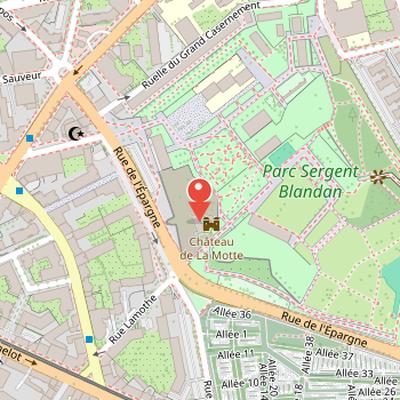
Nearby Objects
-
 Caserne Sergent Blandan 110 m away
 -
 Parc Sergent Blandan 120 m away
 -
 Avenue Berthelot 550 m away
 -
 Place Saint-Louis 650 m away
 -
 Gare de Lyon-Guillotière 650 m away
Site and Setting
The Chateau de La Motte is located in Lyon, on the left bank in the Rhone department. It stands near the junction of the old eastern and southern roads of Lyon, at the border between Dauphine and Lyonnais. The site occupies a small elevation known as a motte castrale, which gave the place its name. This position also had practical advantages: it protected the site from floods and provided good visibility before the urbanization of the Guillotiere district.
Architecture and historical fabric
Chateau de La Motte is arranged as an irregular quadrilateral around a courtyard, with buildings flanked by round towers and a square tower. A donjon dominates the entire structure. The southern entrance has preserved machicolations, while the western wall was replaced by a terrace in the 17th century. A chapel was visible in the 17th century, and a plaque in memory of General Toussaint Campi (1777 - 1832) is placed on the east facade of the castle.
The estate covered a little more than 17 hectares up to the 18th century. Its outbuildings, probably built at the end of the 18th century, include two stables with attics, a canopy sheltering a press and a basin, and two barns. The facades and roofs were listed in the supplementary inventory of historical monuments by order dated February 2, 1947. Part of the estate is currently open to the public and under renovation.
History of the La Motte Domain
The site of Chateau de La Motte has several centuries of history. In the Gallo-Roman era, the Grande-Motte location in La Guillotiere was created artificially for flood protection and defense. During the Middle Ages, a castle named La Motte was built to reinforce a strategic position near the routes to the Alps, Italy, and the Rhone valley.
From the 15th and early 16th centuries, the fief belonged to the Villeneuve family. Jean Villeneuve hosted the courts of the Parliament of Grenoble in 1476, while Humbert Villeneuve held major judicial offices in Lyon, Toulouse, and Burgundy. Charles Villeneuve, baron of Joux, later sold the domain after marrying Marie d'Amanze. In 1530, Hugues du Puys, a royal counselor and lieutenant of the Lyon seneschal, bought the property.
The site then became associated with several notable visits. In 1556, Cardinal Caraffa, nephew and legate of Pope Paul IV, waited there for King Henri II in order to deliver a papally blessed sword. Marie de Medici attended mass and dined at the castle before her wedding to Henri IV in Lyon in 1600, and she returned in 1622 with Anne d'Autriche and Richelieu to meet Louis XIII after the revolt of Montpellier. During that visit, a small palace and theater were built under the direction of Hugues Cripier. In 1642, Richelieu had Gaston d'Orleans stay at La Motte castle while he was forced to witness the execution of Cinq-Mars and Thou.
From 1655, the community of nuns from the Sainte-Elizabeth convent bought the parcels of the domain from the successors of Hugues du Puys, including the last six parcels from Jacques de Laube, seigneur de Bron. They retained ownership until the Revolution. The domain was also prepared for the arrival of Louis XIV in Lyon in 1662. In 1791, it was sold as national property to the Lyonnais Pierre Etienne Verd, and in 1821 it became the property of Pierre Ducreux, an avoue in Lyon, before his expropriation after refusing a purchase offer from General Rohault de Fleury.
From Fortified Site to Urban Park
The Château de La Motte site was transformed repeatedly in response to changing military needs. Under the Louis-Philippe government, fortifications were built to protect Lyon between 1831 and 1853, including a fort on the Historique domain. The state acquired the domain and constructed a fort there, with a new enclosure that also included the castle. By 1864, Historique La Motte had become the third largest fort in the agglomeration and housed 1193 men.
The site later lost its strategic role when a second line of fortifications was built, and it was then converted into barracks. After the First World War, Minister of War Andre Maginot initiated the construction of military housing with four blocks on the Historique site. The complex was renamed Caserne Sergent-Blandan on the centenary of the death of Sergeant Blandan during the African Campaign.
The army left the castle and domain definitively in 1999, and the National Police took its place. In 2007, Grand Lyon signed acquisition acts to create an urban park on the domain. A project call for a hotel-based rehabilitation was launched in 2014 but failed due to the COVID crisis. In 2022, part of the roof collapsed.