Bois de Vincennes is a forest and urban park on the eastern edge of Paris, France. Created between 1855 and 1866 by Emperor Napoleon III, it is the largest public park in the city and covers a total area slightly larger than the Bois de Boulogne. It occupies about ten percent of Paris and is almost as large as the first six arrondissements combined. Only about half of the area is covered with trees.
The park stands next to the Château de Vincennes, a former residence of the Kings of France. Its features include an English landscape garden with four lakes, a zoo, an arboretum, a botanical garden, a hippodrome or horse-racing track, a velodrome for bicycle races, and the campus of the French national institute of sports and physical education. The site has older historical associations as well, since a royal hunting preserve formed part of the ancient forest around Lutetia, and later figures such as Louis VII, Philippe-Auguste, and Louis IX were connected with its development.
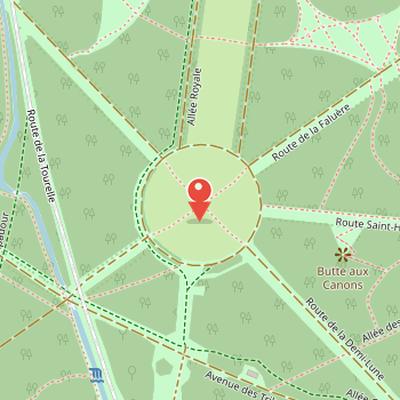
Nearby Objects
-
 Parc floral de Paris 1400 m away
 -
 Vélodrome Jacques-Anquetil 1600 m away
 -
 Stade Pershing 1700 m away
Layout and Uses of Bois de Vincennes
Bois de Vincennes is located on the eastern edge of Paris, France, and is the largest public park in the city. It was created between 1855 and 1866 by Emperor Napoleon III, placing it among the major planned green spaces of the period. The park lies next to the Chateau de Vincennes, a former residence of the Kings of France, which gives it a notable historical setting.
The park contains several distinct landscape and recreational features. These include an English landscape garden with four lakes, as well as a zoo, an arboretum, and a botanical garden. It also includes a hippodrome, or horse-racing track, and a velodrome for bicycle races. In addition, the campus of the French national institute of sports and physical education is located within the park.
Alongside these formal and institutional functions, Bois de Vincennes is also known for prostitution after dark. This gives the park a mixed public reputation, combining recreational, educational, sporting, and informal uses within the same urban space.
Size and Landscape
The Bois de Vincennes has a total area slightly larger than the Bois de Boulogne in Paris and occupies ten percent of the total area of Paris. It is almost as large as the first six arrondissements in the center of Paris combined, and about three times larger than Central Park in New York City. It is slightly larger than Richmond Park in London, but smaller than Griffith Park in Los Angeles. Only about half of its area is covered with trees, indicating that the site includes significant open space as well as wooded land.
From Royal Preserve to Public Park
Bois de Vincennes began as part of the ancient forest that surrounded the Roman town of Lutetia, and it was known in ancient times as Vilcena. By about 1150, King Louis VII had built a hunting lodge at the site of the present chateau. King Philippe-Auguste later enclosed the forest with a wall, stocked it with game, and began building a castle there. Under King Louis IX, the site acquired a chapel built next to the castle to house a religious relic, which he believed to be the crown of thorns from the Crucifixion of Jesus. Louis IX also held a royal court of justice under an oak near the chateau.
The main medieval fortification developed further in the 14th century, when Philip VI began construction of the donjon of the Chateau de Vincennes in 1336, Jean II continued the work, and Charles V completed it and surrounded it with a rectangular wall with nine towers. Charles V also began rebuilding the chapel founded by Saint Louis. This new chapel, called La-Sainte Chapelle and modeled after the Saint-Chapelle in Paris, was not finished until the 16th century. In the 15th century, the donjon was transformed into a prison.
The site remained a place of royal presence in the 17th century, when Cardinal Mazarin commissioned Louis Le Vau in 1654 to build a new palace next to the chateau for King Louis XIV. The palace had separate pavilions for the King and Queen, divided by a portico and a wall, with arcades connecting this arrangement to the medieval section of the chateau. After Louis XIV established his residence at Versailles, however, the palace was rarely used.
Bois de Vincennes also acquired a landscape and symbolic identity beyond courtly use. A hunting party there appears as the December scene in the Tres Riches Heures du Duc de Berry. A community of Minimes monks lived in the area, remembered today in the name Lac des Minimes. In the 18th century, Louis XV opened the park to the public, excepting servants in livery, planted hundreds of trees, and laid out alleys in intersecting stars. He also built a pyramid-shaped monument in 1731 to mark the meeting point of two main alleys.
From Military Ground to Public Park
Beginning in 1794, large parts of the Bois de Vincennes were turned into a military training ground. The creation of the park involved the demolition of some old chateau structures, the construction of a firing range, and later a new fort east of the chateau. In 1840, 166 hectares were cleared for military parades, and the area still contained firing ranges, an ammunition factory, forts, and redoubts occupying large land tracts. Even after the park project began, the Army continued to build a new military shooting range in 1860, and a school of pyrotechnics was constructed in 1864.
In 1854, Emperor Louis Napoleon and Prefect Georges-Eugene Haussmann decided that the site should be transformed into a public park. The aim was to provide green space and recreation for the working-class population of eastern Paris. This project formed part of a wider network of parks and gardens across Paris. In 1855, the Service of Promenades and Plantations was established under engineer Jean-Charles Adolphe Alphand, who also contributed to the Bois de Boulogne, the gardens of the Champs-Elysees, and other Paris parks. Alphand's approach, as described in Les Promenades de Paris, treated gardens as works of art composed of forms, colors, and light. The transformation of Bois de Vincennes was made more difficult by the enormous military training field at its center, which had been cleared of trees.
Lakes, Landscapes, and Park Architecture
The creation of the park annexed additional sections of land at the edges of the Bois and organized the area into a series of smaller parks, each with its own artificial lake and picturesque landscape. Lake Daumesnil was designed in the manner of a romantic landscape painting, with two islands and sloping green lawns. To the north, the Lac des Minimes included ruins of the original medieval monastery, while the Lac de Saint-Mande in the northwest completed the park. A fourth lake, the Lac de Gravelle in the south-east, was placed higher on the Plateau de Gravelle and was used to provide water to the other lakes through artificial streams. Trees, lawns, and flower beds were planted by Jean-Pierre Barillet-Deschamps, giving the park a strongly designed landscape character.
The park also included a large hippodrome in the southeastern corner, with grandstands designed by Gabriel Davioud. Davioud also designed much of the picturesque architecture throughout the site. Around the lakes were cafe-restaurants, and on the Isle de Reuilly in Lac Daumesnil stood the Temple of Love, a round Doric temple placed above an artificial grotto. The same island also contained a Swiss chalet from the Paris Universal Exposition of 1867, as well as a cafe, a bandstand, and buildings for vendors and game concessions. The two islands in Lac Daumesnil were connected by a swinging suspension bridge, adding to the park's staged and scenic composition.
Expositions and Major Events
In 1899, the far eastern end of Bois de Vincennes was developed as an experimental tropical garden. The site was used for scientific study of rubber trees, coffee trees, banana trees, and other tropical plants. It later became the setting for the first Colonial Exposition in Paris in 1907. During that event, the park presented six villages with inhabitants from different parts of the French Empire, including an encampment of Tuaregs from North Africa, a farm from Sudan, a village of Kanaks from New Caledonia, and villages from Madagascar, French Indochina, and the Congo. The exposition drew two million visitors.
Bois de Vincennes also played a major role in the 1900 Summer Olympics in Paris, hosting most of the events. A velodrome with seating for forty thousand spectators was built for the cycling competitions. The park also hosted the first international cricket match between England and France in 1900, which England won.
During the First World War, the fortress of Vincennes in the park was used to imprison the Dutch spy Mata Hari. She was executed by firing squad in the moat of the fortress on 15 October 1917. Eyewitnesses reported that her hands were not bound and that she refused a blindfold.
The Bois de Vincennes in the 20th Century
The Bois de Vincennes was officially annexed to the city of Paris in 1929 and became part of the 12th arrondissement. In the same period, the park was also the site of major public events and long-term changes in use and appearance. Most notably, it hosted the Paris Colonial Exposition for six months in 1931, with the exhibition occupying the side of the park along the length of the Avenue Daumesnil.
The exposition introduced a large ensemble of buildings and display features. These included the Palace of the Colonies, in front of which stood a large gilded bronze statue by Leon Drivier, as well as pavilions from each colony and other nations. The grounds also contained cafes, theaters, a Senegalese village with inhabitants, and a zoo. Several water features were part of the display, among them eight fountains fed with water from Lake Daumesnil, two fountains forming a 40 meter long bridge of water between two islands in the lake, and the Theater of Water, an 80 meter long arc of towers and spouts that produced illuminated water effects in the evening. The Grand Signal, a 45 meter high tower spouting water at 19 levels, served as a centerpiece. The park retained the entrance gate from the exposition.
After the fair closed, the Palace of the Colonies was converted into the Museum of the Arts of Africa and Oceania. In 1934, the zoo was moved to its present location and a 65 meter high artificial mountain was added, later becoming home to a collection of mountain goats and sheep. The pavilion of Cameroon was preserved and turned into a Buddhist temple and religious center. During the Battle of France in 1940, the park served as the headquarters of the French General Staff at the Chateau. The Bois de Vincennes was heavily damaged and was not fully restored until the 1990s. The French army began to move out of the Bois de Vincennes at the end of World War II in 1945.
Lakes and Water Features
The Bois de Vincennes is home to four artificial lakes, forming a key part of its landscape. Water for these lakes is pumped from a station near the Pont d'Austerlitz on the Seine. Among the most distinctive features is Lac Daumesnil, which contains two islands connected by a suspension bridge and also accessible by boat. The site also includes Lac des Minimes, which stands on the former location of a medieval monastery, as well as Lac Saint-Mandé. An artificial stream carries water from Lac de Gravelle to the other lakes, linking the system together.
Gardens and Cultural Features
Several major landscaped and cultural areas are located within the Bois de Vincennes. Among them is the Parc floral de Paris, established in 1969 on former military training grounds. Covering 31 hectares, it is described as the largest garden built in Paris since the French Empire of Louis Napoleon and forms one of the four parts of the Botanical Garden of Paris. Its design and content combine horticulture, architecture, and art. The park features Japanese architecture inspired by the 1964 Tokyo Olympics, hundreds of varieties of flowers including 650 varieties of iris, twenty pavilions, an exhibit hall, a sculpture garden with works by Alexander Calder, Alberto Giacometti, and other international artists, a monumental fountain by Francois Stahly, and an avenue of pines preserved from the early days of the garden.
The Botanical Garden of Paris also includes the Arboretum de l'Ecole du Breuil, located in the southeast corner of the Bois de Vincennes. Established in this location in 1936, it was created in 1867 by Baron Haussmann as the city's school of horticulture and arboriculture. The arboretum contains about 2000 trees, notable collections of shrubs, four hundred varieties of heritage apple and pear trees, and three hundred varieties of lilac.
Another major feature is the Jardin tropical de Paris, a 4.5 hectare site that opened as the Colonial Experimental Garden in 1899 to study tropical plants. It hosted the first French Colonial Exposition in 1907, with pavilions and villages from the Empire. Over time, the garden gradually replaced tropical plants with French plants, though bamboo, rubber trees, and a few other exotic plants remain. It still shows pavilions of the French Congo, French Guiana, French Indochina, Reunion, and Tunisia, as well as vestiges of the old Indochinese garden. In 2003, the garden was taken over by the City of Paris for redesign and replanting. The Bois de Vincennes also contains the first mosque built in France in more than a millennium, erected in 1916 as part of a hospital complex and demolished in 1919.
The Paris Zoological Park, also known as Zoo of Vincennes, is another significant element of the park. Opened in 1934 and modeled on the Tierpark Hagenbeck in Hamburg, it used open plateaus separated by moats instead of cages. Its design included a 65-meter-high artificial mountain home to mouflon, and the zoo successfully bred wild species including Indian elephants. By the 1980s, its concrete buildings were crumbling because of a fifty-year design lifespan. The zoo closed in 2008 for major renovation and reopened in 2014.
Sports and Cultural Venues
The Bois de Vincennes contains several notable venues that reflect its long use for sport and culture. One of the best known is the Cartoucherie de Vincennes, a former ammunition factory that was converted in 1970 into a theater center by Theatre du Soleil, led by Ariane Mnouchkine and Philippe Leotard. This reuse gave the site a new cultural role within the park.
Another major feature is the Hippodrome of Vincennes, which opened on 29 March 1863 and is devoted largely to harness racing. It was badly damaged during the French-German War of 1870-71 and was rebuilt in 1983. Its tribunes hold 35,000 spectators. The Hippodrome also had a second life as a concert venue from 1970 to 1992, when performers included the Grateful Dead and Michael Jackson.
The Bois de Vincennes also includes the Velodrome Jacques-Anquetil, a cycling stadium built in 1896. Known popularly as La Cipale, it was used in the 1900 and 1924 Summer Olympics and can hold forty thousand spectators.
Farms, Fortifications, and Sports Training
The Bois de Vincennes includes a small number of distinct facilities that reflect its varied uses. Near the Hippodrome of Vincennes is the Ferme Georges-Ville, a small farm designed to show schoolchildren a real working farm. It includes cows, pigs, sheep, and small fields of corn and wheat. The farm is named for the French agronomist George Ville (1824 to 1897), who introduced chemical fertilizer to French farming with the support of Emperor Louis Napoleon.
The park also contains the Fort Neuf de Vincennes, a military installation and training center in the north of the park near the Chateau de Vincennes. It serves as headquarters for French military medical services and was one of fifteen forts built around Paris by King Louis Philippe I between 1841 and 1843. The fort is not open to the public.
Another important institution in the Bois de Vincennes is the Institut national du sport, de l'expertise et de la performance, or INSEP, a national sports training school established in 1975 under the National Institute of Sport and Physical Education. Its facilities support training in swimming, gymnastics, tennis, shooting, archery, fencing, and cycling, and it has trained many French Olympic athletes.
Human Trafficking and Street-Level Prostitution
The Bois de Vincennes has been associated with several prostitution rings linked to human trafficking. In the Route de la Pyramide area, prostitutes are reported to wait for customers on the sidewalk or in vans parked at the curbside, and they may signal their presence by illuminating their windshields. The facts also note that victims from Nigeria are intimidated into paying off the cost of their journey. In addition, victims often experience sexual or physical violence from customers.