Parc floral de Paris is a public park and botanical garden located within the Bois de Vincennes in the 12th arrondissement of Paris. Created in 1969, it remains the legacy of an international horticultural exposition organised under the auspices of the International Association of Horticultural Producers and recognised by the Bureau International des Expositions. It is one of four botanical gardens in Paris and serves as the site of major annual flower shows.
The park’s history is tied to the wider Bois de Vincennes, which was originally a royal park and hunting domain. Over time, the area was enclosed, reforested, and later transformed through military and public uses. The Parc floral site remained under military control after the Second World War before being developed as a permanent exhibition space for floral and botanical events. The area is described as largely flat, with a few buildings for exhibit space, and includes a grove of oaks and a grove of pine trees as notable features. The nearest metro station is Chateau-de-Vincennes.
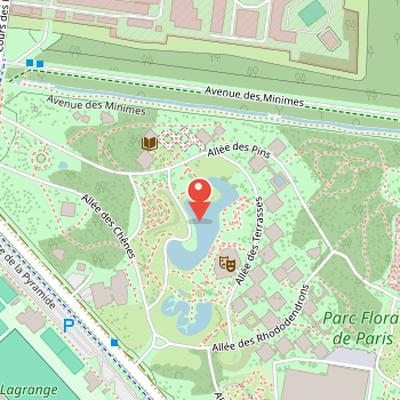
Nearby Objects
-
 Bois de Vincennes 1400 m away
 -
 Stade Pershing 1400 m away
Origin and Setting
The Parc floral de Paris is a public park and botanical garden located within the Bois de Vincennes in the 12th arrondissement of Paris. Created in 1969, it remains the legacy of an international horticultural exposition organised under the auspices of the International Association of Horticultural Producers (AIPH) and recognised by the Bureau International des Expositions (BIE). It is one of four botanical gardens in Paris and serves as the site of major annual flower shows. The nearest metro station is Chateau-de-Vincennes.
From Military Ground to Floral Exhibition Park
The Parc floral de Paris is part of the Bois de Vincennes, a site that was originally a royal park and hunting domain. Its early history includes King Philippe-Auguste enclosing the park with a wall in the 12th century, while King Charles V of France built the neighboring chateau. Later, King Louis XV reforested the park and added paths and promenades. After the French Revolution, Napoleon Bonaparte turned the Bois de Vincennes into a training ground for his soldiers.
Between 1840 and 1843, the land that would become the Parc Floral was mostly deforested and converted into a 166 hectare infantry practice field. During the Second Empire of Napoleon III, a large part of the Bois de Vincennes became a public park, but the future Parc Floral area remained under military control after the Second World War. A pyramid from 1831 is visible outside the Parc Floral at the intersection of the route de Polygone and route royale de Beaut of.
The present site is described as largely flat, with a few buildings used for exhibit space. Notable landscape elements include a grove of oaks and a grove of pine trees. The Bois de Vincennes hosted major international flower shows called the Floralies in 1959 and 1964, and the city of Paris then decided to create a permanent exhibition space for the Floralies and other botanical shows.
Design Responsibilities in the Parc Floral Project
In 1969, Paris city architect Daniel Collin was assigned to the Parc Floral project. The design responsibilities for different parts of the park were divided among several specialists. Caroline Stefulesco-Mollie was responsible for the valley of flowers, Jacques Sgard for the sculpture garden, Alain Provost for the water garden, and Lucienne Talihade-Collin for the playground. These assignments indicate a collaborative planning process in which distinct landscape and recreational areas were developed under separate responsibilities.
Landscape, Facilities, and Public Use
Parc floral de Paris occupies 31 hectares in Paris, making it the fourth-largest park in the city and larger than the Tuileries gardens. In the 1960s and 1970s, it was seen both as a form of amusement park and as a botanical garden, reflecting its mixed recreational and horticultural character. The park includes the Delta, a large outdoor concert stage, along with a restaurant, a cafe, large and small exhibit halls, an art gallery, a large playground, and a miniature railway. These facilities show its role as a place for leisure, exhibitions, and public events.
The park also contains modern works of sculpture by Alexander Calder, Alicia Penalba, and other artists. These sculptures are placed in different gardens around the park, integrating art into the landscape. Parc floral de Paris can be entered from the Chateau de Vincennes or from the Route de la Pyramide. Visitors entering from the Chateau de Vincennes pass through a forest of cedars and oaks, creating a distinct approach to the site.
Flower Valley and Water Features
Visitors enter the park and reach the Vallee des Fleurs, or Valley of Flowers. The varieties of flowers in this area are changed each year according to a chosen theme. The Valley of Flowers borders the Miroir d'eau, a lake placed near the center of the park. One side of the lake includes a modern fountain and a series of cascades. The park also contains smaller ponds devoted to lily pads, lotus, and other aquatic plants. The Delta faces and dominates the lake, creating a strong visual relationship with the central water feature.
Gardens and Plant Collections
Parc floral de Paris includes a range of themed plant areas and smaller flower gardens scattered throughout the site. Among its features are a garden showing varieties of azalea, a large garden showcasing rhododendron, and a garden of ferns. The park also has gardens for irises and dahlias, as well as a garden and pavilion devoted to medicinal plants and culinary herbs. Other specialized areas include a garden for varieties of cactus and a garden of plants from the Mediterranean regions. A large pavilion is used for displaying Japanese bonsai plants. One of the best known areas is the jardin des Quatres-Saisons, where flowers are in bloom year-round.