Parc de la Toison d'or was an amusement park in Dijon, Bourgogne-Franche-Comté, France, located adjacent to the La Toison d'or shopping center. It opened in an unspecified year and closed permanently in 1993. The park used a golden ram as its mascot, referencing the myth of the Toison d'or. Since 1993, the site has been managed by the city of Dijon as an urban park.
The broader Parc d'attractions project originated in Dijon in the 1980s under mayor Robert Poujade. An idea to develop the Pouilly districts appeared in 1983, and a larger commercial and leisure complex was presented in 1987. The estimated cost of the design was 80 million French francs. The site was assigned to Lyonnaise des eaux, and the development convention was signed with the city of Dijon and Société Espace Expansion. The park became part of the Toison d'or complex, which included commercial and leisure areas. Today, the urban park includes playgrounds for children, rose gardens, and animal enclosures.
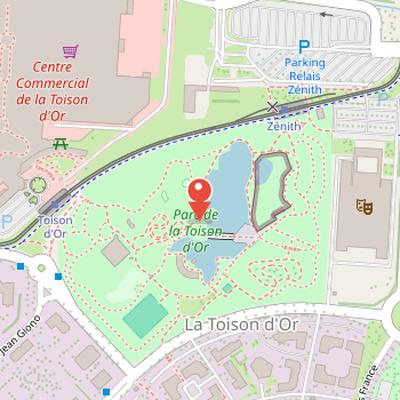
Nearby Objects
-
 Zénith de Dijon 250 m away
From Amusement Park to Urban Park
Parc de la Toison d'or in Dijon, Bourgogne-Franche-Comte, France, began as an amusement park located next to the shopping center La Toison d'or. It opened in an unspecified year and remained in operation until its permanent closure in 1993. The park's mascot was a golden ram, a reference to the myth of the Toison d'or.
Since 1993, the site has been managed by the city of Dijon as an urban park. Its present features include playgrounds for children, rose gardens, and animal enclosures. The park's history reflects a change from a leisure attraction to a public green space with recreational and landscaped areas.
Planning and development of Parc de la Toison d'or
Parc de la Toison d'or emerged from a project initiated in Dijon in the 1980s by Robert Poujade, who had been mayor of the city since 1971. The idea to develop the Pouilly districts appeared in 1983, and a broader concept for a large commercial and leisure complex was presented in 1987. The estimated cost of the design was 80 million French francs, or 12.2 million euros.
The project was not universally welcomed, and some voices opposed it, including the local territory manager. Its development nevertheless moved forward through formal agreements: a convention was signed between the city of Dijon, Lyonnaise des eaux, and Societe Espace Expansion. Lyonnaise des eaux was assigned to realize the site and also signed a lease for the site and parking north of Dijon.
The complex was named Parc recreatif de la Toison d'or, and it was also referred to as Parc de la Toison d'or by language abuse. It formed part of the wider Toison d'or complex, which included commercial and leisure areas. Within the complex, the Cyclades aquatic park was renamed Oxygene. The project leader was Michel Van Zingel. Ownership was shared, with Lyonnaise des eaux holding 46 percent and the Walibi group 13.85 percent.
Site, Financing, and Closure of Parc de la Toison d'or
Parc de la Toison d'or occupied a site of 15 ha 52 a 22 ca near the Toison d'or shopping center in Dijon. The land belonged to the Dijon municipality, which had purchased it for 650,000 francs. The park was operated under an emphyteutic lease lasting 40 years, with annual rent fixed at 35 million francs excluding taxes for the first three years. Its construction cost 70 million francs excluding taxes, with an additional 22 million francs planned for a second phase. That second phase was to be built on the site of the current Zenith and would have started after the third year if annual attendance had reached 500,000 visitors. In practice, the park drew about 320,000 visitors per year and generated annual revenue of 17 million francs. The total cost reached 155 million francs, or 23.63 million euros. The project later went bankrupt because of a debt of 162.5 million francs, or 25 million euros. The Nanterre commercial court opened receivership for the operating company and ordered the sale of its assets. The lease was then terminated without indemnity to either the landlord or the tenant. For the city of Dijon, the financial loss amounted to 12.9 million francs, including 12.4 million francs in net cost and 0.5 million francs in bad debts.
From Amusement Park to Free Urban Park
After the closure of the amusement park, the land was transferred by Lyonnaise des eaux and the site was opened to the public following a deliberation by the commune. In 1993, it became a free urban park-garden for the people of Dijon, with the northern parking lot also made available free of charge. The citys final development cost for the parc urbain amounted to 19 million francs, or 3 million euros.
The transition from amusement park to public green space involved significant changes to the original installations. Equipment and about fifteen attractions from the Toison dor park were purchased at scrap price by the leaders of Nigloland from a subsidiary of Lyonnaise des Eaux. At the same time, some original buildings were demolished, including the puppet theater building, which had remained in operation after the amusement park closed. The puppet theater itself was relocated. Later, the Cyclades water park, renamed Oxygene, was demolished in summer 2012 to allow for shopping center expansion.