Château de la Buzine is a building in Marseille. It is known for its association with Marcel Pagnol, who mentioned it in Souvenirs d’enfance and was once its owner. The city of Marseille owns the site and manages it under a public service delegation.
Since 2010, the château has hosted the Maison des cinématographies de la Méditerranée. This institution is managed by the cinematheque of Marseille and by the association of the château. The site has also been linked to the management of Nicolas Pagnol, who directed it for six years, increased attendance fivefold, and brought the site to financial balance. In 2023, Mayor Benoît Payan decided not to renew his contract. The building’s later use as a cinema-related venue gives it a notable place in Marseille’s cultural landscape.
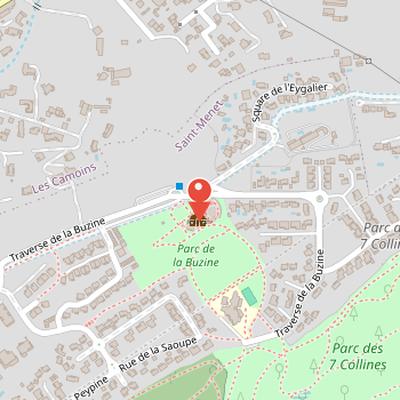
Nearby Objects
-
 Château Régis 650 m away
 -
 Château de la Reynarde 650 m away
Ownership and cultural role
Chateau de la Buzine is a building located in the city of Marseille and owned by the city of Marseille. Its management is carried out under a public service delegation with the city. The building is also associated with Marcel Pagnol, who owned it and mentioned it in Souvenirs d'enfance, which made it well known. Since 2010, it has hosted the Maison des cinematographies de la Mediterranee. This institution is managed by the cinematheque of Marseille and by the association of Chateau de la Buzine, giving the building a continuing cultural function linked to cinema.
History of the Château de la Buzine Site
The historic domain of the Chateau de la Buzine extended from Saint-Menet to Camoins and was owned by the Diodie family. In 1457, it was partially bought by the farmer Guillaume Cabofigue, while its southern part was ceded to Guillaume Reynard, who then took the name La Reynarde as an homage. Much later, during the Occupation, the castle was requisitioned by the German army and became La maison de repos du marin allemand. After the Liberation, it was occupied by a FTP patrol and then replaced by part of the French Army staff. The building was also used as a military infirmary and housed a company of soldiers. It was later occupied again by the army and then by the General Council of Poland. After a period of vacancy, Spanish refugees lived there for a few years, after which the site became uninhabitable and unsanitary.
Municipal Management and Cultural Use
Four years after its abandonment, the city of Marseille bought the site and later registered it as a historic monument on the inventory, on an unspecified date. Marseille then transformed it into a Mediterranean Cinematography House. Under the management of Nicolas Pagnol, who directed the site for six years, attendance increased fivefold and the site reached financial balance. In 2023, mayor Benoit Payan decided not to renew Pagnol's contract. After his departure, memorabilia at the site were returned to their rightful owners.
Le Chateau de la Buzine in Pagnol's Memory
Le Chateau de la Buzine is associated with Marcel Pagnol through the name he gave it, Le Chateau de ma mere, meaning the castle of my mother. Pagnol became the owner of the property in 1941, and he recognized it when he took possession of it. In his childhood memories, it was one of the properties he crossed on his walks, using a key given by Bouzigue, an old student of his father, to follow the canal. An incident near the property left a mark on his mother during one of these crossings, which helped give the place its remembered importance in his personal narrative.
The site is also notable for the uncertainties surrounding Pagnol's recollections. It does not match several details he later associated with it: it does not have at least ten floors, nor does it have thirty stone-carved balconies on each facade. The Marseille canal did not pass through the La Buzine estate, now Parc des Sept Collines, and it bends west toward La Valentine rather than near La Treille to the northeast. It also does not pass the Carrefour des Quatre-Saisons, where the porte du Pere Humilie was said to open. For this reason, doubts remain about whether the Pagnol family actually crossed the property as described in his account.