Stade de Gerland, publicly named Matmut Stadium Gerland, is a multi-purpose sports venue in the Gerland district of Lyon. With a current seating capacity of 25,000, it is the second largest sports arena in the Lyon metropolitan area and is registered as a historical monument. Designed by Lyon architect Tony Garnier, construction began in 1913. The original aim was to complete the stadium for the 1914 Exposition internationale, but there was not enough time. An initial phase included tracks, a grandstand, and dressing rooms, and work was suspended during the Great War before resuming in 1919 with help from German prisoners of war. The stadium became operational in 1920 and was inaugurated in 1926, while modifications to the main entrance continued until 1932. A related elevated Olympic swimming pool with a 10-meter diving board was built in 1929 as part of Garnier’s 1913 ‘Plan général des sports’. Olympique Lyonnais was the resident club from 1950 to 2015.
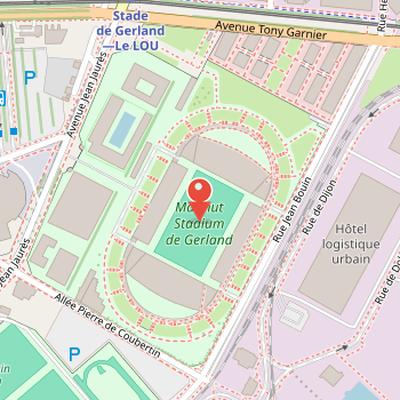
Nearby Objects
-
 Palais des Sports de Gerland 300 m away
 -
 Parc Henry Chabert 700 m away
 -
 P4 Laboratory - Jean Merieux 700 m away
 -
 Halle Tony Garnier 900 m away
 -
 Avenue Jean-Jaurès 1200 m away
Stade de Gerland in Lyon
Stade de Gerland, publicly named Matmut Stadium Gerland, is a sports arena in the Gerland district of Lyon. It is the second largest sports arena in the Lyon metropolitan area and has a current seating capacity of 25,000. The stadium is also registered as a historical monument, which adds to its public and heritage significance within the city.
Design and Early History
The Stade de Gerland was designed by the Lyon architect Tony Garnier, with construction beginning in 1913. The original plan was to complete it for the 1914 Exposition internationale, but there was not enough time to finish it for that event. The first phase included some tracks, a grandstand, and dressing rooms. Construction was then suspended because of the Great War, before work resumed in 1919 with the help of German prisoners of war. The stadium became operational in 1920 and was inaugurated in 1926. Modifications to the main entrance continued until 1932. The stadium was initially supposed to host a round of 16 match at the 1938 FIFA World Cup, but it was not used for the tournament after Austria withdrew following the Anschluss.
The Olympic Swimming Pool Project
The Histoire describes an elevated Olympic swimming pool with a 10 meter diving board, built in 1929. It was part of Tony Garnier's 1913 Plan general des sports and had also been included in the 1914 Exposition universelle program, Sport et Education physique. The pool replaced the unrealized Quartier des athletes, showing how the site evolved from an earlier urban sports vision into a built facility. Its dressing rooms were added later by other architects. The history of the pool also reflects the wider limitations on Gerland's development, since Lyon's financial problems after World War I hindered the full realization of the southern sports urbanism planned for the district. The pool further affected the jardins du LOU project, linking it to other intended landscape and sports developments around the stadium.
From Football Ground to Multiuse Venue
Stade de Gerland was the home ground of Olympique Lyonnais from 1950 to 2015, while Lyon olympique universitaire had previously played at Stade des Iris in Villeurbanne before 1950. At its inauguration, the stadium had no covered stands, and it later underwent successive renovations that altered both its structure and its capacity. One of the earliest changes was the removal of the cycling track around the football field by the late 1960s in order to increase capacity. In the early 1970s, the original seven-lane clay athletics track was replaced by pits after the removal of the tartan track.
By 1984, the stadium capacity had risen above 40,000 to host UEFA European Championship matches. The venue also served events beyond football, including a religious gathering during Pope John Paul II's apostolic visit to France on May 11, 1986, which brought together 35,000 people. For the 1998 Football World Cup, the stadium underwent major changes: the two bends were demolished except for the arcade perimeter wall and rebuilt, the covered bends were moved closer to the field and their capacity was reduced, and the lateral stands had their old wooden benches replaced by individual seats. These changes reduced the overall capacity.
Further adjustments continued after that period. In summer 2005, the Jean-Bouin stand was fitted with boxes to attract partners to Olympique Lyonnais, causing the loss of additional seats. The lawn was later fully replaced with new turf from Portugal for the first time since the stadium's construction. The final years of football use included the closing of Gerland for Ligue 1 with a 2-0 defeat to Angers SCO, the last match at the stadium, a 2-1 Coupe de la Ligue round of 16 win against Tours, and the final Lyon scorer at the venue being Claudio Beauvue, who scored twice. Olympique Lyonnais then moved to Parc Olympique lyonnais with a 4-1 Ligue 1 win over Troyes.
After football, Gerland became a rugby venue for Lyon Olympique Universitaire in 2017, following the club's promotion to Top 14. The stadium was renamed Matmut Stadium, reviving the old club name from Vennissieux. LOU had already drawn a large crowd for a Pro D2 derby against Oyonnax at Gerland, and the end of the 2016-2017 season was played using the original stadium layout. The venue then entered a major reconfiguration led by AIA Architecte, with the aim of promoting economic and sports growth for the club. The redevelopment included a maximum capacity configuration, covered upper blocks of the curves except for gala matches, removal of the pit between the stands and the field to tighten the stands, renovation of both lateral stands with black and red seats in club colors, and the addition of VIP and event spaces. The club also obtained a 60-year lease on 20 hectares owned by the metropolis for its headquarters and training center, which includes a gym, brasserie, and shops. Later developments included the replacement of the natural grass pitch by synthetic turf, the opening of the Ruck Hotel near the stadium in 2022, and the full renovation of the historic Gerland swimming pool between 2021 and 2024. These changes were presented as part of an effort to recreate Tony Garnier's dream of making Gerland the sports city of Lyon.
Attendance and Stadium Experience
Stade de Gerland has played a central role in Histoire's recent match history and spectator experience. The resident club first played at Gerland against Grenoble in the Challenge European, winning 57-13. The stadium then hosted all matches during the 2017-2018 season after renovation, and the club averaged over 14,000 spectators for TOP 14 matches that year. Histoire also reached its first TOP 14 semi-finals, played at Groupama Stadium, while the renovated home ground continued to attract rising crowds.
Attendance increased further in later seasons. In 2019, a playoff match against Montpellier drew 17,002 spectators, which was a season record. Before the cancellation of the 2019-2020 season due to Covid-19, the club averaged 14,478 spectators for TOP 14 matches. The stadium then recorded a Champions Cup attendance of 15,577 against Leinster. In the TOP 14 2022-2023 season, the club exceeded 200,000 spectators overall and averaged nearly 16,500 per match, ending the regular season with a sold-out crowd of 24,556 against Aviron Bayonnais.
The stadiums use has been marked by specific public features and access arrangements. It includes animations on the forecourt, free circulation inside the stadium, a children's stand, and a students' stand. After reconfiguration, all spectators must enter via Avenue Jean-Jaures, while car exit is complicated by roadworks on Avenue Tony-Garnier lasting until 2025.
Crowd records continued to rise in 2023-2024, when the club reached the TOP 14 podium for highest average attendance with 17,710 spectators. It also set an attendance record of 32,306 during a victory over Stade Toulousain, and drew 15,620 for a Challenge Cup match against the Cheetahs, a record for a European Cup match.
Stadium Configuration and Seating
Stade de Gerland is configured with two corners, the Nord and the Sud, and two facing stands, Jean-Jaures and Jean-Bouin. After the arrival of LOU, the stands were renamed tribune Serfim and tribune Sixieme Sens Immobilier. The seating is mainly white, with red and blue seats in tribune Jean-Jaures and red and black seats in the lateral stands.
Major Sporting Events at Stade de Gerland
Stade de Gerland in Lyon has served as the venue for a wide range of major football, rugby union, and rugby league events. In football, it was scheduled to host the Sweden-Austria match in 1938, though Austria forfeited the game. The stadium later hosted Denmark-Yugoslavia and Spain-Denmark matches during Euro 84, and it was the site of the 1986 UEFA Cup Winners' Cup final between Dynamo Kiev and Atletico Madrid. In 1997, it recorded two notable international draws, France against Brazil ending 1-1 and Brazil against Italy ending 3-3. During the 1998 FIFA World Cup, Stade de Gerland hosted five group matches and one quarter-final. It also hosted Confederations Cup matches in 2003, including the Cameroon-Colombia semi-final, during which Marc-Vivien Foe died. The stadium continues to host the Danone Nations Cup football competition.
In rugby union, Stade de Gerland hosted three pool matches of the 2007 Rugby World Cup, all with full attendance. It was also the venue for the 1999 European Challenge Cup final, where ASM Clermont Auvergne defeated Bourgoin-Jallieu 35-16, and for the 2017 European Rugby Champions Cup semi-final, in which ASM Clermont Auvergne beat Leinster Rugby 27-22 before 40,024 spectators.
The stadium has also been important in rugby league history. It hosted a 1954 Rugby League World Cup match between Great Britain and Australia, the 1972 Rugby League World Cup final between the same teams, and several 1950s test matches between France and Australia, France and Great Britain, and France and New Zealand. A France-Australia test during the 1952-53 Kangaroos tour drew nearly 25,000 spectators, underlining the stadium's long association with major international rugby league.