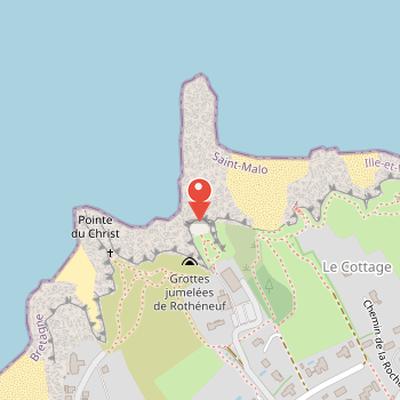
The Rochers sculptés de Rothéneuf are monumental sculptures carved directly into granite rocks overlooking the sea between Saint-Malo and Cancale in Brittany. Created from late 1894 to 1907 by abbé Adolphe Julien Fouéré, known as abbé Fouré, the site is associated with art brut. After leaving his position as rector at Langouët in 1894, Fouéré retired to Rothéneuf near Saint-Malo and devoted himself to this large sculptural ensemble. More than 300 statues were carved into the rocks, ranging from low relief to fully detached faces and figures. The sculptures represent dozens of enigmatic characters that blend with the surrounding stone. They were originally polychrome, with some features highlighted in tar. Fouéré also created wooden sculptures in the house known as Haute Folie, Hermitage de Rothéneuf, or Maison de l'Ermite, later called Musée Bois. His work drew on rock forms and on historical and geographical knowledge acquired through seminar studies and newspapers. He stopped working in 1907 because of paralysis and speech difficulties.
The Sculpted Rocks of Rotheneuf
The Rochers sculptes de Rothéneuf are monumental sculptures in Brittany, located between Saint-Malo and Cancale. They were created from late 1894 to 1907 by abbé Adolphe Julien Fouere, also known as abbe Foure. The site is known for these carved rocks, which are classified as art brut. Fouere, born in 1839 and died in 1910, is closely associated with the artistic identity of the place.
Creation at Rotheneuf
After leaving his post as rector at Langouet in 1894, Histoire retired as a habituated priest at Rotheneuf near Saint-Malo. There he created a monumental work directly carved on granite rocks. From the end of 1894 to 1907, he sculpted more than 300 statues on granite rocks overlooking the sea. In parallel, he also created numerous wooden sculptures in a house known as Haute Folie, the Hermitage de Rotheneuf, or Maison de l Ermite, which was later known as Musee Bois.
His activity came to a stop in 1907 because of paralysis and speech difficulties. Histoire died in the house where the famous chair was located, and he is buried in the cemetery of Rotheneuf.
Figurative Program and Sources
The sculpted site presents dozens of enigmatic characters that blend into the rocks, ranging from low relief to fully detached faces. The figures were originally polychrome, with some features highlighted in tar. Their inspiration came both from the shapes of the rocks and from the sculptor's knowledge of history and geography, acquired through seminar studies and reading the newspapers Le Salut and l Ouest-Eclair. The subject matter was also informed by sources such as the 1919 museum guide and articles in L'Eclair, La Cote d'Emeraude, Le Salut, and Lectures pour tous.
The program does not depict an imaginary family of smugglers or corsairs, but rather known contemporary characters and historical references. It includes a Transvaal War scene with President Kruger and Colonel de Villebois-Mareuil, as well as colonial current events presented with propaganda support for evangelization by France. Breton religious figures appear too, including Saint Budoc, represented twice, and Saint Yves. Other figures include Gargantua, La mere Michel and her cat, Andrea the charmer, and an oyster seller. Jacques Cartier is represented on the rocks and in wood in the nearby hermitage. The site also contains scenes evoking China, Russia, and Japan.
Visitor Access and Conservation Concerns
The Rochers sculptes de Rotheneuf remained a major visitor destination over time. A survey published in Le Pays malouin in 1925 already described the site as highly visited, and it still received many visitors each year in 2012. The site is privately owned and admission is charged. In 2020, it also offered virtual visits using VR headsets.
The historical record of the site is partially preserved through digitized photographs in the Brittany heritage photo library, including images of the sculptures, abbe Foure, and the hermitage. The site originally included paintings on rocks, but these are no longer visible. According to abbe Foures guestbook, the rocks were mostly painted in blue, light yellow, garnet, and chocolate colors.
The sculptures have faced deterioration from mosses, lichens, and repeated visitor passage. The Regional Directorate of Cultural Affairs inspected the site and assessed the conservation state in a report that described the sculptures condition as worrisome in 2012. Jean Jehan warned in 2010 that, without action, the sculptures might become unrecognizable within several decades. Protection and preservation measures are poorly documented, although restoration work on sculpted rocks outside the main area is carried out regularly. A friends association created in 2010 for abbe Foures work also organizes exhibitions, guided walks, and events to promote the site and outsider art. The site is not classified or registered as a historical monument.
Wooden Sculptures and the Museum Setting
After his death, AbbE FourE's wooden sculptures were kept in a manor with a garden that was turned into a museum. The works included totems, political figures, saints, mythological figures, and animals. They were carved from raw material and accompanied by naive legends. The sculptures were displayed in galleries described as infernal and mystical. The museum was protected by a crenellated wall decorated with dragons and laughing heads. Old postcards show AbbE FourE seated in a chair with his motto and standing among the sculptures. The wooden sculptures later disappeared at an unspecified time, and the hermitage has been extensively modified since AbbE FourE's time.