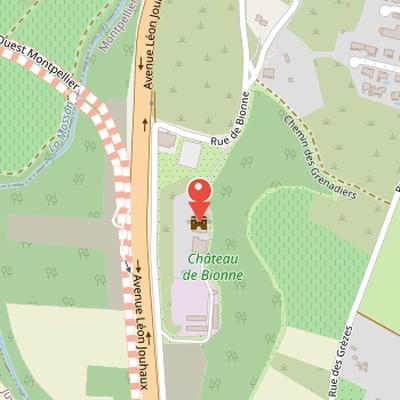
The Château de Bionne, formerly the château de Mont-Louis, is a folly in Montpellier dating from the late 18th century. It stands west of the city in Hérault, at the end of rue de Bionne. The building was modified in the 19th century, reflecting changes to the property over time.
Its name first appears in 1685, when the estate was associated with Mont-Louis castle. The property then passed through several owners, including the Bonnier family, who also owned the castles of La Mosson and Alco. Under their ownership, Mont-Louis took the name château de Bionne. Later owners included the families Pourtalès, Montpezat, Thibault, Tissié, and Leenhardt. The domain of Bionne remained in the Tissié family for nearly a century and played a role in the life of painter Frédéric Bazille. In later periods, the château served as a holiday camp center, then as the first abortion center in Montpellier, and it is now used as a hotel-castle.
Location and History of the Chateau de Bionne
The Chateau de Bionne, formerly known as Chateau de Mont-Louis, is a folly in Montpellier dating from the late 18th century. It was modified in the 19th century, which adds to its historical development over time. The building is located at the end of rue de Bionne, west of Montpellier in the department of H?rault. Its position and period of origin place it within the architectural heritage associated with the city.
From Mont-Louis to Chateau de Bionne
The site first appears in 1685 as Mont-Louis castle, when Historique is recorded as its owner. It is associated with an adultery affair involving Gabrielle Pavee de Villevieille at Mont-Louis castle, and Historique kept the property until returning to the Court in 1718. The castle then passed to the Bonnier family, who also owned La Mosson and Alco castles. Under their ownership, Mont-Louis castle took the name chateau de Bionne. Local legend links Bonnier de la Mosson to underground tunnels allegedly used to visit a lady of Bionne.
After the Bonnier period, the chateau passed through the hands of the Pourtales, Montpezat, Thibault, Tissie, and finally Leenhardt families. In later periods, it became a holiday camp center managed by the Amis de l'ecole laique association, then the first abortion center in Montpellier. In the present day, it functions as a hotel-castle. Poker Cup events were held there on July 11, 2010.
The Tissié Family and the Domain of Bionne
The domain of Bionne was owned by the Tissié family for nearly a century. André Tissié became the owner of the domain after the Thibault family, and he later founded the bank Tissié-Sarrus. In 1866, ownership passed to Louis Tissié, who succeeded André Tissié. The domain also played a role in the life of the painter Frederic Bazille. In addition, Alfred Bruyas visited the domain of Bionne with Louis Tissié in the summer, indicating its place within local social and cultural circles.
The Tissi e Family and the Artistic Memory of Bionne
The history of Bionne is closely linked to the Tissi e family and to several works preserved at the Muse e Fabre. Andre Tissi e painted as an amateur, and the museum preserves two paintings by him. A painting by Glaize, Int erieur du cabinet de Bruyas, testifies to the friendship of Alfred Bruyas and Louis Tissi e, further situating the family within a network of artistic relations.
The connections continued into the next generation. Suzanne, the daughter of Louis Tissi e, married Marc Bazille in 1867. Marc Bazille was the brother of Fr ed eric Bazille, who later painted Suzanne in La R eun ion de famille, where she appears wearing a black and white striped dress. She likely wore mourning for her grandfather Andre Tissi e, who had died on an unspecified date.
Fr ed eric Bazille also painted the vineyards of Bionne in 1868, and his Etude pour une vendange is now housed in the Muse e Fabre. In 1881, Alphonse Tissi e, son of Louis, became owner of Bionne. He later donated his portrait in cuirassier uniform, painted by Fr ed eric Bazille, to the Muse e Fabre in 1918. The domain then passed to Pauline Tissi e, daughter of Alphonse, who married the architect Edmond Leenhardt and inherited Bionne in 1919.
Architectural Features and Later Alterations
The chateau de Bionne is described with a Mansard roof, and its architectural principle is related to that of the chateau de Flaugergues in the late 19th century. The building underwent modifications at the end of the 19th century and at the start of the 20th century, which altered its original appearance. Among these changes, the traditional hollow tile covering was replaced by slates, and zinc gutters were added. The chateau also preserved a grotto-fountain beneath the terrace, probably dating from the Nicolas de Basville period in the late 17th and early 18th centuries.