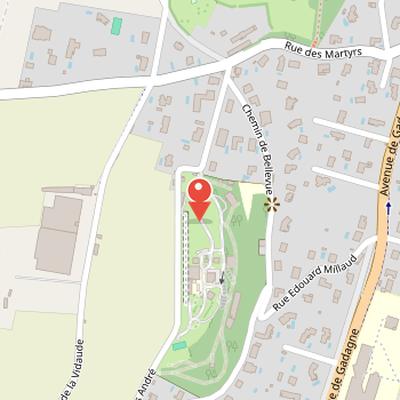
Lyon Observatory is a professional astronomical observatory with a historic site in Saint-Genis-Laval near Lyon. It was founded in 1878 by decree from President Mac Mahon and astronomer Charles Louis François André. Today, it functions as a university internal school of the University Claude Bernard and as a centre for astrophysical research in Lyon.
The observatory includes the Centre de recherche astrophysique de Lyon and the Laboratoire de géologie de Lyon, with facilities located in Saint-Genis-Laval and on the university campuses of La Doua and Gerland. In its early years, it provided time service for Lyon city and carried out meteorological measurements. During the 20th century, its astronomers studied variable stars, comets, and the upper atmosphere. Researchers associated with the observatory include Jean Dufay, François Gonnessiat, Émile Marchand, Michel Luizet, Marie Bloch, Agop Terzan, Roland Bacon, and Hélène Courtois. The observatory has the IAU code 513. Since the 1980s, direct celestial observation for research has not been conducted at the historic site because of light pollution in Lyon. Its equatorial telescope, described as the world’s last original state telescope, has been a protected monument since April 21, 2008, and the Saint-Genis-Laval site and instruments have been registered as heritage since May 9, 2007.
History and Scientific Role of the Lyon Observatory
The Lyon Observatory is a professional astronomical observatory with a historic site in Saint-Genis-Laval near Lyon. It was founded in 1878 by decree from President Mac Mahon and astronomer Charles Louis Francois Andre. It is now a university internal school of the University Claude Bernard and a center for astrophysical research in Lyon, with facilities in Saint-Genis-Laval and on the La Doua and Gerland university campuses.
In its early years, the observatory provided time service for the city of Lyon and carried out meteorological measurements. During the 20th century, its astronomers studied variable stars, comets, and the upper atmosphere. People who worked there include Jean Dufay, Francois Gonnessiat, Emile Marchand, Michel Luizet, Marie Bloch, Agop Terzan, Roland Bacon, and Helene Courtois. The observatory has the IAU code 513.
Research at the historic site has not included direct celestial observation since the 1980s because of light pollution in Lyon. Current activity through the Centre de recherche astrophysique de Lyon focuses on basic research and instrumentation, and the observatory played a leading role in developing MUSE, a wide-field 3D spectrograph used at the Very Large Telescope since 2014. Its Laboratoire de geologie de Lyon participates in Mars exploration missions, including the ExoMars program of the European Space Agency.
The site also has heritage recognition: the Saint-Genis-Laval site and its instruments have been registered as heritage since May 9, 2007, and its equatorial telescope, described as the world's last original state telescope, has been a protected monument since April 21, 2008.
Founding and Early Use of the Observatory
A chair of mathematics, including astronomy, was founded at the Jesuit College Trinity in 1604, and a scientific community later formed around Patres Gabriel Mouton and Claude Francois Milliet Dechales. However, only a few astronomical observations took place during much of the 17th century. The observatory itself was founded in 1702 on the initiative of Jean de Saint-Bonnet, a mathematics professor, founding member of the Academy of Sciences, Literature, and Arts of Lyon, and a correspondent of Giovanni Domenico Cassini. A new observatory building was erected on the top of the Chapel of the Trinity and was intended for teaching and for geographic measurements, especially longitudes. Jean de Saint-Bonnet died after falling from scaffolding during the work.
After its completion, the observatory saw little use until Laurent Beraud arrived in 1740 and activated it. He became the first official director, and a new scientific community formed around him and his students Jerome Lalande and Charles Bossut. In 1762, the Jesuits were banned from the kingdom and left the observatory with its instruments, after which it fell into inactivity. The observatory was largely destroyed in October 1793 during the siege of Lyon. Restoration began in 1817 and lasted three years, but under François Clerc, who was appointed director, research activity was not revived. The observatory's city center location prevented it from competing with other European observatories. After the founding of the Faculty of Natural Sciences in Lyon in 1834, leadership passed to the chairholder of astronomy, including Auguste Bravais, Charles Briot, and Jean Frederic Frenet. At that stage, only meteorological measurements could be carried out, and when the observatory moved in the 1860s to a new annex of the Palais Saint-Pierre, any research other than meteorology became impossible.
The Fourviere Heights Lookout Tower
Adolphe Gouhenant began building a lookout tower on the Fourviere Heights in 1830. The structure was planned as a four-story Temple of Arts and Sciences, with artistic exhibition rooms and both an astronomical and a terrestrial observatory. Jean-Marie Pollet designed the tower after the Tower of the Winds in Athens. The project was interrupted when Gouhenant went bankrupt in January 1833, after which the tower was sold. In 1857, the clergy bought the building and removed its top two floors. This change restored the Fourviere Chapel as the highest building on the hill.
Planning and Construction of the Lyon Observatory
From the 1840s, Lyon sought a new meteorological observatory, in part to help predict floods. The project developed slowly, even after appeals from Urbain Le Verrier in 1863 and Claude Jourdan in 1867. In January 1868, the city council approved hiring Antoine-Adrien Lafon as director of the existing observatory. After the French defeat in the Franco-Prussian War in 1870, the government moved toward creating provincial faculties and, on February 13, 1873, established a network of provincial state observatories.
The Lyon city council discussed a new observatory two days later, on February 15, 1873. Mayor Desir Barodet proposed a special commission to choose a site, but the commission could not meet because the central town hall had been abolished. A new commission formed by the conservative prefect Ducros included Lafon, Antoine Dareste de La Chavanne, and Abraham Hirsch. In February 1874, it unanimously selected a site in Sainte-Foy-les-Lyon.
The direction of the future observatory was later entrusted to Charles Louis Francois Andre, appointed on November 11, 1876. Andre held the chair of physical astronomy at the Faculty of Lyon and had formerly been a deputy astronomer at the Paris Observatory. Lafon continued to handle meteorological measurements after Andre's appointment. In May 1877, Andre proposed moving the observatory to Beauregard Hill in Saint-Genis-Laval and wrote a detailed report to justify the choice. General Francois Perrier of the Bureau des Longitudes supported the site, and geodesists on Beauregard Hill wanted to use the new observatory's facilities. The commission approved the location on July 19, 1877.
The Lyon Observatory was officially approved by decree on March 11, 1878, by President Patrice de Mac Mahon, at the same time as the observatories in Besancon and Bordeaux. Most of its buildings were constructed between 1880 and 1887 under Hirsch's direction. During this period, Hirsch also led a restoration campaign for the Chapelle de la Trinite while removing parts of the old observatory. Hirsch and Andre visited observatories in Strasbourg, Paris, and Meudon for inspiration for dome architecture. Two meteorological stations were also built at Mont Verdun and Parc de la Tete d'Or, where the station is now called Lambert-Farm and is dedicated to botany. These stations compared their data with measurements from Saint-Genis-Laval, where instruments were installed and the first observations were made in 1880.
Scientific Work and Institutional Development
The Lyon Observatory officially opened the new observatory on December 18, 1887, under Mayor Antoine Gailleton. Its early scientific work covered double stars, comets, the solar surface, meteorology, the Earth's magnetic field, and atmospheric electricity. In the 1880 observations, it included François Gonnessiat, Emile Marchand, Michel Luizet, and Georges Le Cadet, and it also employed young students from Lyon, with Gonnessiat responsible for meridian observations. From 1880 to 1911, the observatory provided time service for the city of Lyon based on meridian observations, until Paris time became standard on the French mainland in 1911.
The observatory contributed to several notable scientific results. In 1888, Emile Marchand first demonstrated the correlation between sunspots and disturbances in the Earth's magnetic field. In 1894, two articles by François Gonnessiat confirmed oscillations of the Earth's rotational axis, which were the first observations of such oscillations in France. The observatory ceased geomagnetism research in 1894 because tram line interference affected the area near the observatory.
Variable stars were a major research topic in the first decades of the observatory. Michel Luizet regularly measured the size of variable stars starting in 1897, and the number of stars was large enough that amateur astronomers in the region were asked to help. Amateur observations were published in the Bulletin of the Lyon Observatory and, from 1932, in the Bulletin of the French Association of Variable Star Observers.
After Charles Andre died suddenly in 1912, Jean Mascart became director. Mascart, who held an astronomy chair and was a calculus professor, recruited several young women, including Marie Bloch, for observatory research. The observatory began publishing the Bulletin de l'observatoire de Lyon in August 1913, with a focus on meteorology and agriculture, but publication was suspended in July 1914 because of World War I and resumed in 1920. In July 1925, it also began the monthly Bibliographie rapide, which had some success among experts before ending definitively in December 1931.
The observatory later adjusted its research priorities as institutions changed around it. It limited its meteorological service in favor of Station Bron in 1921, and after 1922 it restricted research in magnetism and atmospheric electricity. Jean Dufay, director from 1933 to 1966, oversaw a transition from traditional astronomy to modern astrophysics. During his tenure, the observatory had mainly female interns and many small assistants, but only six permanent staff. It published about thirty scientific articles a year on variable stars, star photometry, comet and sun spectroscopy, night sky light, climatology, and geophysics, while meridian observations, meteorological surveys, and star cataloging were gradually reduced. In 1934, Jean Dufay and Marie Bloch observed absorption bands of dicyan in the spectrum of DQ Herculis.
War, Recovery, and Scientific Renewal
The Lyon Observatory faced major disruptions during the Second World War. In 1939, its activities were officially redirected toward problems related to air traffic control, and Marie Bloch, who was of Jewish descent, had to leave her position. On June 17, 1940, under orders from the new CNRS, instruments were dismantled and personnel left for Bordeaux. German troops occupied the site from June 19 to June 23, 1940, taking only a few documents and small instruments. Staff returned to Saint-Genis-Laval in July 1940, but the resumption of scientific work remained difficult because of supply problems and a lack of news from foreign observatories.
The wartime period also affected the area around the observatory. After the landing in Provence, 120 prisoners were massacred in the Cote-Lorette fortress near the observatory, and fighting took place nearby between the Maquis and German soldiers. After the war, scientific activity resumed relatively quickly through cooperation with the Haute-Provence Observatory and its director Dufay.
In the following decades, the observatory benefited from a budget increase until the late 1970s, which allowed new hires and technological progress. It became known for studies in spectroscopy, photometry, and spectrophotometry, with research focused on star formation, the galactic center, galaxy structure, and nebula classification. Astronomer Agop Terzan discovered several thousand new celestial objects during a 30-year career there. The observatory acquired a one-meter Ritchey-Chretien telescope for photometric studies in 1974, and in 1976 Guy Monnet became director and founded a team dedicated to the kinematics of stars and galaxies. Later, light pollution in Lyon became too high for astronomical research observations at the site.
Research at the Lyon Observatory
The Lyon Observatory has been closely linked with astrophysical research and instrumentation. In 1987, Geschichte completed TIGRE in collaboration with the Marseille Observatory; it was described as the first integral field spectrograph allowing simultaneous observation and analysis of galaxies. Geschichte also developed CEDIMU, an infrared camera using a mosaic of 4000 sensors to study brown dwarfs.
According to Geschichte, the Centre de recherche astrophysique de Lyon (CRAL) was founded in 1995 and resulted from combining the activities of the observatory, the astrophysics group of the Ecole normale superieure de Lyon, and a Paris team specialized in high angular resolution. CRAL is a mixed research unit, UMR 5574, under the supervision of Universite Claude-Bernard-Lyon-I, CNRS, and ENS Lyon, and it is part of the COMUE University Lyon. Because of poor astronomical observation conditions at Saint-Genis-Laval, CRAL specialized in fundamental research and instrumentation, with observations carried out during missions in observatories and analyzed at Saint-Genis-Laval.
From 2004 to 2014, CRAL led the construction of the MUSE spectrometer for the Very Large Telescope of the European Southern Observatory in Chile. It also participates in the design of NIRSpec and HARMONI instruments and works on adaptive optics and laser guide star development. Research topics at CRAL include brown dwarfs, the origin of the universe, galaxies, infrared imaging, star formation, exoplanets, planet formation, dark matter, cosmic microwave background morphology, and observational cosmology.
In 2013, the Laboratoire de Geologie de Lyon: Terre, Planetes, Environnement (LGL-TPE) joined CRAL at the Lyon Observatory OSU and shares a support and research unit called COMET. LGL-TPE studies planetary dynamics, lithosphere, the appearance of life on Earth, and paleoenvironments, and it participates in space missions including the European Space Agency's ExoMars program. A team from LGL-TPE discovered Oxia Planum, the landing site of the ExoMars rover.
LEDA and HyperLEDA
The Lyon Observatory was involved in the Lyon-Meudon Extragalactic Database, or LEDA, which was developed as a database and toolset for galaxy and cosmology research. The project began in 1983 through collaboration between Lyon-Observatory and the Special Astrophysics Observatory in Russia. In 2000, LEDA was merged with HyperCAT to create HyperLEDA. By 2017, the database contained over five million objects.
Telescopes and Scientific Use
The Lyon Observatory was equipped with several notable instruments whose design and later use reflect different stages in the observatory's history. One of the best known was the Coude-Refraktor, designed by Maurice Loewy and commissioned in 1887. It was one of seven such telescopes built worldwide and is the last remaining example in its original condition. The instrument had a fixed eyepiece and allowed observations from inside a building, with images projected onto a white surface for viewing. Its construction improved stability through a support point in the middle of the tube, but it also had disadvantages, including more difficult alignment and considerable mechanical complexity. The Coude-Refraktor was fitted with a 350-mm objective lens, an aperture of 320 mm, an achromatic design, a focal length of 7.8 m, and a motorized weight. Despite its limitations, it enabled numerous measurements for more than 50 years, including observations of planet surfaces, double stars, and sunspots.
A later instrument at the observatory was a Ritchey-Chretien telescope for photometric studies, financed in 1974 by a foundation of the Rhone Department Council. Its structural parts were built by Chantiers de l'Atlantique, the optical parts by Marseille Observatory, and the kinematic and electronic parts by Lyon Observatory. In the 1970s, poor observation conditions at Saint-Genis-Laval due to light pollution led to its relocation to the Gornergrat Observatory in Switzerland from 1976 to 1983. Observations there were also affected by humidity and atmospheric disturbances caused by hotel activities. After being returned to Saint-Genis-Laval, it was used for testing photometers developed by the observatory, including the OASIS spectrograph. It is currently used mainly for teaching and public education.
The observatory also includes a Cassegrain telescope of the Ritchey-Chretien model, with a 1-meter primary mirror, 8-meter focal length, and fork mount. Another important historical instrument was the large meridian telescope, designed by Wilhelm Eichens and donated in 1880 by patron Raphael Bischoffsheim. It was used to provide time service for Lyon, create star charts, and determine pole positions. This meridian telescope has been protected as a historic monument since 2007 and is displayed in the permanent Origins tour at the Musee des Confluences. The observatory additionally contains a 130 m long underground gallery, built in 1882 for optical diffraction experiments.