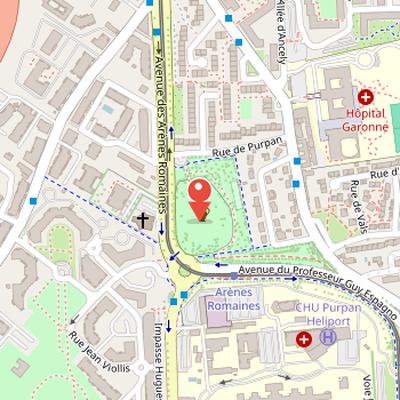
The Roman amphitheatre of Purpan-Ancely is an archaeological site in west Toulouse that preserves the ruins of a Roman amphitheatre. Located at the crossroads of avenue du Professeur-Guy-Espagno and avenue des Arènes-Romaines, between the Purpan and Ancely neighbourhoods, it stands near a small rural agglomeration close to the Gallo-Roman city of Tolosa. The monument was built in the middle of the 1st century, probably between 40 and 50 CE under Emperor Claudius, although its date is known only through archaeological material because no textual sources survive. It is one of the only practically intact Roman buildings in Toulouse. The site was agricultural land and belonged to the priory of La Daurade from at least the Middle Ages. After the French Revolution it was sold to an unknown buyer, and the city of Toulouse acquired it in 1962. The amphitheatre was classified as a monument historique on 23 October 1974 and is under the responsibility of the musée Saint-Raymond de Toulouse.
The Roman Amphitheatre Site of Purpan-Ancely
The amphitheater romain de Purpan-Ancely is an archaeological site that preserves the ruins of a Roman amphitheatre. It was constructed in the middle of the 1st century near a small rural agglomeration close to the Gallo-Roman city of Tolosa. The site is located west of Toulouse, at the crossroads of avenue du Professeur-Guy-Espagno and avenue des Arenes-Romaines, between the quartiers of Purpan and Ancely.
The amphitheatre is notable as one of the only practically intact Roman buildings in Toulouse. It has been classified as a monument historique since 23 October 1974 and is under the responsibility of the musee Saint-Raymond de Toulouse.
History of the Site
The date of construction is known only through archaeological material, since no textual sources survive. Several objects dated to the middle of the 1st century CE indicate a probable construction between 40 and 50 CE, during the reign of Emperor Claude. The site later became associated with a long history of changing use and ownership. It was property of the priory of La Daurade from at least the Middle Ages, then was sold to an unknown buyer after the French Revolution. In the 20th century, the amphitheatre served as an illegal dumping site, while its bricks were also pillaged by inhabitants of the neighborhood. The area is now used as an agricultural zone. The city of Toulouse purchased the site in 1962, it was classified as a historical monument in 1974, and it was cleaned in the early 1980s.
Excavation and study of the monument
Cleaning of the site enabled the first precise survey of the monument after the podium wall and the southwest carcer, room D, were uncovered; this room had previously been interpreted as a vault. Excavations carried out by Michel Labrousse and Sylvain Stym-Popper in 1961, and by Gerard Villeval in 1962, helped clarify the structural foundations. The site was cleaned again by local associations in the early 1980s. In 1983, the Toulouse city hall planned a four-year excavation campaign entrusted to the University of Toulouse-Le Mirail. The project brought together several organizations, including the Directorate of Antiquities of Midi-Pyrenees, the city of Toulouse, the Association of National Archaeological Excavations, and the Institute for Research on Ancient Architecture. The use of machinery such as backhoes during the excavations sparked debate. Companies such as Sagne and Buzzichelli also took part, while the National Gendarmerie and Purpan hospital lent a helicopter for aerial photography. Two complementary operations examined the link between the 19th-century vomitorium and room E located under the cavea. Histoire underwent a restoration program.
Architecture and Layout
The Roman amphitheatre of Purpan-Ancely was built in brick and had a solid structure. Its overall length is noted, although the exact measurement is not specified. The arena was almond-shaped, with its north-south and east-west dimensions also left unspecified. The building had two monumental entrances on the north-south axis, both wide and covered by high vaults. The north entrance was a monumental sloped entrance that has been excavated.
Several rooms, possibly used as carceres, opened onto the arena. These rooms were located at the extremities of the east-west axis and beside the main entrances, and some had secondary entrances. The cavea had a specified width, though the measurement is not given, and it supported two maeniana, or tiers of stands. The stands above the main north and south entrances were possibly masonry, while the other stands were wooden. In addition, twenty-two vomitoria opened onto the cavea; these were wide and of a specified height, though the width is not stated.
The facade featured a series of exedrae, comparable to those of amphitheaters in Avenches in Switzerland and Ivrea in Italy. These exedrae alternated between blind and open entrances leading to the vomitoria, giving the exterior a repeated rhythmic pattern.
Construction and Architectural Features
The Roman amphitheatre of Purpan-Ancely was built as a solid structure rather than on flat terrain. The arena was excavated to an unspecified depth, while the cavea was partly supported by earthworks deposited around it. This construction technique is also found in the amphitheatres of Pompeii and Merida. The structure is made of bricks, and brick use is one of its distinctive features. Brick stamps show evidence of at least six workshops, including some that also produced bricks used in the construction of the Tolosa rampart and theater.
The building also incorporated earth and pebble backfill under the cavea. At vomitoria level, boxes limited by brick walls were filled with opus caementicium, and the structure was reinforced by buttresses at the same level. Rainwater drainage was handled by a network of drains connected to a sump dug down to the water table beneath the circulation level.