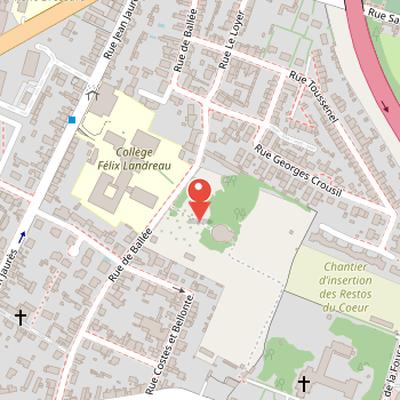
Located on rue de Ballée in the Justices district of Angers, Maine-et-Loire, the Church of the Holy Sepulchre is a memorial rather than a church, as the monument is not consecrated. It is a replica of the rotunda of the Basilica of the Holy Sepulchre of Jerusalem, with the edicule, the tomb of Jesus Christ, placed at its center. The Congregation of the Servants of the Poor of Angers, founded in 1872 by Dom Camille Leduc and situated next to the memorial, maintains and manages the site.
The monument was built by Monseigneur Henri Potard, born in Angers in 1866, after seventy-two pilgrimages to Palestine. He faced difficult travel conditions by boat, donkey, and train, along with political and military uncertainties, and brought back most of the materials and objects used in the decoration. Architecturally, the memorial is built in reinforced concrete and consists of a rotunda topped with a dome and surrounded by a gallery or ambulatory. It measures 22 meters in diameter and has an interior dome height of 15 meters. Eight windows illuminate the lantern at the top. A monumental schist gate with two crenellated neo-Gothic towers opens onto a lane lined with Lebanese cedars. The monument was originally topped by an iron cross, later removed because the concrete base had deteriorated.
A Memorial Replica in Angers
The Church of the Holy Sepulchre in Angers, Maine-et-Loire, France, is a memorial rather than a church, since the monument is not consecrated. It is a replica of the rotunda of the Basilica of the Holy Sepulchre of Jerusalem, and its center contains the edicule, the tomb of Jesus Christ. This makes it a place of remembrance closely linked to the form and symbolism of the Jerusalem basilica.
The monument belongs to a small group of similar replicas. A complete replica of the basilica is located in Washington, United States, and a copy of the tomb exists in Gorlitz, Germany. In Angers, the memorial is maintained and managed by the Congregation of the Servants of the Poor of Angers, a congregation founded in 1872 by Dom Camille Leduc. The congregation is located next to the memorial, reinforcing the site as part of a local religious and memorial setting.
Construction and Origin
The history of the Church of the Holy Sepulchre in Angers is linked to the construction of a replica of the Holy Sepulchre of Jerusalem. The monument was built by Monseigneur Henri Potard, who was born in Angers in 1866. Potard made seventy-two pilgrimages to Palestine, undertaking travel by boat, on donkey back, and by train, while also facing political and military uncertainties. He brought back most of the materials and objects used for the monument's decoration, giving the building a direct connection to his repeated journeys.
Architecture and setting
The Church of the Holy Sepulchre in Angers is located on rue de Ballée, in the quartier des Justices. Its approach is marked by a monumental gate in schist ardoisier, flanked by two crenellated neo-Gothic towers, and a lane bordered by Lebanese cedars leading to the memorial. A postcard acquired by the Archives municipales d Angers shows that the monument was less visible from the street in 1936.
The monument is built in reinforced concrete and takes the form of a rotunda topped with a dome and surrounded by a gallery or ambulatory. It measures 22 meters in diameter, and the interior dome rises to 15 meters. Eight windows illuminate the lantern at the top. The building was originally crowned by an iron cross, which was removed because the concrete base was in poor condition.
Its exterior rotunda has sixteen niches intended to hold statues of the twelve apostles. Seven of these niches are filled with statues, including one above the entrance pediment containing the statue of Pierre l Ermite.
The Tomb of Christ
The monument contains a small building beneath the dome that houses the tomb of Christ. This tomb is said to match the appearance and dimensions of the one in Jerusalem. It measures 2.30 meters long, 1.15 meters wide, and 1.30 meters high. Its side walls are decorated with sixteen pilasters supporting a small terrace with a balustrade of colonnettes. The structure is topped by a low dome shaped like a crown. Internally, the tomb is divided into two chambers connected by a very low door measuring 1.20 meters in height.
The two chambers
The churchs two chambers are arranged as a sequence of devotional spaces that reproduce features associated with the Holy Sepulchre in Jerusalem. The first chamber, called the chapel of the Angel, includes twelve small white columns, marble floor designs copied from the original, and a small marble stele at the center that replicates the one in Jerusalem and contains a fragment of the millstone said to have sealed the tomb. It also has two cylindrical openings used by Greek and Armenian clergy to present the new fire on Holy Saturday. According to Christian tradition established after Constantines conversion, this is the place where the angel spoke to the three Marys on Easter morning.
The second chamber represents the Holy Sepulchre itself. Its design follows the Jerusalem model in which the burial bed in the rock is covered by a white marble slab placed above the floor. The tomb slab is made of marble, polished by Christians from the Holy City, and a photograph of the Turin Shroud is placed on it. Copper lamps and menorahs from Palestine are also present in this chamber. Several rock fragments from the Holy Places are placed on the marble benches, including rocks from the Nativity, the Virgin Marys house at Nazareth, Calvary in Jerusalem, and the rock of Gethsemane.
Both chambers have vaults pierced with an opening for the evacuation of smoke from lamps, candles, and incense, following the arrangement used in Jerusalem.
Greek Choir Chapel
The chapel known as the choir of the Greeks of the basilica of Jerusalem is located opposite the edicule. Its walls are decorated with paneling adorned with lace, together with a mother-of-pearl Way of the Cross made by Christians from Bethlehem. The altar stone comes from the Holy City and was used to celebrate mass at the Holy Sepulchre on Easter Day. Above the chapel is a bell from Mount Tabor, which was rung at the arrival of pilgrims. These elements give the space a strong devotional character and connect it closely to places and practices associated with the Holy Sepulchre.
Le panorama de Jerusalem
Le panorama de Jerusalem displays thirty-one remarkable sites arranged from south to north and east to west. The ensemble includes ten stained-glass windows and thirteen paintings, and it features artworks created by artists from Angers. Its subject matter combines landscapes of Palestine with episodes from the life of Jesus, giving the work both a geographic and religious dimension. The composition therefore brings together a wide visual range and a clear narrative focus, while also reflecting the involvement of local artists from Angers.
Easter Cultural Events
Since 2006, the Easter cultural program at the Saint Sepulchre in Angers has offered visitors a way to discover the monument during the Easter weekend. The events highlight the Saint Sepulchre as a monument unique in Europe and provide free access to it. A voluntary financial contribution is requested for the maintenance of the building. The visitor booklet, described as both a spiritual and geographical guide, is also made available online.