The Musée de la Faïence de Marseille was located at 157 avenue de Montredon in the 8th arrondissement of Marseille, in the bastide known as Château Pastré. The museum was housed in a building constructed for Eugène Pastré and Céline de Beaulincourt-Marles for social festivities and meetings, and designed around 1860 by architect Jean-Charles Danjoy. Its architecture combines polychrome bricks and blonde stones, with curves and counter-curves. The château stands at the end of a large alley within the campagne Pastré estate, which was donated by the Pastré family to the city of Marseille. The museum was permanently closed to allow the transfer of collections to the new museum des Arts décoratifs, de la Faïence et de la Mode. The site was associated with ceramic display, including a collection of faience pieces exhibited on the ground floor.
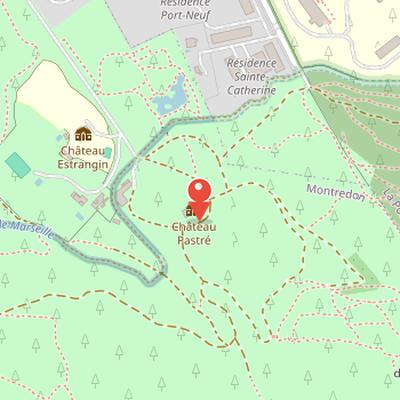
Chateau Pastr and its Museum Setting
The Musee de la Faience de Marseille was located at 157 avenue de Montredon, 13008 Marseille. It was housed in a bastide named Chateau Pastr, set at the end of a large alley within the campagne Pastr estate. The museum closed permanently to allow the transfer of its collections to the new Musee des Arts decoratifs, de la Faience et de la Mode.
Chateau Pastr takes its name from its former owner, Eugene Pastr (1806-1868), a merchant and shipowner. Eugene Pastr managed the family business with his four brothers, including Jean-Baptiste Pastr, who was president of the chamber of commerce and received Napoleon III for the inauguration of the palais de la Bourse. The campagne Pastr estate was later donated by the Pastr family to the city of Marseille.
The Chateau and Its Ceramic Display
The chateau was constructed for Eugene Pastra and Celine de Beaulincourt-Marles for social festivities and meetings, and its construction was entrusted to architect Jean-Charles Danjoy around 1860. Its architecture combines polychrome bricks and blonde stones, with curves and counter-curves that give the building a distinctive appearance. The chateau also served as a setting for ceramic exhibition, housing nearly pieces of ceramic. On the ground floor, these ceramic pieces were removed several years ago, leaving empty display cases.
Origins and Rise of Marseille Faience
Marseille faience began around 1525, when the Italian Jean Angeli first created it in the suburb of Marseille at Chateau de Saint-Marcel. The site later became associated with further production developments, including a kiln built there by Charles de Forbin. In the early 17th century, Antoine de Clerissy produced quality faience and helped establish its presence in Paris, marking an early stage in its wider recognition.
A major revival came with Joseph Fabre (1634-1717), an influential and wealthy silk manufacturer and banker who renewed the faience tradition. In 1675, Fabre brought Joseph Clerissy from Moustiers-Sainte-Marie to Marseille and installed him at Saint-Jean du Desert. Clerissy became the first significant manufacturer of Marseille faience. The craft then developed from the late 17th century and flourished between 1750 and the French Revolution.
This growth was supported by rising demand, linked to population increase and to a growing bourgeoisie seeking luxury objects. Marseille faience was closely tied to refined domestic interiors and to the ritual of table art, which gave it both practical and social value. After Clerissy, the workshop leadership continued through several hands: Francois Viry directed production from 1688 to 1697 after marrying Anne Roux, widow of the former owner, and Antoine Clerissy, Joseph Clerissy's son, directed the workshop from 1697 to 1722. Antoine Clerissy first rented a factory in the Plaine Saint-Michel and later established production in La Joliette until 1732.
Antoine Clerissy and the Workshop Legacy
Antoine Clerissy, associated with the history of the Musee de la Faience de Marseille, died in 1748. This date marks the end of his life and provides a basic chronological reference within the broader history of the museum's subject matter. Based on the available facts, no further details are given here about his role, work, or the museum's development.
Production, Workshops, and Decorative Styles
The faience production associated with Marseille was marked by sobriety in color and by decoration inspired by historical, mythological, religious, or romantic scenes. At first, the workshops produced grand feu ceramics influenced by Rouen, with symmetrical compositions in blue and red, and they also used the decor known as "a la Berain". Later production included pieces in the Rouen style, as well as ornament made with garlands or foliage scrolls framing landscapes. The range of decoration broadened further to include polychrome landscape pieces in the Moustiers style, "a la Chine" pieces, and naturalistic floral motifs created with the help of colorists and chemists. Other recurring decoration types were sepia, green, pink or blue camaieu, polychrome landscapes, animals, fish, flowers, gilt motifs, and high relief.
The workshops changed hands and locations several times. The faience factory near porte d'Aix passed from Anne Clerissy to Madeleine Heraud, who operated it under the condition of collaboration with Joseph Fauchier. In 1727 the factory was expropriated during the opening of rue d'Aix and the creation of place Pentagone. Madeleine Heraud then managed the factory on rue de la Calade, first herself and later through her son Louis Leroy. After Heraud's death in 1749, Louis Leroy established a new factory near porte Paradis. Management then passed to Antoine Leroy, who died in 1780, two years after his father.
Joseph Fauchier played a major role in this history. Born in Peyruis in Alpes de Haute Provence, he directed the factory from 1710 to 1728, and in 1730 he founded his own factory at place Pentagone, becoming a major producer in the first half of the 18th century. His nephew, also named Joseph Fauchier, led the business from 1751 until his death in 1789, after which Joseph Francois Fauchier continued until the definitive closure in 1795. The production line also included artists such as Joseph Viry and Jean Rome.
The scope of manufacture remained wide. The workshops produced many shapes and decorations, as well as statues, statuettes, and fantasy objects. They executed numerous statues and later produced small porcelain objects intended for snacks or service pieces. Around 1750, work in a porcelain factory led to collaboration with Andre Estieu in Marseille, and an independent faiencerie was established in 1761. The firm expanded constantly by receiving many disciples, partnered with Jean Jacob Dortu from Berlin in 1773 for porcelain production, and exported products to Northern Europe and England with help from Freemasonry connections. The factory was visited by the comte de Provence, and in 1789 it was represented by a deputy of the third estate for faienciers. Activity stopped around 1794 because of the economic crisis, and the manufacture came to a definitive end in 1803 after being succeeded by Joseph and Anne.
Honoré Bonnefoy and Workshop Production
Honoré Bonnefoy was trained in the workshops of Les faiences de Marseille. In 1777, he created a company with his brother Joseph, but the two separated in 1778, after which Bonnefoy continued production on his own. He employed Viry, who was a member of the academy of painting and sculpture. In 1793, Bonnefoy bought a large plot of land near his workshops at the allées de Meilhan. He died before 1815.
Production and Decorative Style
After the death of Les faiences de Marseille, the widow and son Augustin continued the enterprise and developed porcelain manufacturing. The factory remained active until 1815, when it closed. Its decorative themes mainly featured marines, landscapes, and animals, painted with small fire polychromy. The workshop also developed the production of statuettes.
Faience from Moustiers-Sainte-Marie and Other Centers
The section presents faience from Moustiers-Sainte-Marie in Alpes-de-Haute-Provence, with pieces produced from around 1680 to 1982. It also notes the revival of Moustiers-Sainte-Marie production in 1927, when Marcel Provence opened a workshop and founded the Academie de Moustiers. The main faienciers identified are Pierre Clerissy, Joseph Olerys, and Joseph Fouque. Common decorative themes include hunting scenes, decor a la Berain, mythological figures, medallions with knotted ribbon, coats of arms, trophies with flags, solanaceous flowers, and flower garlands. The exhibition also includes faience from other centers such as La Tour d'Aigues, Apt, Le Castellet, Varages Provencon workshops, Gien, and modern productions.