Château de Pourtalès is a château in Strasbourg, in the north of Robertsau. The original estate was built in 1750 by royal fortress architect Joseph Guérault, who had also led the expansion of Strasbourg’s 18th-century city fortifications. In 1784, the estate was acquired by Baron de Coehorn, and in 1802 it was purchased by banker Athanase Paul Renouard de Bussière. Around 1840, Baron Alfred Renouard de Bussière created a park in the English garden style, and in 1844 the building was remodeled and decorated in Louis-seize style. The estate later passed to Mélanie Renouard de Bussière, who married Count Edmond de Pourtalès in 1857. The couple expanded the park, gave the château its name, and commissioned architect Charles-Jules Breffendille to remodel it beginning in 1887. Breffendille added outbuildings and transformed the interior in Louis-seize and Napoleon-III styles. Further extensions were built in 1907 by Strasbourg architects Gustave Krafft and Jules Berninger. The château became known for salons hosted by Countess Mélanie and visited by figures from European high nobility, politics, and culture. It has been protected as a Monument historique since 1984.
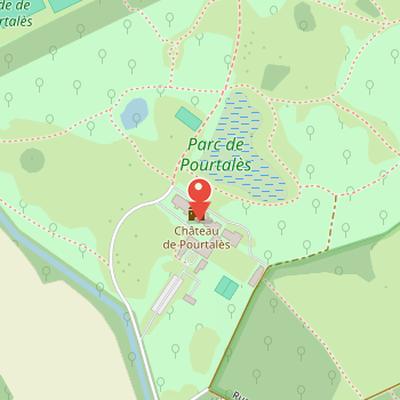
Location and Heritage Status
The Chateau de Pourtales is a castle located in Strasbourg. It has been protected as a Monument historique since 1984, reflecting its recognized heritage value and official monument status.
Development of the Chateau de Pourtales
The original estate in the north of Robertsau was built in 1750 by the royal fortress architect Joseph Guerault, who also led the expansion of Strasbourg's 18th-century city fortifications. In 1784, Baron de Coehorn acquired the property, and it was later purchased in 1802 by the banker Athanase Paul Renouard de Bussiere. After Baron Alfred Renouard de Bussiere married Sophie Melanie de Coehoorn, he established an English-style park around 1840, and the building was remodeled and decorated in Louis-seize style in 1844.
The estate then passed to Melanie Renouard de Bussiere, who became sole heiress and married the banker Count Edmond de Pourtales in 1857. Edmond de Pourtales was the son of James Alexander de Pourtales-Gorgier, a financier from Neuchatel, and the family traced its origins to Huguenot refugees who fled southern France to Neuchatel under Louis XIV. Countess Melanie and Count Edmond expanded the park and gave the castle its name. From 1887, they commissioned architect Charles-Jules Breffendille to remodel the castle; he added outbuildings and transformed the interior in Louis-seize and Napoleon-III styles. Further extensions were built in 1907 by the Strasbourg architects Gustave Krafft and Jules Berninger.
Salons and Distinguished Visitors
After the 1907 extensions, the castle housed a wood-paneled library. It also became closely associated with Countess Melanie, who regularly hosted social events known as salons there. These gatherings turned the castle into a popular meeting place for European high nobility, politics, and society. Among its visitors were King Ludwig II of Bavaria, Emperor Wilhelm II, King Leopold II of Belgium, Queen Marie Henriette, and the Prince of Wales Albert Eduard, later King Edward VII. Other guests included Prince Napoleon, Prince Klemens von Metternich, Franz Liszt, Albert Schweitzer, and Leon Bakst. After Countess Melanie died in 1914, her daughter Agnes continued the salons.
From Wartime Use to an Educational and Cultural Venue
From 1939, Chateau de Pourtales was vacant and was used during World War II as a hospital, soldiers' quarters, and a refugee home. In 1951, it became a training center for an Eastern European university, and the Free Europe College later operated there until it closed because of increasing Iron Curtain restrictions. After the college closed, the castle fell into neglect and disrepair. Walter Leibrecht and Lydia Leibrecht purchased and renovated the dilapidated complex in 1972, and Walter Leibrecht, who founded Schiller International University, hosted its French campus at the castle. The castle continues to accommodate international students, and Harald Leibrecht, Walter Leibrecht's youngest son, and his family currently own it. A hotel was established in the castle and its outbuildings, and in October 2019 new hotel rooms and conference rooms opened in a new building on the site. The city also acquired part of the park and opened it to the public. Concerts and symposia are regularly held at the castle, adding to its role as a venue for education and public events.
Architectural Features of the Chateau
The oldest part of Chateau de Pourtales is a two-story baroque manor house with a mansard hipped roof, risalits, and two iron pavilions. Its western narrow side has two square, four-story oriels with an octagonal three-story oriel between them, while the eastern narrow side features a square tower. East of this tower stands a pavilion built in Napoleon III style with a flat roof, and a farmyard with outbuildings and a pavilion adjoins it. The large park includes several outbuildings, fountains, sculptures, a dovecote, a water tower, and ponds.