Eglise Notre-Dame-de-l'Assomption de Saint-Tropez is a baroque church in Saint-Tropez, in the Var department of Provence. Built in the 18th century on the site of a previous church, it remained under construction until 1784 and was consecrated in 1820 by the Archbishop of Aix-en-Provence, de Bausset-Roquefort. The church has been listed as a historical monument since an unspecified date and is regarded as one of the emblems of the city of Saint-Tropez.
Its façade is made of white limestone, while the bell tower and campanile are painted in ochre and sienna earth colors, creating a contrast with the azure blue of the sky and sea. Inside, the church displays a bust of Saint Tropez and a bust of Saint Pierre. The bell tower was painted by Paul Signac in 1896 in the artwork Le Clocher de Saint-Tropez, now preserved at the Fondation Bemberg in Toulouse.
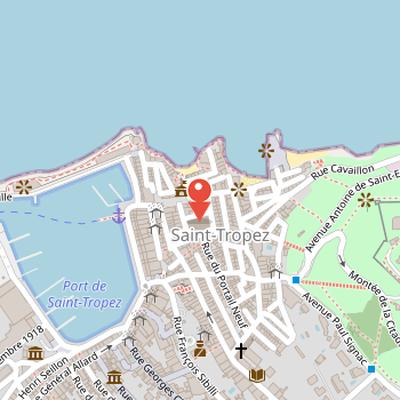
Nearby Objects
-
 Annonciade Museum 300 m away
 -
 Cemetery of Saint-Tropez 500 m away
 -

Baroque Church and City Emblem
Eglise Notre-Dame-de-l'Assomption de Saint-Tropez is a Baroque style church dedicated to Notre-Dame de l'Assomption. It is located in Saint-Tropez, in the Var department of Provence. The church has been listed as a historical monument since an unspecified date. It is also regarded as one of the emblems of the city of Saint-Tropez, reflecting its place in the local identity and heritage.
Architecture and History of the Church
Eglise Notre-Dame-de-l'Assomption de Saint-Tropez was built in the 18th century in the village of Saint-Tropez on the site of a previous church. Construction works continued until 1784, and the church was later consecrated in 1820 by the Archbishop of Aix-en-Provence, de Bausset-Roquefort. Its facade is made of white limestone, while the bell tower and campanile are painted in ochre and sienna earth colors. These tones contrast with the azure blue of the sky and sea. Inside, the church displays a bust of Saint Tropez and a bust of Saint Pierre. The bell tower was also depicted by Paul Signac in 1896 in the work Le Clocher de Saint-Tropez, which is now preserved at the Fondation Bemberg in Toulouse.