Saint Pierre Cemetery is the largest cemetery in Marseille, covering 63 hectares in the La Timone and Saint-Pierre neighborhoods. It is the third largest necropolis in France, after Pantin and Thiais. The cemetery was created in 1855 from the gardens of several bastides and was designed by Sixte Rey. Its first burials took place in 1854, and it was blessed on July 9, 1855. A public utility declaration had been issued by imperial decree on April 9, 1854.
The cemetery belongs to a wider historical context in which burial practices in Marseille changed over time. In antiquity, burials were outside cities, while from the Middle Ages to the 18th century they took place in cemeteries inside cities, and ecclesiastics and nobles were buried inside churches until the 18th century. Opposition to urban burials began around 1770 in Marseille, including a 1771 publication by doctor Olivier. Saint Pierre Cemetery followed the closure and later replacement of Saint Charles Cemetery, which had initially been the only recognized burial place in Marseille.
Size and Location
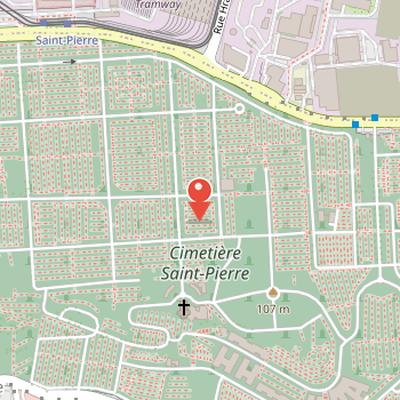
Saint Pierre Cemetery is the largest cemetery in the city of Marseille. It covers an area of 63 hectares and is located in the neighborhoods of La Timone and Saint-Pierre. In the broader national context, it is the third largest necropolis in France, after Pantin Cemetery, which covers 130 hectares, and Thiais Cemetery, which covers 106 hectares.
Origins of Urban Burial Reform
The historical background of Saint Pierre Cemetery reflects a long shift in burial practices. In Greek and Roman times, burials were carried out outside cities, but from the Middle Ages to the 18th century they were often placed inside city cemeteries. Until the 18th century, ecclesiastics and nobles could also be buried inside churches. Around 1770, opposition to urban burials began in Marseille. In 1771, doctor Olivier published a text with Mossy entitled Sepultures des Anciens, ou l’on demontre qu’elles etaient hors des villes, l’on donne les moyens de revenir a l’ancien usage et l’on expose les effets de la putrefaction sur l’air et sur nous. A royal ordinance later forbade burials in churches and required cemeteries to be enlarged and moved outside city boundaries.
Creation and Early Role of Saint Pierre Cemetery
Saint Pierre Cemetery was created in 1855 from the gardens of several bastides and was designed by Sixte Rey. A declaration of public utility was issued by imperial decree on April 9, 1854, and the cemetery was blessed on July 9, 1855. The first burials took place in 1854, before its official inauguration, which was held on November 14, 1864 under the direction of prefect Maupas and mayor Rouviere.
The cemetery appeared in a context shaped by the earlier Saint Charles Cemetery, which Marseille had developed from multiple plot purchases beginning in the mid-18th century. Saint Charles covered a total area of 31 hectares and was initially the only recognized burial place in the city. It was soon condemned because railway development and urban growth prevented any expansion. Burials there were banned by prefect Maupas on December 26, 1860, the municipal decision to close the cemetery was taken on September 7, 1863, and the closure was confirmed by prefectural order on July 29, 1866. Between 1856 and 1863, remains were transferred from Saint Charles to Saint Pierre. The land of the old Saint Charles cemetery was later used for the new Faculty of Sciences.
Remarkable Tombs and Sculptures
Saint Pierre Cemetery contains numerous and varied monuments decorated with sculptures, and its remarkable tombs and sculptures are described through architectural art elements that are severe, graceful, sad, and consoling. In the hemicycle in front of the main entrance door stand vast bourgeois tombs, alongside two sculptures by Andre-Joseph Allar, L'homme a la harpe and Une pleureuse. Behind the hemicycle is a tomb honoring a World War I soldier in full uniform, with the sculptor Honore's signature on the right shell.
Along the main alley are several notable monuments, including the tomb of Camille Olive, a wood merchant, designed by Pascal Coste, the architect of the Palais de la Bourse. This tomb combines Islamic decorative forms with explicitly Catholic monument design, including a frieze with alternating crosses and angel heads topped by stars. It was registered as a historical monument in 2014. The cemetery also includes a mausoleum by Pascal Coste, described as the only oriental-inspired building in his native city.
Another important monument in the main alley is the tomb of Clot-Bey, a Marseille doctor who had a career in Egypt. Presenting itself as an oriental-style chapel, it recalls his stay in the Middle East and bears the motto Inter infideles fidelis, meaning Faithful among the infidels.
Notable Tombs and Sculptures
Among the remarkable tombs and sculptures at Saint Pierre Cemetery is the Barbaroux family monument, which represents religion consoling pain. The monument was created by Pierre Travaux and is identified as his last work. Travaux is also associated with bas-reliefs on the facades of the Palais de Justice and with sculptures for the Suez Isthmus in the park of Chateau Borely. The cemetery also includes a bas-relief by R. Bagnasco, which repeats the same theme of religion consoling pain.
Notable Tombs and Sculptures
Saint Pierre Cemetery contains a number of notable tombs and sculptural monuments associated with artists, writers, performers, and explorers. The tomb of the painter Jules-Justin Claverie is decorated by a sculpture by Louis Botinelly representing a young woman lying down with a painter's palette and a laurel branch. A bust of Claverie is placed on a pedestal, and nearby are a bronze by Henri-Edouard Lombard representing La Charite protegeant l'Enfance and a sculpture by Auguste Carli representing L'Envol.
The tomb of the singer Gaby Deslys is located in a pine grove and consists of a marble column decorated with a garland of flowers. Above it is a medallion sculpted by Louis Botinelly showing Gaby Deslys in profile, and two statues by Auguste Carli are placed next to the tomb. The pine grove of square 6 is described as a pantheon of Marseille's glories of the Second Empire and early Third Republic.
At the top of the pine grove stands the tomb of the writer and republican militant Alphonse Esquiros, composed of a marble column with a bust sculpted by Lucien Chauvet. In the belt alley of the pine grove is a high relief by sculptor Allar representing L'Ame a Dieu. Near it is the tomb of the painter Raphael Ponson, marked by a medallion of his son Edouard sculpted by Henri-Edouard Lombard.
Other memorials include the tomb of the mime Louis Rouffe, which takes the form of a marble column with a head sculpted as Pierrot at the top and a medallion by Emile Aldebert on the shaft. Jean-Baptiste Rolland, known as Rolland de Kessang, is buried a few meters away; his tomb features many birds sculpted on the marble column to recall his exploration of the Malacca Peninsula and the bird skins supplied to European commerce. Painter Emile Loubon is also buried in the same area, with a bronze sculpture of a painter's palette and brushes above his tomb and a marble bust created by Marius Guindon, for which the marble block was offered by Jules Cantini.